Mesh Fabric: Ventilation
Mesh is specified by three numbers, not by appearance: open area percentage, hole geometry and claw snag resistance. A ventilation panel that performs well typically exposes 40-60% open area across at least three faces of the bag, with aperture small enough that a claw tip cannot enter and catch the yarn. Insufficient open area is the most cited cause of in-transit heat stress complaints.
Executive summary. Ventilation is the one performance feature that customers test on the first use and cannot forgive if it fails, which makes mesh the highest-risk low-cost component in any pet bag. Our production team specifies four mesh families and treats each as a structural material with its own test targets, rather than as trim chosen from a colour card. Quotations assume MOQ 500 pieces per colourway.
Development follows the standard calendar: sampling requires 6-10 working days after the tech pack is frozen, and bulk production runs 35-50 days after sample approval, because knitted spacer mesh and coated polyester mesh frequently have mill lead times longer than the shell fabric and must be booked early. Every shipment clears pre-shipment inspection at AQL 2.5 with zero critical defects, and ventilation panels are checked for snagging and aperture consistency rather than only for appearance.
The right buying posture is to treat the mesh specification as part of the safety case. When ventilation is quantified, it protects the animal, protects the listing and protects you from the single most damaging review a carrier can attract.
A wholesale dog carrier order and a wholesale cat carrier order rarely share one mould, so the Material & Technology decision has to be locked before tooling money moves. Wholesale pet carriers built on a single shared shell platform let a buyer cover both species from one fabric purchase, which is usually where the first real saving appears.
Why ventilation is a measured property, not a style choice
A mesh panel is often chosen late in development, usually because an open panel looks lighter on a product image. That ordering is backwards. Air exchange is a physical property with measurable parameters, and it interacts with animal physiology in ways that make the panel decision one of the earliest and most consequential in the build.
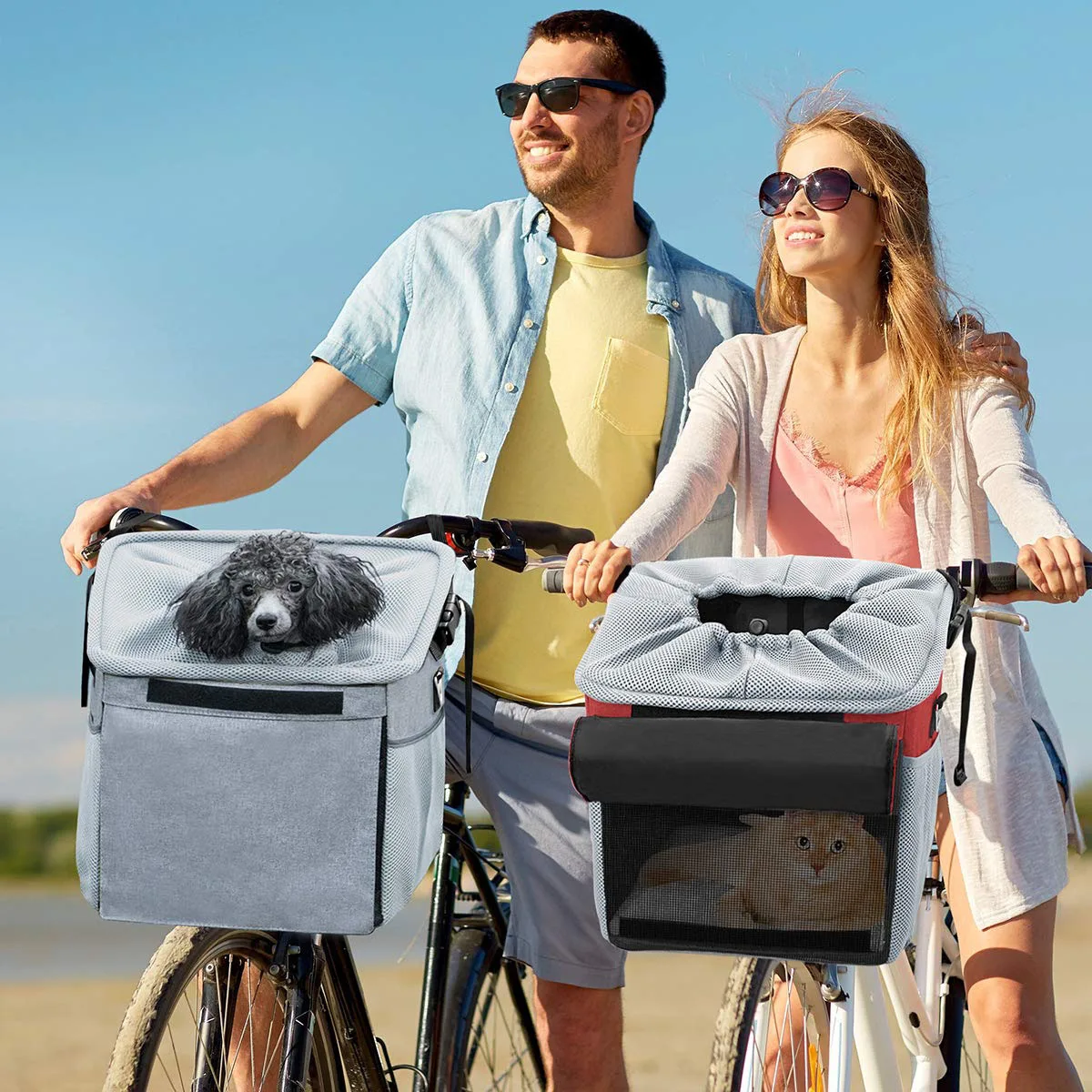
The mechanism is straightforward. Animals dissipate heat largely through panting and through contact surfaces, both of which depend on moving humid air away from the body. Warm, moist air rises, so high-mounted panels exhaust it, while intake should occur lower on the body to establish circulation rather than simple diffusion. A bag with a single small front panel looks ventilated and performs far worse than one with panels across three faces positioned to create a through-flow path.
The second measurement is open area, expressed as the percentage of a given fabric area that is actual aperture rather than yarn. A fine-gauge micro-mesh may look robust at 25% open area but deliver inadequate exchange, whereas a coarse net at 65% performs beautifully and is easily damaged. The practical target for most small-animal bags lands between 40% and 60%, subject to the claw constraint described below.
Third is aperture geometry. Rounded or hexagonal apertures distribute stress better than rectangular ones and resist tear propagation; elongated slits transmit load badly and tend to run. Once again this is specifiable, testable and cheap to get right the first time.
Finally, note that ventilation competes with other requirements. Panels must not reduce the structural integrity needed to contain an animal, must not admit drafts that chill small pets in winter and must not create entanglement hazards. Well-specified programmes often pair generous mesh with a roll-down insulated flap, giving owners seasonal control.
Understanding these mechanics changes how a specification should be written. Instead of requesting "mesh panels" and relying on the supplier's judgement, buyers should request a stated effective open area, stated placement and a stated aperture limit, then verify airflow on a sample. The discipline costs nothing and converts a marketing feature into an engineering one.
There are also secondary benefits of getting ventilation right that rarely appear in planning documents. Better airflow reduces condensation, which reduces the damp smell that otherwise accumulates, and it moderates the temperature spikes that make animals restless during short journeys.
Four mesh families and what each is good at
The market offers far more mesh types than buyers expect, and confusing one family for another is a common cause of a sample that performs differently from bulk. Four families cover essentially all pet bag applications.
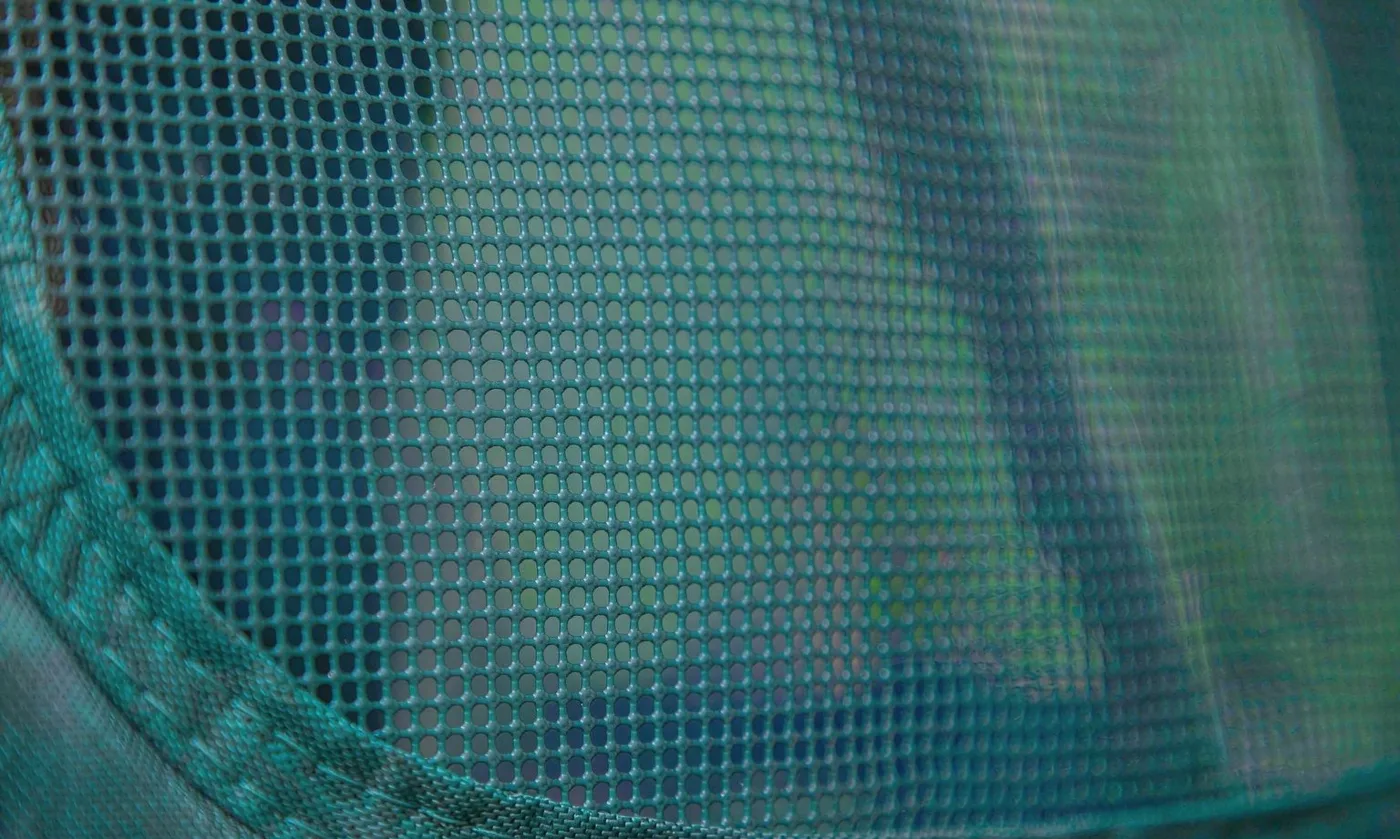
Knitted polyester mesh is the volume default: soft, quiet, cheap and available in many colours. Its weakness is that a determined claw can snag a loop and pull a run, so it suits interiors and lower-risk locations. Coated polyester mesh improves dramatically on this - the coating locks filament intersections, resists water and wipes clean - making it the standard choice for exterior panels.
Spacer mesh, also called air mesh or 3D mesh, is a knitted double-face fabric with a filament layer between the surfaces. It moves air through its thickness, cushions under load and does not fully expose the interior, which makes it ideal for shoulder strap padding, back panels and any location where comfort and airflow both matter. It costs several times more per metre than flat mesh and is worth it selectively.
Nylon mesh rounds out the set, used where maximum abrasion life is needed against hard surfaces. It is stiffer and more expensive, and rarely necessary across large areas.
Colour availability differs sharply across these families as well, with knitted mesh offered in far broader shade ranges than coated options, which occasionally drives selection for branding rather than performance reasons. Where colour matters, agreeing the palette early avoids discovering at booking stage that only two of five planned shades are stocked.
Finally, remember that mesh behaves differently under a needle. Curved seams in mesh tend to pucker unless carefully eased, which makes panel geometry a manufacturing decision rather than a purely aesthetic one.
Mesh types compared on the numbers that matter
The table below compares the four families across open area, snag behaviour, cost and best placement. Cost index is anchored at 1.00 for standard knitted polyester mesh. Note that installed cost also depends on panel size and binding method, occasionally exceeding the fabric difference itself.
| Mesh family | Typical open area | Claw snag behaviour | Air permeability | Best placement | Cost index |
|---|---|---|---|---|---|
| Knitted polyester mesh | 35-50% | Moderate - runs possible | High | Interior panels, side gussets | 1.00 |
| PVC-coated polyester mesh | 30-45% | Good - filaments locked | Medium-high | Exterior panels, front faces | 1.45 |
| Spacer / 3D air mesh | Effective 45-60% | Excellent - no loose loop | High through thickness | Strap pads, back panels | 2.60 |
| Nylon monofilament mesh | 45-65% | Very good | Very high | High-wear exterior panels | 2.10 |
Two caveats apply when reading this table. Coated mesh has lower effective open area than the same construction uncoated, because the coating closes a share of each aperture; always compare finished, coated values. And higher open area does not automatically mean better performance if the panel is positioned where air cannot flow through it - a high-ventilation panel buried under a shoulder strap contributes little.
For programmes destined for air travel, remember that ventilation requirements are also written into transport rules rather than set by preference. Reference guidance published by IATA and independent protocols from the Center for Pet Safety both treat adequate ventilation on multiple sides as a minimum condition rather than an optional feature.
Procurement should also note that air permeability figures depend heavily on the pressure differential at which they are measured. Comparing results measured at different settings is meaningless, so always specify the test condition alongside the target value.
Placement, aperture size and the claw problem
Ventilation performance follows from where panels are placed rather than how large they are, with three placement principles producing most of the improvement buyers seek. Panels on opposing faces create through-flow; panels at different heights create stack-effect circulation; and panels that remain uncovered in both carried and set-down positions stay functional in real use rather than only in photographs.
Aperture size is governed by claws, and getting it wrong is expensive. A useful rule: the aperture should be small enough that a claw tip cannot fully enter behind the yarn. Open weaves that pass this test with a cat still need verification against a dog's thicker claw, particularly on products adjacent to larger breeds. Because a snagged loop propagates into a visible run and eventually a hole, snag resistance should be evaluated mechanically, not by feel.
Reinforcement solves most conflicts between airflow and containment. A coarse mesh framed with webbing or bound edges takes load through the frame rather than the net, allowing larger apertures safely. Where an animal repeatedly contacts the same area, a secondary layer behind the mesh spreads the load and prevents the development of a worn-through patch.
Consider also behavioural containment. Some animals chew at any accessible edge; tightly bound openings with hidden raw edges and no loose binding reduce this markedly, and a top-open panel with a zip guard removes the most common target.
Designing reinforcement into the pattern from the beginning costs far less than adding it after failures appear, because retrofitting usually means changing several panels rather than one binding specification.
Testing ventilation before a first order ships
Three tests give buyers most of the assurance available without expensive equipment, and all three can be run on pre-production samples.
- Apex temperature test. Place a calibrated heat source of known output inside the closed bag, hold ambient constant and measure internal temperature after a fixed interval. Comparing materials and placements produces defensible relative data.
- Air permeability measurement. Standard textile methods quantify airflow through fabric at a defined pressure differential, and replicate across laboratories. Airflow-related test methods referenced by ASTM International are widely accepted, giving your QC team a verifiable figure instead of a claim.
- Snag and run propagation. A weighted claw analogue drawn across the panel under defined load, repeated in two directions, reveals both whether the mesh catches and how far damage travels.
Results should be recorded with temperature and conditioning stated, since both affect outcomes. Our practice is to attach these results to the first bulk inspection so later reorders can be compared against a baseline rather than re-litigated, and to re-test after any change in mesh source.
Recording ambient conditions with every result is not pedantry; it is what makes the data usable six months later when a reorder needs comparison.
Where several designs compete, testing them side by side in the same session produces far more reliable ranking than comparing results taken weeks apart.
Cost, MOQ and the hidden lead-time risk
Mesh is inexpensive per metre and rarely dominates a costing sheet, but it carries two disproportionate risks. The first is lead time: speciality constructions such as spacer mesh and coated mesh are mill items with limited stock shades and meaningful minimum order quantities from the weaver. If the mesh is not booked when the shell fabric is booked, the whole order can slide by weeks waiting for one panel component.
The second is tooling and setting. Bound openings and sewn-in panels add labour that exceeds the fabric cost several times over, particularly on curved shapes where the panel must be eased rather than simply stitched flat. Buyers who simplify panel geometry - fewer, larger, rectangular panels instead of several shaped insertions - usually save more assembly cost than any fabric substitution could deliver.
MOQ behaviour here is standard: 500 pieces per colourway per style, with size variants within one style counted toward the same colourway. Where speciality mesh requires a larger minimum woven quantity, we flag it during quotation rather than after confirmation, because the two options available at that point - paying for surplus or changing the design - are both avoidable earlier.
Volume planning also affects whether inventories stay healthy, since mesh-dependent designs are difficult to sell when a seasonal colour has been discontinued by the mill.
Cleanability and appearance after use
Ventilation panels accumulate hair, dust and dried moisture in their apertures, and how easily they release that soiling decides whether a bag still looks presentable after a season. Coated meshes win decisively here: a wipe removes most residue because there is no fibre structure to hold particles. Uncoated knits trap hair in their interstices and require brushing or washing.
Second aspect is shape retention. Low-cost mesh can relax and bag outwards after load cycling, changing product appearance even where no functional loss occurs. Specifying a mesh with adequate dimensional recovery and stabilising panel perimeters with binding keeps the silhouette close to the original.
Third is colour stability. Darks absorb heat, which slightly raises internal temperature under sunlight, and bright or pastel shades show soiling more quickly. Mid-tone colours with heat-reflective characteristics frequently represent the best compromise across both concerns, particularly for designs intended for warm climates.
There is a third dimension worth specifying: abrasion behaviour along panel edges, where rubbing against clothing and car interiors eventually frays exposed mesh if binding coverage is insufficient.
Cleaning behaviour should also be judged on a used sample rather than a new one, because mesh collects hair and dried soil inside the aperture structure where a surface wipe cannot reach. A specification that reads "wipe clean" is only honest for large-aperture coated mesh; fine-gauge uncoated mesh generally needs a soft brush or a rinse. Buyers supplying boarding, grooming or veterinary channels should assume rinse-and-dry cleaning, specify a frame that tolerates it, and confirm that laminated mesh does not cloud or stiffen after repeated wetting - a failure that looks cosmetic in the sample room and looks like a defective product by month three.
Lead time and production scheduling for mesh programmes
Mesh programmes fail on calendars more often than on quality, and the reason is that mesh is a bought-in component with its own mill schedule sitting in front of the sewing schedule. A supplier can commit to 35-50 days for bulk only when the mesh specification is frozen and the roll order is placed; if the mesh choice is still open at sample approval, the clock effectively restarts.
The sequence buyers should plan around has five gates. Freeze the mesh specification, aperture and colour in the tech pack. Place the roll order, which for standard polyester mesh runs 10-15 days and for coated or heavy-denier variants can reach 25. Build the sample in 6-10 working days once material is on hand. Approve or amend, with every amendment round costing the same sampling window again. Then run bulk in 35-50 days from approval.
| Schedule stage | Working days | What typically delays it | Decision owner |
|---|---|---|---|
| Tech pack freeze (mesh spec, aperture, colour) | 0-3 | Undecided open-area target | Buyer |
| Mesh roll order and mill production | 10-25 | Coated or heavy grades, peak season | Supplier |
| Sample build | 6-10 | Amendment rounds | Supplier |
| Sample approval or amendment | 3-10 | Late design change | Buyer |
| Bulk production | 35-50 | Trim shortages, congested capacity | Supplier |
| Pre-shipment inspection | 2-4 | Re-inspection after a failed report | Third party |
Two scheduling habits shorten that calendar reliably. First, freeze the mesh before the shell: shell fabric is almost always a stock item and mesh frequently is not, so sequencing the decision the other way round wastes the longest lead item in the build. Second, order trim - zips, binding, webbing, frames - at the same time as the mesh rather than after sample approval, because trim shortages are the most common reason a bulk run slips past day 50.
Seasonality compounds the effect. Mesh-heavy assortments are bought for spring and summer selling, which means the production months preceding that window are contested. Buyers who place bulk orders ahead of the rush, or who accept a slightly later delivery in exchange for a quieter slot, get more scheduling attention and fewer substitutions of nominally equivalent material.
Commercial terms follow the standard programme: T/T 30/70, FOB Xiamen, and the 30 percent deposit is what releases the material order. A buyer who delays deposit release by two weeks should expect the delivery date to move by the same amount, because the mill slot is booked on payment rather than on intention.
Inspection criteria and the compliance file buyers should request
Mesh inspection is unusual because the defects that matter are dimensional and optical rather than cosmetic, and a generic bag checklist will miss them. Four checks should be added explicitly to any AQL 2.5 protocol written for a mesh-heavy style.
Open-area verification comes first: measure the specified aperture at several points across the panel instead of assuming the roll matches the approved swatch, because knitting drifts across a roll width. Second, check seam integrity at the mesh-to-shell join, where load concentrates and where a claw catch turns into a tear. Third, examine panels for pulled or dropped stitches, which read as runs in the fabric and are the most frequently rejected mesh defect found at final inspection. Fourth, confirm that coated or laminated mesh shows no blocking - apertures closed by coating - which silently removes the ventilation the design was built around.
Classification matters as much as the check itself. Critical defects carry zero tolerance: a hole, a broken seam at a load point, or a missing structural element on an animal containment product is not an AQL negotiation. Major defects, including visible runs and aperture deviation beyond the stated tolerance, are assessed at AQL 2.5, and minor appearance issues at the same level unless the buyer specifies a tighter plan.
The documentation file should be requested at quotation rather than at shipment. It normally contains the material composition declaration for the mesh and any coating, restricted-substance certification for dyed components, the test report behind any claw or abrasion resistance claim, and the pre-shipment inspection report with photographs. Where a claim appears on the listing - chew resistance, puncture resistance, airline suitability - the file must contain the report that supports it, because marketplaces and retailers increasingly ask for the document rather than the assurance.
Buyers shipping into Europe should also confirm that coated mesh is inside the same restricted-substance scope as the rest of the build, since coating chemistry is where a compliant base fabric becomes a non-compliant article. Component-level certificates issued under scheme criteria published by OEKO-TEX are the pattern most retailers accept without further questions, and holding those certificates inside a quality system maintained to ISO 9001 is what keeps them current across repeat lots rather than valid for one shipment only.
Writing the mesh clause into your tech pack
A complete mesh specification takes one paragraph and prevents most downstream problems. Include the mesh family and construction, finished open area percentage, aperture description, finish treatment, colour reference and tolerance, and written targets for snag resistance and air permeability.
Add a placement drawing showing panel dimensions and heights, not merely "mesh insert" notes on a sketch. Then add a sourcing instruction: mesh booked with the shell rather than after approval, and alternative sources rejected without re-testing. Both are cheap instructions that remove the most common schedule risk in this component.
Our production team works from this format routinely, quoting against written targets with sampling in 6-10 working days and bulk in 35-50 days under AQL 2.5 inspection. Buyers designing for warm climates should pair this guide with our notes on temperature control and material selection, since insulation and ventilation must be designed together.
Including measurements on the drawing rather than in prose removes the ambiguity that otherwise costs a sample round and, in the worst cases, an entire production slot.
Finally, write the acceptance criteria into the same document rather than into email. The mesh clause should name the aperture and its tolerance, the open-area percentage and the method used to measure it, the seam construction at the join, the test method and pass level behind any resistance claim, and the defect list with its classification. A tech pack that names a material without naming how it will be checked transfers the definition of acceptable to whoever happens to be on the line that week. Our production team works to written targets of this kind because they turn a subjective conversation into a measurable one, and they make the second order reproducible without renegotiating quality.
Why brands source here
- Pet bag programmes run since 2014; founding team in sewn goods since 2004
- SGS-verified production floor of 4,950 m² with 137 workers across 7 lines
- Monthly capacity of 200,000 units, audited to BSCI and ISO 9001
People Also Ask
How much ventilation does a pet bag need?
Enough to move warm air continuously: typically 40-60% open area distributed across at least three faces, with an established through-flow path from lower intake to upper exhaust.
What mesh do pet carriers usually use?
Knitted polyester mesh internally and PVC-coated polyester mesh externally, with nylon monofilament for high-wear areas and spacer mesh for padding.
Can cats tear through mesh?
They can snag loops and eventually open a worn area. Coated constructions with locked filament intersections greatly reduce this risk.
Is mesh waterproof?
Generally not, though coated meshes shed light spray and dry quickly. Fully waterproof designs require a separate barrier layer or cover flap.
How do I clean a mesh pet bag?
Wipe coated mesh with a damp cloth; vacuum or brush uncoated mesh and launder removable elements. Cleaning ease should influence the mesh family chosen.
Does ventilation matter for short trips?
Yes. Internal temperature can rise within minutes in a closed bag on a warm day, so effective air exchange matters on short journeys as much as long ones.
Frequently Asked Questions
What percentage of open area should mesh have?
Most small-animal bags perform well between 40% and 60% effective open area across multiple faces. Compare finished values rather than base fabric, because coatings reduce effective aperture.
Where should ventilation panels be placed?
On at least three faces, with high panels exhausting warm air and lower panels admitting cooler air, creating circulation rather than diffusion. Avoid placing intake panels where straps or pockets cover them in use.
Can pets damage mesh panels?
Yes, primarily by snagging loops or chewing edges. Coated meshes resist snagging best, and bound-opening construction with hidden raw edges removes the most common chewing target.
Is more open area always better?
No. Very coarse mesh raises snag and entanglement risk and weakens containment. Balanced aperture size with adequate open area almost always outperforms maximising the number.
Which mesh is easiest to clean?
PVC-coated polyester mesh, which releases hair and dried deposits with a wipe. Uncoated knitted meshes trap hair and require brushing or laundering.
Does mesh weaken the bag structure?
It can if placed across load paths. Framing panels with webbing or binding takes load through the frame, allowing generous ventilation without compromising containment.
What is spacer mesh used for?
Mainly comfort applications such as shoulder strap pads and back panels, moving air through its thickness while cushioning load. It is more expensive and should be placed selectively.
Do airlines require ventilation on specific sides?
Yes, air transport guidance generally requires ventilation on multiple sides. Review current carrier requirements before finalising a design intended for cabin travel.
How is ventilation performance verified?
Through air permeability testing under standard methods, supported by comparative temperature-rise tests on a finished sample and mechanical snag evaluation.
Does dark mesh raise interior temperature?
Slightly, since darker surfaces absorb radiant heat. In warm climates specify mid-tone or light-reflective colours for panels exposed to direct sun.
Can mesh be combined with insulation?
Yes, and it is often the best solution: mesh vents in warm conditions while a roll-down insulated flap retains warmth or blocks drafts when required.
What are typical mesh defects found at inspection?
Aperture inconsistency, snagged runs, relaxed or bagging panels and binding misalignment, all of which are counted separately from structural defects during AQL sampling.
What causes mesh orders to run past the quoted lead time?
Two things above all: a mesh specification still open at sample approval, which restarts the mill order, and trim ordered after approval instead of alongside the fabric. Freezing the mesh first and booking trim at the same time removes both.
Which mesh defects are treated as critical at inspection?
Holes, broken seams at load points and missing structural elements are critical with zero tolerance. Runs, dropped stitches and aperture drift outside tolerance are major and assessed at AQL 2.5.
Talk to QUANZHOU JUNYUAN BAGS about a wholesale pet bag order: MOQ 500 pieces per colourway, samples in 6-10 working days, bulk production in 35-50 days under AQL 2.5 inspection.
Get a free quote Request a sample