Puncture Resistant Pet Bags: Claw Proof Sourcing Guide
Puncture-resistant pet bags are specified by puncture resistance force, not by fabric thickness: 40-60 newtons suits small-breed soft totes, 80-120 newtons suits general cat and small-dog programmes, and 150 newtons and above is the realistic target for claw-heavy or multi-pet household programmes. Puncture resistance is measured by driving a standard probe through the taut fabric and recording the peak force in newtons, and that number is what separates a shell that survives a claw from one that does not. Thickness alone is a poor proxy: a 0.9 mm coated knit can be punctured more easily than a 0.4 mm high-tenacity woven.
Puncture complaints are expensive because they are safety-adjacent. A cat that pushes a claw through a mesh panel or a dog that works a seam open inside a bag creates an escape event, and an escape event inside an airport, a vet clinic or a car is the kind of incident that produces a claim, a chargeback and a listing problem rather than a simple return. Our production team specs puncture performance the way a compliance file needs it: a named test method, a minimum force in newtons, a panel-level map of where that force applies, and a coupon from the production lot rather than a mill reference roll. Qualification sampling runs 6-10 working days and includes puncture probes on the mesh, the shell and the seam, because those three fail at very different loads. Bulk production is 35-50 days from approved sample, inspected to AQL 2.5 with any puncture failure classified as critical. Standard terms are MOQ 500 pieces per colourway, T/T 30/70 and FOB Xiamen.
Pet bag retail buyers and pet bag wholesale business owners look at the same unit cost from opposite ends, and Material & Technology is where those numbers meet. Pet bag procurement teams normally fix quality first and negotiate price second, which is why pet bag supplier selection is really a documentation exercise.
Puncture Resistance Defined: Force, Not Thickness
Puncture resistance is the peak force required to push a defined probe through a taut specimen. The standard textile version, ASTM D4833 for geotextiles and its luggage-adapted equivalents, drives a 8 mm flat-tipped or 45-degree conical probe at a fixed crosshead speed and records the maximum load before the fabric yields. The result is reported in newtons or pounds-force, and it is a small-sample test: five to ten specimens per direction, averaged, with the lowest individual result usually reported alongside.
Thickness correlates weakly with that number because puncture is governed by how the load distributes across yarns at the probe tip. A loose, thick knit lets the probe push yarns aside and slip between them; a tight, thin high-tenacity weave forces the load onto multiple yarns simultaneously and resists far better. This is the single most useful fact in this category, because "make it thicker" is the most common instruction buyers give and it is frequently the wrong one.
Three related numbers belong in the same spec and are often confused with each other. Puncture resistance is peak force to defeat the material. Tear resistance is force to propagate an existing cut. Abrasion resistance is surface wear under repeated rubbing. A fabric can be excellent at one and poor at another, so a single "toughness" claim on a spec sheet is meaningless without all three.
For pet bag programmes the buyer's real question is narrower: will a claw, a tooth or a snapped zipper pull defeat this panel before the end of the intended service life? That is a force question with a defined answer, and it should be written down as one.
In practice the number also settles internal arguments. Sourcing, product and finance rarely agree on what "tough enough" means, and a force threshold converts a subjective debate into a line item that can be costed, quoted and audited. Our production team sees the same pattern repeatedly: programmes that specify force have fewer post-launch change requests, because the sample approval stage is objective. Programmes that specify adjectives tend to approve a sample on feel and then argue about it after the first container arrives.
Why Small-Sample Results Need a Range, Not a Single Number
Puncture testing is a small-sample method, and a single coupon result is not a specification. Five specimens from the same roll can differ by 20% or more because local weave variation, coating thickness and yarn placement all affect the peak load at the probe tip. Reporting only the highest result is the most common way a weak fabric passes review. A defensible spec states an average and a floor, and a defensible report shows both the average and every individual result.
Claw Mechanics: What Actually Pushes Through a Panel
A cat claw is a curved, tapered point with a tip radius far smaller than a dog's, which is why cats puncture soft panels that dogs merely scratch or chew. The force a cat generates is modest - a front-paw swipe or a climbing push is a low-newton event - but the contact area is tiny, so the local stress at the tip is high. Puncture resistance therefore depends less on bulk strength and more on whether the fabric resists point-load concentration at the tip scale.
Three mechanisms defeat a panel. Direct penetration happens when a climbing cat pushes a claw into a mesh or a coated knit and the yarns separate locally. Shear-through happens when the animal treads or kneads and the claw moves laterally, cutting yarns rather than pushing them apart; this is the dominant failure on mesh and on thin coated fabrics. Seam bursting happens when the animal pushes against a sewn joint and the stitch holes act as perforations, so the seam opens at a load well below the fabric's own rating.
Seam bursting deserves emphasis because it is the most reported failure and the least tested. A seam is a line of holes through the fabric, and its effective puncture resistance is a fraction of the base cloth. Mitigations are cheap: a bound seam, a tape over the stitch line, or moving the seam out of the load path entirely by cutting panels so the seam falls on a curve rather than on a flat push surface. Each costs cents and each raises the real-world result substantially.
Temperature and moisture change the picture too. Coatings stiffen in cold transit environments and become more brittle, which lowers puncture resistance at exactly the moment the animal is most agitated. Specify a coating with a low-temperature flex rating if the programme ships to cold markets.
Mesh, Woven and Coated Panels: Choosing the Right Substrate
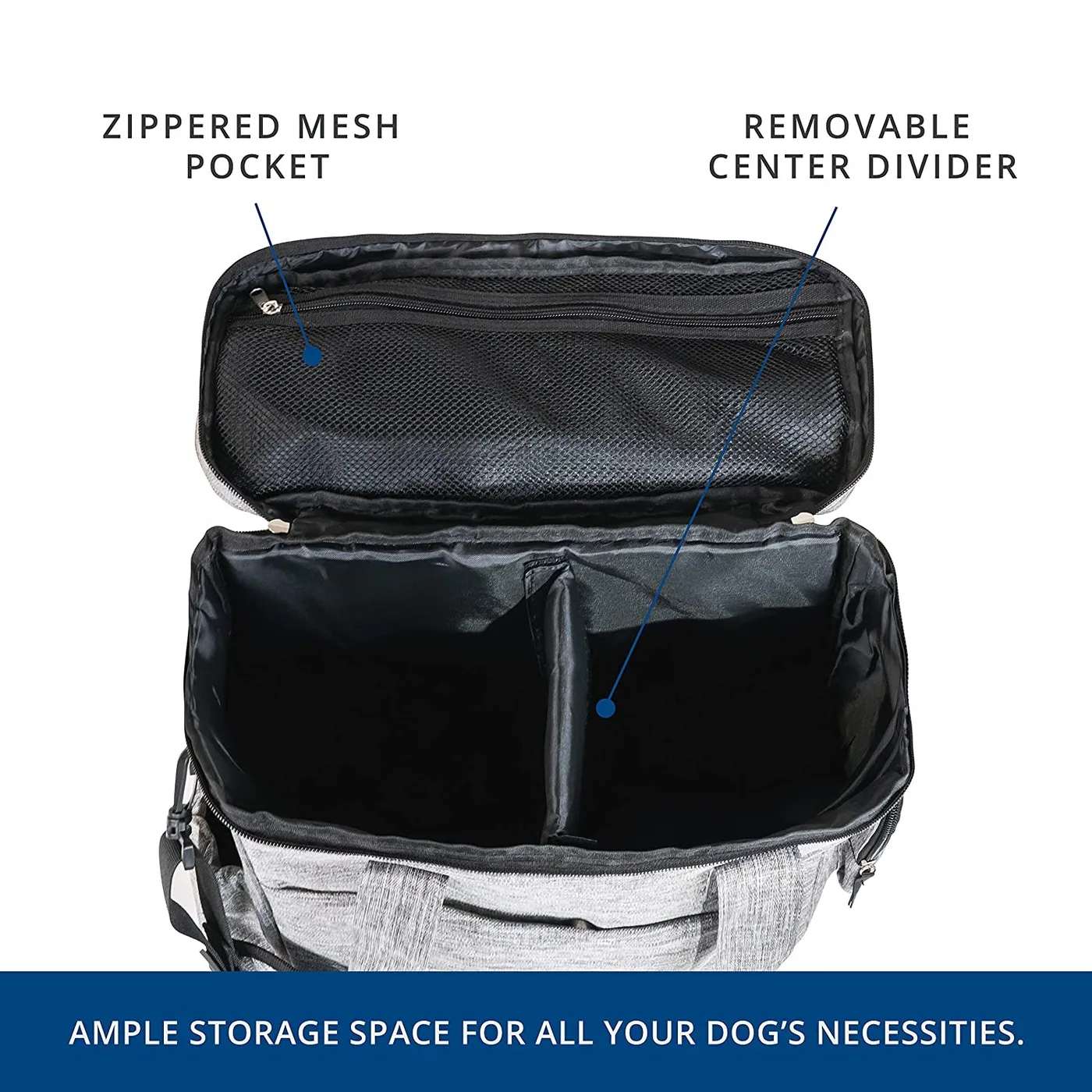
Ventilation is non-negotiable in pet bags, and mesh is the usual solution, which puts the weakest puncture material exactly where the animal is most likely to push. The answer is not to remove mesh but to engineer it. Monofilament polyester mesh in the 250-400 gsm range with a tight hexagonal or square aperture resists claw shear far better than a knitted Raschel mesh of the same weight, because monofilament strands are stiff and resist lateral cutting.
Aperture size matters as much as yarn type. An aperture under 2 mm prevents most claw tips from entering the plane of the mesh at all, so the load stays on the strand surface rather than concentrating at a caught tip. Larger apertures look more open and ventilate marginally better but invite catches, which then propagate into runs. For claw-heavy programmes, specify aperture as a number, not as "fine mesh".
| Panel material | Typical puncture force | Claw behaviour | Cost index | Best channel |
|---|---|---|---|---|
| Knitted Raschel mesh, 180 gsm | 25-40 N | Catches easily, runs propagate | 100 | Light retail totes |
| Monofilament polyester mesh, 320 gsm | 70-95 N | Resists catch, good shear resistance | 128 | Specialty pet retail |
| 600D polyester, PU backed | 90-130 N | Good, seam is the weak point | 135 | Mass retail carriers |
| 1000D nylon, high tenacity | 150-210 N | Very good, resists shear | 172 | Daily-use programmes |
| Laminated woven + scrim | 220 N+ | Excellent, claw cannot enter plane | 205 | Multi-pet / shelter use |
Laminated constructions sit at the top of the table for a reason: a scrim layer bonded between two films or between film and cloth removes the aperture entirely, so a claw has no entry point. The penalty is ventilation, which must then be solved geometrically with gussets and baffled vents rather than with an open panel.
Test Methods Buyers Should Name in the Tech Pack
Naming the method is what turns a puncture claim into an enforceable clause. Textile and flexible-material puncture testing is standardised, and the method numbers you will see on commercial reports come from the bodies that maintain them: ASTM International publishes the puncture and tear test methods used across North American supply chains, while ISO maintains the quality-management framework that governs how labs document results. Textile-specific variants are catalogued by AATCC, whose method numbers appear on most mill reports.
The clause itself should contain six fields: probe geometry and diameter, crosshead speed, specimen count, conditioning, the minimum average force, and the minimum individual force. A clause with fewer fields invites an argument. Specimen count of five per direction with a minimum individual result of 80% of the average is a workable default for pet bag panels.
Conditioning is frequently skipped and should not be. Textiles change properties with moisture content, and accredited labs condition at standard atmosphere before testing. If the report carries no conditioning statement, the number is not reproducible and you cannot compare it to next season's result.
Finally, test the assembly, not only the cloth. A coupon test of the shell tells you the fabric's number; a push test on the assembled panel with its seam, binding and frame tells you the product's number. Our production team runs both, because the second is what the animal meets.
Reinforcement Strategies That Beat a Fabric Upgrade
The instinct when a puncture complaint arrives is to upgrade the face fabric, and that is usually the most expensive possible fix. Reinforcement at the failure point is cheaper and often more effective, because the load that defeats a panel is local. Four strategies cover almost every case, and they can be combined.
- Scrim interlayers: a light grid bonded behind the face fabric spreads a point load across a wider area and lifts puncture force 40-70% for a small weight and cost addition.
- Panel doubling at push zones: a second layer on the base and lower side panels, where animals brace, costs less than upgrading the whole shell because it covers 30-40% of surface area.
- Bound and taped seams: covering the stitch line removes the perforation effect and prevents the most commonly reported failure mode entirely.
- Rigid or semi-rigid inserts: a moulded base or a framed vent bezel takes the load off the textile altogether at the highest-stress points.
Cost-wise, a scrim interlayer typically adds 0.18-0.30 USD per unit on a mid-size pet bag and delivers more puncture improvement than a full denier upgrade costing two to three times as much. Doubling the base panel adds 0.10-0.16 USD. Both are invisible to the consumer, which matters because a heavier, stiffer shell is not always a better-selling one.
Reinforcement also changes how the product is assembled, and that has a schedule consequence. A doubled base panel, a scrim interlayer or a framed vent bezel each add a step to the sewing sequence, and added steps lengthen the setup window and the operator training curve. Our production team quotes these constructions only after the line has run a pilot, because a reinforcement that looks simple on paper can slow a station enough to change the whole bulk schedule. Build the pilot into the calendar rather than discovering the slowdown in week two of production.
Weight is the constraint to watch. Reinforcement adds grams, and grams compound across the shell, the base, the frame and the hardware until the bag crosses a shipping band or feels overbuilt for its price point. Programme-level target weight should be set before reinforcement decisions, not discovered after them.
Escape Events, Liability and What Retail Compliance Asks For
Puncture performance is one of the few material properties with a direct liability pathway. A pet that escapes through a failed panel in a public space can cause injury to third parties, and the resulting claim typically names the brand, the retailer and sometimes the importer. Retail compliance teams know this, which is why puncture and seam-strength documentation is increasingly requested at line review rather than after an incident.
Documentation expectations vary by market but converge on the same shape: a named test method, an accredited lab report dated within the last 12-24 months, a clear statement of the minimum force met, and a panel map showing where that force applies. Buyers who can produce that folder at line review move through onboarding faster; buyers who cannot often get asked to fund additional testing at their own cost and on the retailer's timeline.
Zipper and closure performance belongs in the same file. Most escape events in practice involve a closure rather than a fabric perforation: a slider worked open by a paw, a zipper that splits under bracing load, or a hook-and-loop flap peeled from inside. Specifying shell puncture force while ignoring closure strength buys a strong bag with a weak door.
Product safety regimes also touch this category indirectly. Where a product is marketed for children or is placed alongside children's products, chemical and mechanical safety rules administered by the US Consumer Product Safety Commission may apply to components and finishes, and EU programmes add chemical documentation under ECHA's REACH framework. Ask your compliance contact which regime the SKU falls under before the tech pack is frozen.
Inspection evidence is the companion to the report. Photographs of the failed panel, the lot label and the inspection record, kept together in the order file, let a supplier investigate a genuine manufacturing fault quickly and let a buyer decline an inappropriate claim just as quickly. Our production team requests all three before re-testing, because a re-test on an unidentified unit answers nothing.
One further practical point: keep the liability file and the sourcing file together. When a claim arrives, the questions asked are what the rated force was, what the report for that specific lot said, and whether the closure was tested to the same standard. Buyers who can answer all three within a day usually settle quickly; buyers who have to reconstruct the file from old email threads usually do not.
Costing a Claw-Proof Programme Without Over-Specifying
Over-specification is the quiet cost problem in this category. A laminated, scrim-reinforced, 200-newton shell is a fine product and a poor value for a boutique tote that will carry a four-kilogram cat between a car and a vet's waiting room. Matching the measured force to the actual animal and the actual use case is what keeps a programme profitable.
The practical method is to classify the programme by animal weight and behaviour rather than by species alone. Small, calm animals in supervised transit generate low puncture loads and need 40-80 newtons. Active cats and terriers that brace and knead need 90-150. Multi-pet households, shelter use and any unsupervised or long-duration use need 150 newtons and above plus a reinforced closure.
| Programme type | Recommended puncture force | Construction | Added cost / unit (USD) | Weight penalty |
|---|---|---|---|---|
| Light retail tote | 40-60 N | Standard mesh, taped seams | 0.00 | 0 g |
| General cat / small dog | 80-120 N | Monofilament mesh, bound seams | 0.32 | +45 g |
| Active / claw-heavy | 150 N+ | Scrim interlayer, doubled base | 0.58 | +90 g |
| Shelter / multi-pet | 200 N+ | Laminated panel, framed vents | 1.10 | +160 g |
Order structure interacts with cost here as well. Reinforcement constructions usually require a slightly longer setup and a dedicated sewing sequence, which is why our production team quotes them against a stable MOQ 500 pieces per colourway rather than against a trial quantity. Below that volume the setup is amortised over too few units and the per-piece premium becomes disproportionate.
Verification, AQL and the Clause That Actually Protects You
The clause that protects a buyer is not the force number; it is the consequence attached to the number. A purchase order that states a minimum puncture force and then says nothing about remedies leaves the buyer with a rejected shipment and no clear path. State the remedy: reject the lot, or require documented replacement material at the supplier's cost, and state who pays for the re-test.
- Specimen source: coupons from the production lot, lot number printed on the report, never a mill reference roll.
- Specimen count: five per panel type per direction, average reported with the lowest individual result shown.
- Threshold: average at or above the spec, no individual result below 80% of it.
- Assembly test: a push test on the sewn panel, because the seam is where real failures occur.
- Remedy: lot rejection or documented replacement at supplier cost, plus a defined re-test window.
At goods-in, puncture failures are critical defects: a single unit that fails a push test at the agreed load is grounds for rejecting the inspection lot, not for an allowance. Our production network inspects to AQL 2.5 and treats any breach of the agreed force threshold as critical, which is stricter than the cosmetic allowance most first-time buyers expect.
Keep the report with the order file and re-test on annual repeat orders. Mills change lots, coatings change suppliers, and a result that held for two years can quietly move in the third. An annual re-test costs far less than a recall conversation.
Briefing Your Supplier for a Puncture-Resistant Build
A usable brief is one page: animal class and weight, puncture force target per panel, panel map, closure requirement, chemical documentation for the destination market, test method with edition, sampling rule and remedy. Anything less and the quotation is built on assumptions the buyer will discover later.
How Sample Approval Differs for Reinforced Builds
Approving a reinforced build requires a different sample protocol from approving a standard shell. The buyer should approve three things separately: the flat material coupon, the sewn panel assembly, and the finished bag under a push test at the highest-stress point. Approving only the finished bag is common and insufficient, because a finished bag can pass a casual inspection while the seam inside it fails at a fraction of the rated force. Our production team supplies all three artefacts in the 6-10 working day sampling window so the approval is defensible later.
Prototype and Bulk Timing
Qualification sampling for a puncture-specified programme runs 6-10 working days, covering shell, mesh and sewn-panel coupons. Bulk production is 35-50 days from approved sample for standard constructions; reinforced or laminated builds may need a few additional days for the bonding sequence, which is quoted up front rather than discovered at booking.
What Good Suppliers Confirm Without Being Asked
Experienced pet bag suppliers confirm the lot number on the test coupon, the seam construction at push zones, the closure test result, the coating's low-temperature behaviour and the dye-lot minimum for the chosen colourway. Those five answers separate a supplier who has built claw-resistant products before from one who is reading the specification for the first time.
Order and quality terms
- MOQ 500 pieces per colourway; samples in 6-10 working days
- Bulk production 35-50 days after approval; AQL 2.5 inspection standard
- T/T 30/70 terms, FOB Xiamen, full document set per shipment
People Also Ask
What puncture force should a pet bag fabric have?
40-60 newtons suits light retail totes for calm, small animals; 80-120 newtons suits general cat and small-dog programmes; 150 newtons and above is the target for claw-heavy, active or multi-pet use. Match the number to animal weight and behaviour, because over-specifying adds cost and weight without reducing complaints.
Is a thicker fabric more puncture resistant?
Not necessarily. Puncture resistance depends on how the load distributes across yarns at the probe tip, so a tight, thin high-tenacity woven can outperform a loose, thick coated knit. Specify force in newtons rather than thickness in millimetres.
Which pet bag panel fails first under claw load?
The seam, not the fabric. A stitch line is a row of perforations whose effective puncture resistance is a fraction of the base cloth, so seam bursting is the most reported failure and the cheapest to fix with binding, taping or relocating the seam off the push surface.
What mesh resists cat claws best?
Monofilament polyester mesh at 250-400 gsm with an aperture under 2 mm resists claw shear far better than knitted Raschel mesh at the same weight, because stiff monofilament strands resist lateral cutting and the small aperture prevents the claw tip from entering the plane.
How much does claw-proof reinforcement add to unit cost?
A scrim interlayer adds roughly 0.18-0.30 USD per unit and a doubled base panel adds about 0.10-0.16 USD, together lifting puncture force 40-70%. That is usually cheaper than a full denier upgrade costing two to three times as much.
Do puncture tests need an accredited lab?
Retail compliance teams generally require an accredited third-party report dated within 12-24 months, with the lot number printed on it. Mill reference reports are useful for internal trend tracking but are rarely accepted as onboarding documentation.
What should the purchase order say about puncture failures?
It should state the specimen source, specimen count, threshold, assembly test requirement and the remedy - lot rejection or documented replacement material at the supplier's cost, plus a defined re-test window. A force number without a remedy is not enforceable.
Frequently Asked Questions
How is puncture resistance measured on pet bag fabric?
A standard probe is driven through a taut specimen at a fixed crosshead speed and the peak force before yield is recorded in newtons. Five to ten specimens per direction are averaged, and the lowest individual result is reported alongside the average.
Can a cat really puncture a pet bag panel?
Yes, and more easily than a dog, because a cat claw is a fine tapered point that concentrates load into a tiny contact area. Cats also knead and tread, which produces lateral shear that cuts yarns rather than pushing them apart.
Why do seams fail before fabric in puncture tests?
Every stitch is a hole through the cloth, so the seam line is a perforation whose effective strength is well below the base fabric's rating. Binding the seam, taping over the stitch line or relocating the seam off the push surface removes most of that weakness.
Does cold weather make panels easier to puncture?
Yes. Coatings stiffen and become brittle at low temperatures, which lowers puncture resistance during cold-weather transit when animals are often more agitated. Specify a coating with a low-temperature flex rating for cold-market programmes.
Is laminated fabric worth the cost for claw resistance?
For multi-pet, shelter or unsupervised use, yes: a bonded scrim layer removes the aperture entirely so a claw has no entry point, and puncture force exceeds 220 newtons. The trade-off is ventilation, which must be solved with gussets and baffled vents.
What is the difference between puncture, tear and abrasion resistance?
Puncture is peak force to defeat an intact material with a probe; tear is the force needed to propagate an existing cut; abrasion is surface wear under repeated rubbing. A fabric can rank differently on all three, so all three need separate numbers in a spec.
Should mesh panels be tested separately from the shell?
Yes. Mesh is typically the weakest puncture material and sits exactly where the animal pushes, so it needs its own force threshold and its own aperture specification. Testing only the shell leaves the most likely failure point unverified.
How many specimens should a puncture test include?
Five per panel type per direction is a workable default, with the average reported and the lowest individual result shown. A credible threshold is an average at or above the spec with no individual result below 80% of it.
What documentation do retailers usually ask for?
A named test method with edition year, an accredited lab report dated within the last 12-24 months, the minimum force met, and a panel map showing where that force applies. Having this folder ready at line review shortens onboarding considerably.
Do closures matter as much as fabric for escape prevention?
Often more. Most real escape events involve a closure rather than a perforation: a slider worked open by a paw, a zipper that splits under bracing load, or a hook-and-loop flap peeled from inside. Closure strength belongs in the same test file as the shell.
What weight penalty comes with claw-proof construction?
A scrim interlayer and doubled base typically add 90-130 grams on a mid-size pet bag, and a laminated build adds about 160 grams. Set a programme weight target before choosing reinforcement so the bag stays inside its shipping and price band.
How often should puncture testing be repeated?
Annually on repeat orders, and whenever the mill, lot or coating supplier changes. Mills change lots and coatings quietly, so a result that held for two years can shift in the third without any visible change to the sample.
Talk to QUANZHOU JUNYUAN BAGS about a wholesale pet bag order: MOQ 500 pieces per colourway, samples in 6-10 working days, bulk production in 35-50 days under AQL 2.5 inspection.
Get a free quote Request a sample