Pet Bag Express: Door-to-Door Shipping Costs and Transit Times
Door-to-door express moves a wholesale pet bag shipment from the production base to your warehouse in 3-7 working days at roughly USD 6.50-11.00 per kg of chargeable weight, with export clearance, linehaul, import clearance and final-mile delivery under one waybill. It is the correct choice up to about 300 kg per shipment. Above 300 kg, air consolidation usually wins on cost, and above roughly 1.2 cubic metres sea freight takes over. The exception is a launch date: if the goods are needed inside five weeks, express or air is the only option that fits.
Express is a logistics instrument, not a default, and the decision should be made per shipment rather than per supplier. Our production team runs wholesale pet bag programs at MOQ 500 pieces per colourway, with samples turned around in 6-10 working days and bulk completed in 35-50 days after sample approval, inspected to AQL 2.5 before release. Express earns its premium when the shipment is small, urgent, or replacing stock that is already late; it wastes money when it is used out of habit on cartons that could have sailed. Three variables decide the bill: chargeable weight, which is the greater of actual and volumetric; the duty model, which must be confirmed as DDP or DAP before the quote is compared with anything; and the packaging, because a carton ten percent larger raises the freight bill by more than ten percent. Buyers who control packaging and book by volumetric plan capture most of the available saving without changing carrier. The sections below break down how rates are built, where volumetric weight inflates the invoice, how sample and bulk shipments should be handled differently, what clearance and duty exposure looks like on door-to-door routes, and how to write express terms into the purchase agreement so that delivery risk sits with the party best placed to manage it.
Where to buy pet bags wholesale is less a question of directory listing than of Market & Business Strategy verification - ask for the test report before the price list. Pet bag wholesale vendors who can name the fabric mill will usually also name the failure mode, which is the fastest way to separate a real programme from a catalogue.
What Door-to-Door Express Covers in a Pet Bag Program
Door-to-door express is a single-contract movement. The courier collects cartons at the production base, handles export formalities, flies the linehaul, clears import customs, and delivers to your dock under one waybill and one invoice. For a wholesale pet bag buyer that means one party owns the shipment end to end and one party answers when the cartons are late. Contrast that with a port-to-port sea booking, where you pay a forwarder, a broker, a drayage carrier and a warehouse appointment separately, then spend hours reconciling four invoices against one purchase order.
The practical difference shows up in exception handling. When a courier flags an incorrect classification or a missing importer reference, the query lands with the same organisation that already holds the cartons, and resolution is measured in hours. In a multi-party sea shipment the identical query can sit for days while a broker waits on a forwarder who waits on a shipper. For buyers running launch calendars on pet travel bags and pet backpacks, those days decide whether a retail slot is hit or missed.
Coverage is not unlimited, and this is where most disputes start. Door-to-door quotes routinely exclude import duties and taxes unless they are written as DDP. Under the ICC Incoterms rules, DDP places duty and tax risk on the seller, while DAP leaves it with the buyer. Confirm in writing which one your quote represents before comparing it against an FOB Xiamen sea rate, because the two numbers are not measuring the same thing and the gap can exceed the freight difference itself.
A useful mental model is that express buys time and administrative simplicity, and you pay for both. The premium is worth paying while the shipment is small, urgent, or high in value per kilogram. Once cartons stack into hundreds of kilograms the premium compounds, the arithmetic flips, and a buyer who keeps shipping express is simply funding a courier margin that adds no commercial value.
Door-to-door express is worth its premium while a shipment is small, urgent or high value per kilogram, and it stops being worth it the moment carton volume makes the courier margin larger than the inventory risk it removes.
How Express Freight Rates Are Built
An express invoice has four components: a chargeable-weight rate, a fuel surcharge expressed as a percentage and revised monthly, remote-area or residential delivery fees where they apply, and ancillary charges for clearance, duty advance and storage. Only the first is quoted prominently, which is why two quotes that look ten percent apart can end twenty percent apart on the invoice.
Chargeable weight is the greater of actual gross weight and volumetric weight. Volumetric weight is calculated by dividing the cubic volume of the cartons by a divisor, conventionally 5,000 for centimetre-based measurements, which produces a figure in kilograms. Pet bags are bulky and light, so volumetric weight almost always governs, and the freight bill is effectively a bill for space rather than for mass.
Rates are banded by weight, not linear. A 40 kg sample shipment and a 400 kg replenishment shipment sit in different pricing tiers, and the per-kilogram rate falls materially as the band rises. This banding is the reason consolidating two small shipments into one can save money even when one of them was not urgent, and it is the reason splitting a large shipment rarely does.
| Chargeable weight band | Indicative rate (USD/kg) | Transit (working days) | Typical pet bag use case |
|---|---|---|---|
| 1-20 kg | 11.00-14.00 | 3-5 | Approval samples, fit samples, colour swatches |
| 21-70 kg | 8.50-11.00 | 4-6 | Salesman samples, small e-commerce replenishment |
| 71-300 kg | 6.50-8.50 | 4-7 | Launch quantities, urgent size runs |
| 301-500 kg | 6.00-7.50 | 5-7 | Emergency restock against a stockout |
| 500 kg and above | Quote only, compare with air | 5-8 | Rarely economic; switch to air consolidation |
The bands above are indicative for China-origin shipments to North America and Western Europe and should be treated as a planning frame rather than a tariff. Real quotes move with fuel surcharges, seasonal capacity, and the lane. What does not move is the shape of the curve: the marginal saving from consolidating within a band is small, while the saving from crossing into a lower band is large.
Buyers should also price the alternative explicitly. A 300 kg express consignment at USD 7.50 per kg is roughly USD 2,250 landed; the same volume on air consolidation might land at USD 3.50-4.50 per kg but add four to six days, and on sea freight at under USD 1.00 per kg but add twenty-five to thirty-five days. Whether the extra days matter is a commercial question, not a logistics one, and it should be answered against stock cover rather than against preference.
Volumetric Weight: The Cost Driver Buyers Underestimate
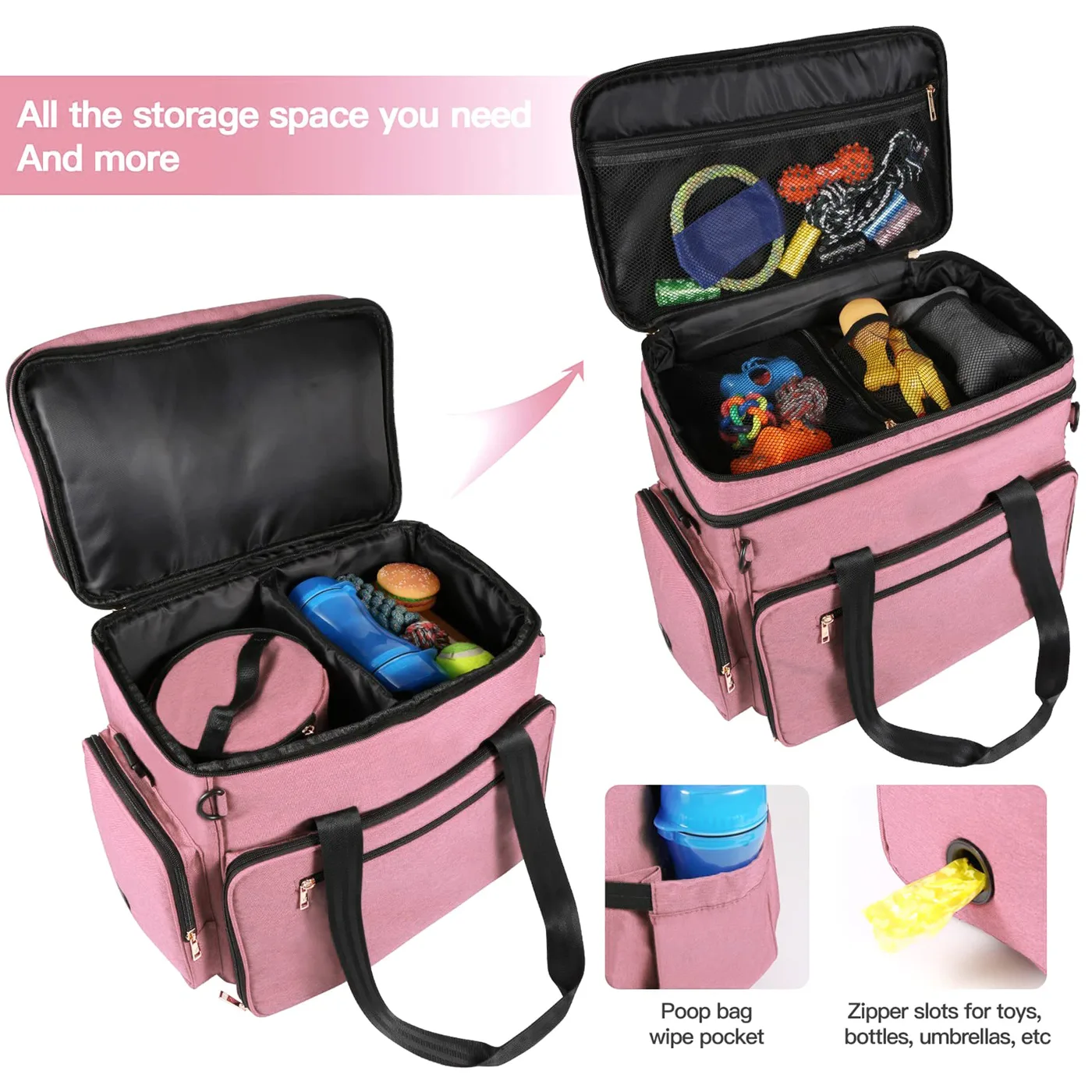
Volumetric weight is where pet bag programs lose money, because the category ships air. A soft pet tote packed in a carton sized for convenience rather than for freight can carry a chargeable weight three times its actual weight. Buyers who only ever look at gross weight are surprised by invoices that bear no relationship to the number of kilos on the scale.
The arithmetic is straightforward and worth internalising. A carton measuring 60 x 40 x 40 cm holds 96,000 cubic centimetres; divided by 5,000 that is 19.2 volumetric kilograms. If the carton physically weighs 7 kg, the courier charges 19.2 kg. If the buyer specifies a flatter carton at 60 x 40 x 30 cm, the volumetric weight drops to 14.4 kg and the bill falls by twenty-five percent for an identical product.
| Pet bag type | Typical carton (cm) | Actual weight (kg) | Volumetric weight (kg) | Billable ratio |
|---|---|---|---|---|
| Soft pet tote, loose packed | 60 x 40 x 40 | 7.0 | 19.2 | 2.7x |
| Pet backpack, nested | 55 x 45 x 35 | 9.5 | 17.3 | 1.8x |
| Structured pet travel bag | 65 x 45 x 45 | 12.0 | 26.3 | 2.2x |
| Fold-flat pet duffle | 50 x 40 x 25 | 8.0 | 10.0 | 1.25x |
| Pet sling, bulk packed | 45 x 35 x 30 | 6.5 | 9.5 | 1.5x |
Three specification decisions control the ratio. The first is nesting: whether units interlock inside the carton rather than sitting side by side. The second is compression: whether the product is packed at its natural loft or lightly compressed, which is safe for most polyester shells and unsafe for structured foam panels. The third is carton sizing: whether the master carton is a stock size chosen by the packer or a size engineered around the packed unit.
Buyers should ask for carton dimensions and packed units per carton at quotation stage, not at booking stage. Those two numbers, multiplied across the order, produce the freight estimate. A supplier who quotes a unit price but cannot state the carton specification is quoting a price that will move.
There is a second-order benefit to engineering the carton. Compact pack-outs stack better, survive linehaul with less crushing, and arrive in better condition, which reduces the arrival-damage defects that inspectors record under AQL 2.5. Freight optimisation and quality outcomes point in the same direction here, which is unusual and worth exploiting.
Because pet bag freight is billed on space rather than mass, a carton specification that reduces volume by twenty percent reduces the freight bill by roughly twenty percent without changing the product, the carrier, or the transit time.
Samples, Replenishment and Launch Orders: Three Playbooks
Three shipment types occur in every pet bag program and they should not be handled the same way. Sample shipments are small, urgent, and low in commercial risk; their purpose is decision speed. Replenishment shipments are planned, cost-sensitive, and tied to a forecast; their purpose is margin. Launch shipments are deadline-driven and often oversized because the buyer is ordering for an unknown demand curve; their purpose is arrival certainty.
Samples should always go express. A 5-15 kg parcel at USD 11-14 per kg costs a few hundred dollars and removes a week from the development calendar. Given that samples take 6-10 working days to produce and bulk takes 35-50 days after approval, shaving five days off sample transit is one of the cheapest schedule compressions available to a buyer. Do not consolidate samples with anything else; the decision they enable is worth more than the freight saved.
Replenishment should almost never go express. If a replenishment order has become urgent enough to require express, the failure happened earlier, in the reorder trigger. Buyers should set the reorder point against remaining lead time plus safety stock rather than against a fixed stock level, so that the default mode stays sea or air and express remains the exception. Our notes on bulk production lead time cover how to build that trigger against a 35-50 day cycle.
Launch orders are the genuinely difficult case, because the buyer is balancing an unknown demand curve against a fixed date. The sensible structure is a split: ship the quantity needed for the first four to six weeks of expected demand by air or express, and the balance by sea. The premium is paid only on the portion where speed has commercial value, and the sea portion arrives as the launch data starts to arrive.
A fourth category deserves a rule of its own: replacement shipments for confirmed defects. These should be shipped express without debate. The cost is small relative to the relationship, and the speed signals seriousness. Trying to recover freight on a replacement shipment is a poor trade.
Finally, buyers should resist the habit of shipping to multiple destinations from one consignment. Split delivery multiplies clearance events and fees, and it removes the consolidation benefit that makes the lower weight bands worthwhile. Consolidate to one dock and distribute domestically.

Duties, Taxes and Clearance on Door-to-Door Routes
Clearance is the part of door-to-door express buyers understand least and complain about most, because it is the part where costs appear after the booking. Pet bags typically enter under heading 4202, with the specific subheading depending on the outer surface material; a buyer's broker should confirm the classification for each SKU rather than applying one code across an assortment that mixes polyester, nylon and coated fabrics. Misclassification on an express shipment produces the same penalty exposure as on a sea shipment, only faster.
The duty model must be settled before booking. Under a DDP quote the seller advances duty and tax and invoices them, usually with an advance fee; under DAP or DDU the courier bills the importer directly, often with a disbursement fee added. Buyers comparing quotes must normalise for this, because a DDP quote that looks higher may in fact be lower once the disbursement fee and the administrative time are counted.
Duty exposure itself varies by market and by programme. General preference schemes, preferential origin arrangements, and de minimis thresholds all change the landed arithmetic, and the rules change often enough that a landed-cost model built two years ago is unreliable. Trade rules and tariff schedules administered under the WTO framework set the baseline, but national schedules and enforcement practice set the bill.
Buyers importing into the European Union should also understand the import VAT mechanics on low-value consignments, because the simplification schemes that apply to small parcels do not apply to commercial consignments of any meaningful size. Assuming the parcel rule applies to a 200 kg shipment is a common and expensive error.
Documentation discipline prevents most clearance delays. A commercial invoice that states the correct importer of record, a packing list that matches the cartons physically, and a declared value that matches the payment actually made will clear routinely. A invoice that understates value to save duty will not, and it converts a three-day transit into a three-week one with storage charges attached.
Where a buyer has any doubt about a new lane, the cheapest test is a pilot: ship one carton express, watch how the clearance behaves, and only then commit the bulk. The pilot costs a few hundred dollars and prevents the failure mode where an entire launch consignment sits in a bonded warehouse while a classification query is resolved.
Carton Engineering That Lowers the Express Bill
Carton engineering is the highest-return cost action available on express, and it is almost always neglected because it sits between two functions. The supplier chooses a stock carton, the buyer never sees the dimension, and the freight bill absorbs the consequence. Bringing carton specification into the tech pack converts an invisible cost into a managed one.
The first lever is units per carton. Packing twelve units instead of six roughly halves the number of cartons and, because volumetric weight is computed per carton with rounding, usually reduces total chargeable weight by more than the arithmetic suggests. The constraint is carton weight and handling: a master carton above roughly 20-25 kg becomes difficult to handle and more likely to be damaged, so there is a practical ceiling.
The second lever is the fold pattern. A pet bag folded at a panel seam packs flatter than one folded arbitrarily, and a flat pack of structured bags can be interleaved so that the rigid panels alternate direction. Both are specification decisions that cost nothing per unit and reduce volume by ten to twenty percent.
The third lever is carton tolerance. Stock cartons are frequently larger than the product requires because they were bought for a different product. Specifying a made-to-measure carton adds a small unit cost and a minimum order on cartons, and it pays back on the first express shipment of any size.
The fourth lever is protective material. Polybags, tissue and corner boards add weight and volume. Where the product tolerates it, replacing loose fill with a formed paper wrap reduces both, and it also improves the unboxing impression, which matters for retail-ready pack-outs.
Buyers should put two lines into every specification: master carton dimensions in centimetres, and units per master carton. Those two lines make freight estimable at quotation stage, make quotes comparable between suppliers, and make the packing list auditable during inspection. Independent inspection bodies such as SGS treat carton specification as part of the pre-shipment check, so a stated carton spec is also a checkable one.

Comparing Express Against Air and Sea for the Same Order
The honest comparison is not freight rate against freight rate; it is landed cost at the date the inventory is needed. A buyer comparing modes should write down three numbers for each: freight and ancillary cost, total door-to-door transit including clearance, and the value of holding the inventory for the difference in transit. The third number is the one usually omitted, and it is often the largest.
Consider a 400 kg pet bag replenishment. Express lands it in five days at roughly USD 7.00 per kg, so about USD 2,800 plus duty. Air consolidation lands it in ten to twelve days at roughly USD 4.00 per kg, so about USD 1,600 plus the same duty plus a handling fee. Sea lands it in thirty to thirty-eight days at under USD 1.00 per kg, so perhaps USD 400 plus local charges. The cash difference between express and sea is around USD 2,400 on one shipment.
Whether USD 2,400 is worth paying depends entirely on what happens during the twenty-five to thirty-three days saved. If the goods are already late and a retail shelf is empty, the answer is clearly yes. If the goods would have arrived with ten weeks of stock cover either way, the answer is clearly no, and paying express is simply buying warehouse space at a courier margin.
There is also a risk dimension that favours the slower modes in some cases and the faster ones in others. Sea freight concentrates a large quantity into one arrival, so a quality failure discovered on arrival affects the whole order. Express and air allow a buyer to receive a smaller quantity first, verify it, and then release the balance, which is a genuine risk reduction on a new SKU.
A practical rule that works for most pet bag programs: express for anything under 70 kg and for any replacement shipment; air consolidation for 70-500 kg when the goods are needed inside six weeks; sea for everything else, with sea booked early enough that express never becomes necessary. Buyers who adopt that rule stop paying emergency premiums because they stop creating emergencies.
Capacity seasonality should be part of the comparison. In the weeks before peak retail season and before the major manufacturing holidays, express and air capacity tightens and rates rise sharply. Booking sea capacity early costs nothing and removes the exposure entirely, which is why the calendar, not the rate card, usually decides the right answer in the fourth quarter.
The correct mode is decided by stock cover at the required arrival date, not by freight rate: express is cheap when it prevents an empty shelf and expensive when it merely moves inventory earlier than it was needed.
Writing Express Terms Into the Purchase Agreement
Express shipping belongs in the contract, not in email traffic. Three clauses matter. The first states the delivery term and the party that books and pays the carriage, which should map to a recognised Incoterm rather than to a phrase such as shipped by express. The second states the delivery window in working days and the event that starts it, normally sample approval plus confirmed payment rather than order placement. The third states what happens when the window is missed.
The remedy clause is the one buyers omit and then need. A sensible structure ties a missed delivery date to a defined consequence, such as the seller bearing the difference between the agreed mode and expedited freight, or a small percentage credit against the next order. It does not need to be punitive to be effective; it needs to be specific, because vague remedies are not enforced.
Insurance should be addressed explicitly. Carrier liability on express is limited by default and calculated by weight, not by commercial value, which means a lost carton of premium pet bags is compensated at a fraction of what it cost. Declaring value or buying cargo cover is cheap and should be a standing instruction rather than a case-by-case decision.
Buyers should also specify the documents that accompany the shipment: commercial invoice, packing list, and any certificate required by the destination. Naming them in the agreement means a missing document is a contractual failure rather than an administrative inconvenience, and it gives the buyer a lever when a shipment is held.
Finally, the agreement should say who owns risk during clearance. A shipment delayed because the importer of record did not respond is not the seller's failure; a shipment delayed because the export declaration was wrong is. Writing the boundary prevents the argument that otherwise consumes a week of correspondence while cartons sit in a depot.
Programs that handle these details well tend to look boring from the outside: few express shipments, no disputes about who paid for one, and inventory that arrives when it was expected. That outcome is a procurement result rather than a logistics one, and it comes from decisions made at the specification and contracting stage, long before anyone books a courier. Buyers building out the commercial side of that framework should read our guides to FOB shipping terms and DDP delivered duty paid, which set the baseline against which any express quote should be judged.
Production capability
- SGS-verified production space of 4,950 m², 149 machines, 7 assembly lines
- Pet bag output since 2014 from a 137-person team
- 200,000 units shipped monthly under BSCI and ISO 9001 systems
People Also Ask
How much does express shipping cost for wholesale pet bags?
Expect USD 6.50-11.00 per kg of chargeable weight depending on the weight band, with 1-20 kg sample parcels at the top of that range and 300 kg consignments at the bottom. Fuel surcharge, clearance and duty advance fees are additional.
How long does door-to-door express take from China?
Three to seven working days door to door for most lanes, including clearance. Samples and small parcels sit at the faster end; consignments above 300 kg, or those requiring a classification query, sit at the slower end.
Why is my express invoice higher than the quoted rate?
Chargeable weight is the greater of actual and volumetric weight, and pet bags ship bulky. A carton with 7 kg of product can bill at 19 kg. Fuel surcharge, remote delivery, clearance and duty advance fees then add to the base.
When should I use express instead of sea freight for pet bags?
Use express up to roughly 300 kg, or whenever stock will run out before a sea shipment could arrive, or for samples and replacement goods. Use sea freight when the order is large and stock cover comfortably exceeds thirty-five days.
Does door-to-door express include import duty?
Only if the quote is written as DDP. Under DAP or DDU the courier bills duty and tax to the importer, usually with a disbursement fee. Always confirm the duty model in writing before comparing quotes.
How can I reduce express freight cost on pet bags?
Engineer the carton: increase units per master carton, nest or fold units to reduce volume, and specify a made-to-measure carton. Reducing packed volume by twenty percent cuts the bill by roughly the same proportion.
What is volumetric weight and how is it calculated?
Volume divided by a divisor, conventionally 5,000 for centimetre measurements. A 60 x 40 x 40 cm carton gives 96,000 cubic centimetres and a volumetric weight of 19.2 kg, which is what you pay if the carton weighs less.
Frequently Asked Questions
What is the maximum practical weight for an express pet bag shipment?
Around 500 kg per consignment. Beyond that, air consolidation is usually cheaper per kilogram and the transit penalty is only a few days, so express stops being the efficient choice.
Should samples always be shipped express?
Yes. A sample parcel costs a few hundred dollars and removes roughly a week from a development calendar that runs 6-10 working days for sampling and 35-50 days for bulk. The speed is worth far more than the freight.
Who is liable if an express shipment is lost?
Carrier liability is limited by weight under standard terms, not by commercial value. Either declare value at booking or carry cargo insurance, because the default compensation on a lost carton of premium pet bags will not cover the goods.
Can one express waybill cover multiple delivery addresses?
Technically yes, but each destination triggers its own clearance event and fees. Consolidating to one dock and distributing domestically is almost always cheaper and simpler.
How do I know whether my quote is DDP or DAP?
Ask for the Incoterm in writing on the quotation itself. If the quote is silent and simply says door to door including delivery, assume duty and tax are excluded until confirmed otherwise.
Do couriers charge more for residential delivery?
Most apply a residential or remote-area surcharge per shipment or per package. It is not included in headline rates and can add a meaningful amount on a multi-carton consignment, so confirm it before booking.
How does the fuel surcharge work?
It is a percentage applied to the base freight and revised monthly, typically published on the carrier website. Because it moves, a quote valid for thirty days is effectively a quote on the base rate only, and the invoice may differ.
Should I split a launch shipment between express and sea?
Often yes. Ship four to six weeks of expected demand by express or air to hit the launch date, and the balance by sea. You pay the premium only on the portion where speed has commercial value.
What documents should accompany an express pet bag shipment?
Commercial invoice, packing list matching the physical cartons, and any certificate the destination requires. Name them in the purchase agreement so a missing document is a contractual failure rather than an inconvenience.
How does carton specification affect inspection?
A stated master carton dimension and units-per-carton figure is checkable during pre-shipment inspection. It also prevents the arrival damage and pack-out defects that inspectors record under AQL 2.5.
Is express faster than air consolidation by much?
Usually four to six days faster door to door, because consolidation requires build-up, a scheduled flight and deconsolidation. Whether that matters depends on stock cover, not on preference.
Can I use my own courier account for supplier shipments?
Yes, and it is often sensible on FOB terms because it gives you visibility and audit of the freight spend. Make sure the account arrangement is stated in the agreement along with who bears the cost.
Talk to QUANZHOU JUNYUAN BAGS about a wholesale pet bag order: MOQ 500 pieces per colourway, samples in 6-10 working days, bulk production in 35-50 days under AQL 2.5 inspection.
Get a free quote Request a sample