Pet ESA Bag: Emotional Support Gear Wholesale Sourcing
A wholesale pet ESA bag programme starts at MOQ 500 pieces per colourway, costs USD 4.90-9.40 FOB Xiamen per unit, and needs 35-50 days of bulk production after a 6-10 working day sample cycle. Because the regulatory treatment of support animals has changed repeatedly, buyers should keep category-specific wording off the shell. Shipments release only after an AQL 2.5 pre-shipment inspection.
Support-animal gear is the most legally volatile category in the pet bag assortment, and volatility is a sourcing problem rather than a marketing one. The rules governing support animals in housing, in air travel and in public access have been revised repeatedly in recent years and differ substantially between jurisdictions. A product printed with category-specific wording can become commercially unviable, or legally exposed, without any change to the product itself. Programmes are structured at MOQ 500 pieces per colourway on a generic shell with removable identification.
The specification response is to separate the bag from the claim. The shell, lining and structure are generic and carry no category wording. Identification is a removable element supplied by the buyer or applied at destination, which means a regulatory change does not strand inventory and does not create a compliance exposure attached to the importer. Our production team applies this structure on every support-gear programme and declines to print fixed category wording on a shell.
Standard timing applies: sampling takes 6-10 working days from confirmed artwork and colour standard, bulk runs 35-50 days, and sea freight adds 28-35 days to a US West Coast distribution centre. Quality gates are fixed at AQL 2.5 under general inspection level II with zero tolerance for critical defects, and all wording is reviewed before production. Terms are T/T 30/70 against FOB Xiamen, with production through an SGS-verified production base running 7 lines, 149 machines and 200,000 pieces per month under BSCI and ISO 9001.
Most buyers source pet bags from china through a mix of catalogue review and sample rounds, and Pet Bag Types & Styles decisions sit in the middle of that sequence. Pet bag wholesale suppliers who publish a price list with the fabric spec attached save a full round of email, and bulk pet bag orders then move on carton weight rather than on unit count.
Why the Support-Animal Category Is Volatile for Buyers
Volatility is the defining commercial feature of this category and it should be designed for rather than hoped away. The rules determining how a support animal is treated in housing, on aircraft and in public places have been revised repeatedly, the revisions have run in different directions in different jurisdictions, and further change is likely. For a buyer holding printed inventory, each revision is a potential write-off.
The mechanism of the loss is specific and worth understanding. A bag printed with category wording is only saleable to a customer who accepts that wording as accurate and useful. When the rules change, two things happen simultaneously: demand falls because the wording is no longer useful, and exposure rises because the wording may now be inaccurate. A buyer holding stock in that position has both a commercial and a legal problem from the same decision.
The categories of volatility that matter commercially are three. Housing rules determine whether a landlord must accommodate a support animal, and these are set nationally in some markets and locally in others. Travel rules determine whether an animal travels in a cabin, in a container or as cargo, and these have been substantially revised for air travel in the United States. Public access rules determine where an animal may accompany its handler, and these are generally narrower for support animals than for trained assistance animals.
The table below shows the four configurations that carry support-gear volume, priced FOB Xiamen at MOQ 500 pieces per colourway.
| Configuration | Primary use | Size (cm) | Animal weight | FOB band (USD) | Identification |
|---|---|---|---|---|---|
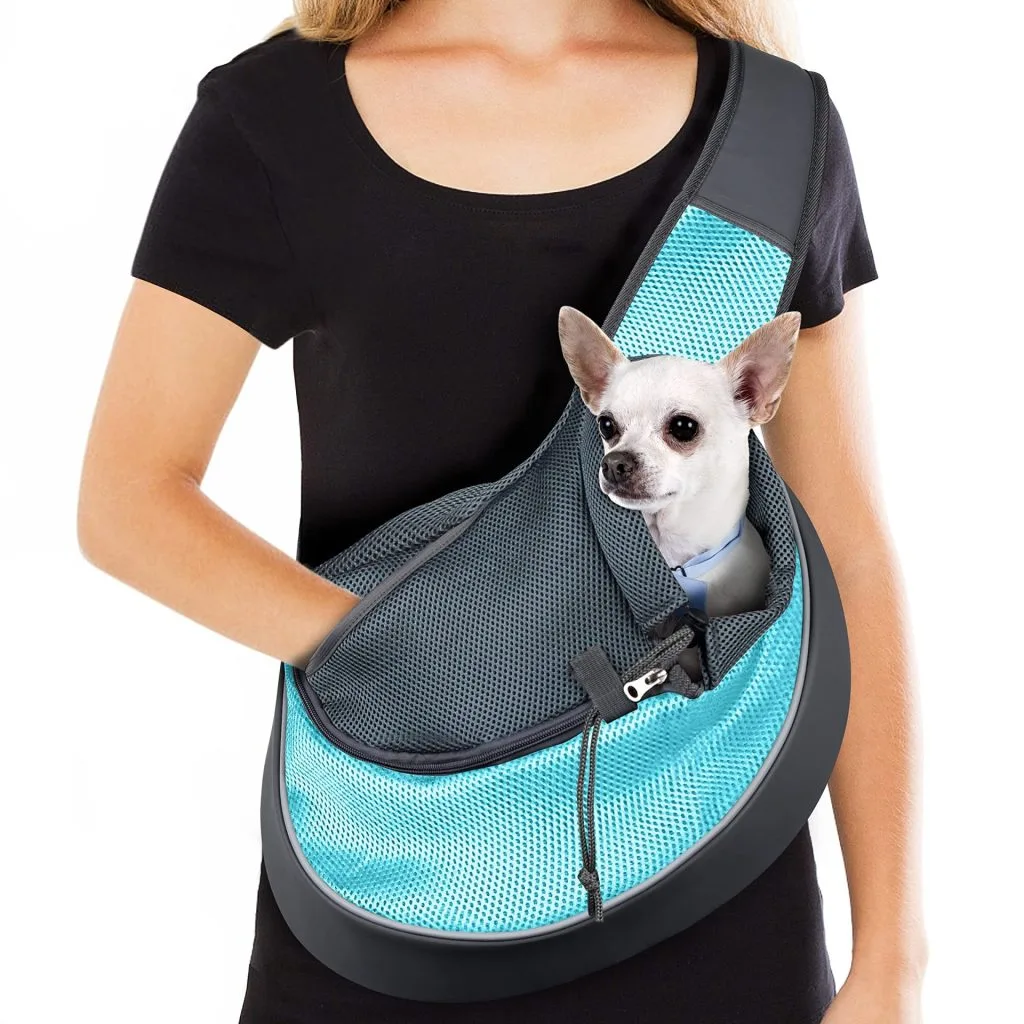
| Generic carry sling | Close carry | 34 x 18 x 24 | Up to 5 kg | 4.90 - 5.90 | Removable patch |
| Cabin-format tote | Travel use | 38 x 22 x 28 | Up to 7 kg | 6.10 - 7.30 | Clear ID window |
| Support-role backpack | Daily carry | 42 x 25 x 32 | Up to 10 kg | 7.20 - 8.60 | Loop panel |
| Documentation wallet set | Document carry | Wallet 24 x 16 x 3 | Not applicable | 8.30 - 9.40 | Neutral sleeve |
The identification column is the point of the table. Every configuration uses a removable or neutral identification element rather than a printed category statement, and that single design decision is what makes the category safe to stock. Buyers should treat it as a requirement rather than as a preference.
The second observation is that the documentation wallet configuration, which carries documents rather than an animal, is the fastest growing line in the category. It has no weight rating, no ventilation requirement and no structural load path, and it is regulated only as a document holder, which makes it the lowest-risk SKU a buyer can hold in a volatile category.
Regulatory Divergence: Housing, Travel and Public Access
Regulatory divergence is not a background detail in this category; it is the specification environment. A buyer selling into more than one jurisdiction, or into more than one use case within a jurisdiction, is dealing with several different rule sets simultaneously, and the product has to be viable across all of them.
Housing is the largest use case by volume and the most variable by jurisdiction. In the United States, federal fair housing provisions require accommodation of assistance animals in housing, and the Department of Housing and Urban Development has issued guidance on how housing providers should evaluate requests. Other markets handle the question through different mechanisms or not at all. A product sold into this use case should not assert a legal outcome, because the outcome depends on a process the product cannot influence.
Travel is the use case that has changed most sharply. Air carriers in the United States now treat support animals under their general pet policies rather than under assistance animal provisions, which means a support animal travels under the same conditions as any other pet. The Federal Aviation Administration guidance for travellers flying with pets is the reference point buyers should check, and the practical consequence is that a cabin-format bag for this category should be specified to airline dimensional and ventilation requirements rather than to any support-animal exemption.
Public access is the narrowest use case and the one that generates the most consumer confusion. In most jurisdictions, public access rights attach to trained assistance animals and not to support animals, and the difference is well documented. Reference material on assistance animal roles and terminology is available from the American Veterinary Medical Association, and buyers should consult it before approving any copy that touches on access rights.
The commercial conclusion is that a support-gear programme should be specified as a general-purpose carry product with optional identification, and marketed without asserting any legal entitlement. That specification is viable in every jurisdiction, in every use case, and under every likely future revision of the rules.
Claims and Wording: The Highest-Risk Element in the Category
In most pet bag categories, the compliance risk sits in materials and hardware. In this one, it sits in words. That is unusual and it requires a different control process, because copy is produced by marketing teams who are not thinking about import compliance.
The exposure has three forms. The first is misrepresentation, where a product or a supplied document implies a legal status that the law does not confer. Several jurisdictions have enacted provisions specifically addressing this, and enforcement has reached retailers as well as manufacturers. The second is unsupported therapeutic claim, where packaging or listing copy states or implies a health outcome. The third is documentation risk, where a product is sold with a card, certificate or registration that resembles an official credential.
The control that works is a copy review gate before production. Every word that appears on the product, on the hangtag, on the card and in the listing copy should be reviewed against the destination market's rules, and anything asserting status, entitlement or outcome should be removed. Our production team runs that gate on every support-gear programme and will not print wording that has not passed it.
The safest copy is functional rather than categorical. Describing a product by what it does, what it holds, what weight it carries and how it is cleaned is accurate everywhere and exposes nobody. Describing it by what legal status it confers is inaccurate in most places and exposes everybody in the chain.
Buyers should also consider what happens after the sale. A product sold with no claims generates no complaints; a product sold with an implied entitlement generates disputes with airlines, landlords and access providers, and those disputes reach the retailer. The cost of a conservative copy decision is a small reduction in conversion. The cost of the alternative is a dispute channel that scales with volume.
Product Specification: Removable Identification and Generic Design
The specification for support gear is a general-purpose carry specification with one addition: a removable identification element. Everything else should be specified exactly as it would be for a mainstream pet bag, because the product is used as a mainstream pet bag.
The identification element has three acceptable forms and one unacceptable one. The acceptable forms are a hook-and-loop loop panel accepting the customer's own patch, a clear window accepting an inserted card, and a neutral sleeve accepting a document. The unacceptable form is any fixed printed category statement on the shell, the lining or the trim. The distinction matters because the first three transfer the claim to the customer and the fourth attaches it to the product.
Dimensions should be specified against travel reality rather than against marketing. A cabin-format unit has to satisfy an airline's under-seat dimensional limit, which in practice means a soft-sided construction with a compressible top and a stated maximum height, and it has to carry the animal's weight without exceeding that height. Our production team specifies a collapsible top panel and a stated compressed dimension for this reason, because a rigid unit that fits the limit empty may not fit it loaded.
Ventilation should be specified as an open area in square centimetres on at least two faces, with the mesh specified by aperture as well as by appearance. Airline and welfare reviewers look at both. A decorative mesh panel with a bonded backing can have almost no open area while looking correct, which is why the numeric specification matters more than a visual one.
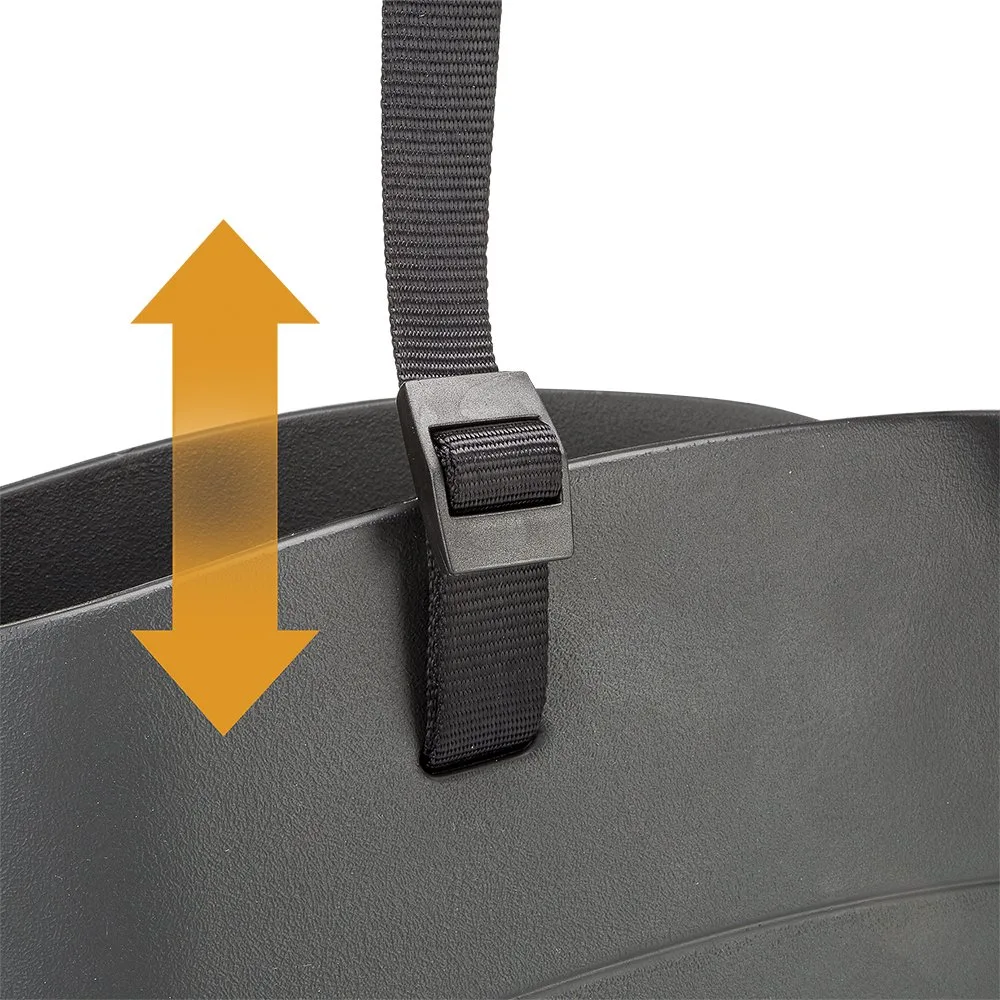
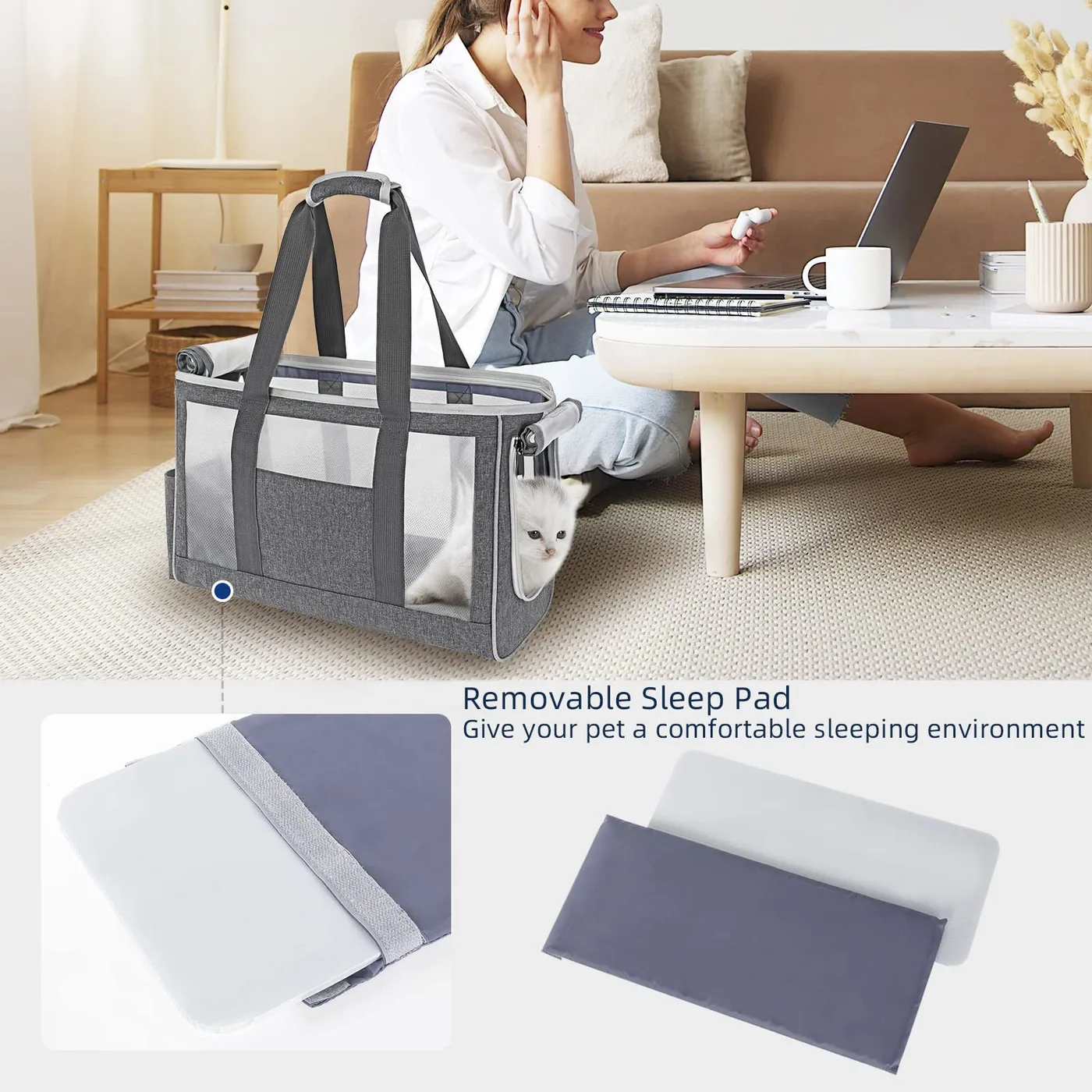
Comfort and cleanability close the specification. A removable washable pad, a wipeable lining and a handle that distributes load are the three features that generate positive reviews in this category, and none of them carries a claims risk. Buyers looking for differentiation should add specification here rather than in wording, because it is safe and it is what customers actually evaluate.
Cost Structure and Price Bands for Support-Gear Programmes
Support gear sits in the middle of the pet bag price range, above commodity consumer units and below rated working-dog equipment. The cost structure reflects that position: better materials than a commodity unit, no rated hardware, and a modest documentation burden.
On a mid-band cabin-format tote, fabric and lining account for roughly a quarter of FOB, trims and hardware for a fifth, cutting and sewing labour for around thirty percent, and finishing, identification elements and documentation for the balance. The hardware share is materially lower than on working-dog gear because nothing has to be rated, and that is the main reason the price bands differ between the two categories.
FOB Xiamen bands run USD 4.90-9.40 as shown earlier. Landed cost adds sea freight at roughly half a dollar to eighty cents per unit in a consolidated container plus duty and handling, supporting retail price points from USD 24.99 for a carry sling to USD 69.99 for a documentation wallet set. The category supports a healthy gross margin, and the margin is best protected by keeping the specification generic, because a generic unit has a carry-over path where a category-printed unit does not.
Volume elasticity is moderate. Moving from 500 to 3,000 units reduces unit cost by roughly nine to thirteen percent, concentrated in amortised setup and in trim purchasing rather than in fabric. Buyers should not assume a steeper curve, and should focus negotiation on consolidating colourways rather than on chasing a volume tier they may not reach.
One cost line deserves explicit attention because it is specific to this category: the copy review. Legal or compliance review of product and listing copy is a real cost, it recurs whenever copy changes, and it should be budgeted as a programme cost rather than discovered as an invoice. Buyers running several markets should budget per market, because a wording set that is acceptable in one jurisdiction is frequently not acceptable in another.
Inventory Hedging: Managing Regulatory Risk in Stock
Inventory strategy in this category should be built around the assumption that the rules will change again, and the question is how much stock is exposed when they do. The answer depends almost entirely on where the category wording sits, which is why the removable identification specification is an inventory decision as much as a compliance one.
Under the generic-shell structure, exposure is close to zero. A change in the rules affects demand but does not strand stock, because the shell is saleable as a general-purpose pet bag and the identification element is either not yet applied or removable. Under a printed-shell structure, exposure is total: the entire stock of category-printed units is impaired on the day the rules change, and the recovery options are discounting into an off-price channel or destruction.
Order sizing should follow from that. Where the structure is generic, buyers can commit to the standard MOQ of 500 pieces per colourway with confidence, and can even use a blanket release against an annual quantity, because the stock carries no category-specific risk. Where a buyer has inherited or commissioned printed stock, the correct strategy is to reduce depth and increase frequency until it is cleared, accepting a higher freight cost per unit as the price of a lower exposure.
Market diversification is the second hedge and it is underrated. A generic unit sells into every jurisdiction, and a buyer who sells into three markets has three demand streams against one inventory pool. A category-printed unit sells into one market's interpretation of one rule set, and a change in that market impairs the whole pool. Buyers should treat market spread as a risk control rather than only as a growth strategy.
One further diversification argument is worth stating plainly. A generic programme can also serve adjacent demand that a category-specific one cannot: travel carriers, everyday totes and cabin bags all draw on the same shell inventory. That adjacency means a downturn in one demand stream does not idle the whole pool, and it is the practical reason our production team recommends generic shells even to buyers who are confident about their current market. Confidence about the present is not a hedge against a future revision.
The final hedge is SKU structure. The documentation wallet configuration has no weight rating, no ventilation requirement and no category exposure at all, which makes it the safest line in the assortment. Buyers building a support-gear programme should weight their opening commitment toward the wallet and the generic carry formats, and treat the printed or category-specific variants as a small test rather than as a core position.
Compliance, Testing and Documentation
Substance compliance in this category is standard and undemanding because the products are ordinary pet bags. Documentation compliance is heavier than usual because of the copy risk, and because several retail and marketplace channels apply extra scrutiny to this category.
The substance package follows the usual component list. Shell, lining, webbing, printed or coated elements and plated hardware each need a declaration, California destinations need a Prop 65 assessment against the safe harbour levels published by the California Office of Environmental Health Hazard Assessment, and a recognised textile certificate on fabric and lining satisfies most reviewers in one document. Testing for a four-component support-gear programme runs USD 580-1,050 and is fixed per order.
Ventilation and dimensional claims should be evidenced rather than asserted. Where a listing states an under-seat dimension or a ventilation area, the buyer should hold a measurement record and, ideally, a test report supporting it, because marketplace and airline disputes turn on exactly those two numbers. Our production team records compressed dimensions and open ventilation area on the technical file for every cabin-format unit for this reason.
Copy documentation is the distinctive element. Buyers should retain a dated record of the copy review covering product wording, hangtag wording, card wording and listing wording, showing who reviewed it and against what standard. That record is what demonstrates diligence if a claim is later challenged, and it costs hours rather than dollars.
Verification closes the package. A recognised body such as SGS can run pre-shipment inspection against the approved specification with copy and packaging included as line items on the worksheet. Independent inspection is worth maintaining on this category even at modest order sizes, because the consequence of a wording error reaching the market is disproportionate to the size of the order.
Supplier Scorecard for Volatile-Category Programmes
The scorecard for support gear weights regulatory discipline alongside the usual commercial criteria. Copy and claims discipline carries twenty-five percent, which specifically means the supplier refuses to print unapproved category wording and maintains a review record. Specification consistency carries twenty percent. Documentation completeness carries fifteen percent. Flexibility on identification components carries fifteen percent. Calendar reliability carries fifteen percent. Price carries ten percent.
Copy discipline earns the top weighting because it is the control that protects the whole programme. A supplier who will print whatever the buyer sends is not a low-friction partner in this category; they are an unmanaged exposure. Buyers should ask directly whether the supplier operates a copy review and what it covers, and should treat a supplier who does not have one as unsuitable for this work regardless of price.
Flexibility on identification components matters because the removable-element structure only works if the supplier stocks and applies those components on call-off. A supplier who requires a finished-goods minimum per identification variant converts a flexible programme into a rigid one and reintroduces the exposure the structure was built to remove. Buyers should confirm this capability at quotation stage.
Quality gates are fixed at AQL 2.5 under general inspection level II with zero tolerance for critical defects, and the critical list should explicitly include any unapproved or incorrect wording on product, packaging or inserted material. That classification is unusual but correct here, because a wording error cannot be corrected after the goods are shipped and is therefore a total loss on the affected units. Major defects cover dimensional deviation affecting a stated travel dimension, ventilation open area below specification, and shade deviation outside the signed band.
Continuity closes the scorecard. A generic shell programme is a long-life programme, and the buyer should expect the supplier to hold fabric, trim and hardware standards on file for years so that replenishment matches the original specification. Our production team maintains those standards for every support-gear programme, and the production base behind this programme holds BSCI social compliance and ISO 9001 quality management across 4,950 square metres, 137 staff, 7 lines and 149 machines at 200,000 pieces per month, with certificates released at quotation stage. Terms are T/T 30/70 against FOB Xiamen with the balance released against the passed inspection report.
Order and quality terms
- MOQ 500 pieces per colourway; samples in 6-10 working days
- Bulk production 35-50 days after approval; AQL 2.5 inspection standard
- T/T 30/70 terms, FOB Xiamen, full document set per shipment
People Also Ask
Why is support-animal gear a volatile sourcing category?
Because the rules on housing, travel and public access have been revised repeatedly and differ between jurisdictions. A change in the rules impairs any stock carrying category-specific wording.
Can I print support-animal wording on the bag?
It is not recommended. Removable identification elements transfer the claim to the customer and keep the shell saleable whatever the rules do.
Do airlines treat support animals differently from pets?
In the United States, air carriers now apply general pet policies to support animals. Cabin-format units should be specified to airline dimensional and ventilation requirements rather than to any exemption.
What is the safest way to differentiate support gear?
Through specification rather than wording: removable washable pads, wipeable linings, load-distributing handles, documented ventilation area and recorded compressed dimensions.
How do I protect myself if the rules change again?
Hold a generic shell, keep identification removable, sell into more than one market against one inventory pool, and weight the assortment toward formats with no category exposure.
What documentation should I retain?
Material declarations, test reports, a measurement record for dimensional and ventilation claims, and a dated copy review record covering product, packaging and listing wording.
Frequently Asked Questions
What is the MOQ for a support-animal pet bag?
MOQ is 500 pieces per colourway. Under a generic-shell structure buyers can commit to that minimum with confidence, because the stock carries no category-specific regulatory exposure.
Why should category wording be kept off the shell?
Because the rules governing support animals change, and a printed category statement strands the entire stock when they do. Removable patches, clear ID windows and neutral sleeves transfer the claim to the customer.
How long does sampling take?
Sampling takes 6-10 working days once artwork, colour standard and the identification element are confirmed. Compressed dimensions and ventilation open area should be measured on the sample and recorded.
What is the bulk production lead time?
Bulk runs 35-50 days. Cabin-format units with collapsible panels and clear ID windows sit at the longer end of the range.
What does a support-gear pet bag cost FOB?
FOB Xiamen bands are USD 4.90-5.90 for a carry sling, USD 6.10-7.30 for a cabin-format tote, USD 7.20-8.60 for a support-role backpack and USD 8.30-9.40 for a documentation wallet set at MOQ 500 per colourway.
Can the product state a legal entitlement?
No. Copy should describe what the product does rather than what legal status it confers. Asserting entitlement creates misrepresentation exposure that reaches every party in the chain.
How should cabin dimensions be specified?
Against airline under-seat limits, with a collapsible top panel and a stated compressed dimension. A rigid unit that fits the limit empty may not fit it loaded.
Which inspection standard applies?
AQL 2.5 at general inspection level II with zero tolerance for critical defects, including any unapproved or incorrect wording on product, packaging or inserted material.
How much does third-party testing cost?
A four-component programme runs USD 580-1,050, fixed per order. Copy review should be budgeted separately and per market, because wording acceptable in one jurisdiction may not be acceptable in another.
What is the lowest-risk SKU in this category?
The documentation wallet. It has no weight rating, no ventilation requirement and no category exposure, which makes it the safest line to hold.
Should I hedge inventory against regulatory change?
Yes. Use a generic shell, spread sales across markets against one inventory pool, and weight the opening commitment toward generic formats rather than category-specific variants.
How does this category differ from working-dog gear?
Support gear has no rated hardware requirement and sits at lower price bands, but carries heavier copy risk. Working-dog gear costs more and is bought by institutions on specification.
Talk to QUANZHOU JUNYUAN BAGS about a wholesale pet bag order: MOQ 500 pieces per colourway, samples in 6-10 working days, bulk production in 35-50 days under AQL 2.5 inspection.
Get a free quote Request a sample