Pet Soft Sided: Flexible Design
Fold it before you price it. A soft-sided pet bag earns its place in an assortment by collapsing, and the only honest way to compare two quotations is to compare the folded height each one reaches under a defined compression load, not the unfolded photograph. Work to a collapse ratio of 0.35-0.55, a packed carton cube under 0.055 cubic metres per unit at medium size, and an FOB Xiamen band of USD 6.40-12.80.
Flexible construction trades shelf drama for logistics economics, and procurement should measure the trade rather than guess at it. Our production team costs a soft body in four blocks: the stiffness gradient built into the panels, the collapse ratio achieved under compression, the packed carton cube, and the repair path once the bag is in a customer's hands. A quotation that answers only the first block is not comparable with one that answers all four.
Terms are the same across the category: MOQ 500 pieces per colorway, samples delivered in 6-10 working days from a frozen specification, bulk production 35-50 days after final sample approval, pre-shipment acceptance at AQL 2.5, T/T 30/70 against FOB Xiamen. Because no tooling is required, a soft-sided line can be revised between seasons far more cheaply than a moulded one, which is the real argument for making it the volume driver of a range.
Runs are scheduled through an SGS-verified production base and partner facilities audited to BSCI and ISO 9001. Request the compression-test figures, the carton-loading photograph and the fabric test reports with the sample rather than with the shipment; they are the three documents that determine whether the landed-cost model survives contact with reality.
Pet bag retail buyers and pet bag wholesale business owners look at the same unit cost from opposite ends, and Pet Bag Types & Styles is where those numbers meet. Pet bag procurement teams normally fix quality first and negotiate price second, which is why pet bag supplier selection is really a documentation exercise.
The Soft-Sided Pet Bag Is a Fabric Stiffness Problem
A soft body has no frame, so whatever shape it holds is borrowed from the fabric system. That makes stiffness the central specification, and stiffness is not one number. It is a distribution across the bag: high at the base where the animal stands, moderate at the walls where the load pushes outward, low at the mouth where the handler needs the bag to yield. Getting that distribution right is the difference between a bag that looks structured on a shelf and one that slumps in the corner of a photograph.
Buyers often specify stiffness by naming a fabric, which does not work. "600D polyester" says nothing about the coating, the interlining, the foam lamination or the seam construction, and those four variables control the result far more than the base cloth does. Specify stiffness by behaviour instead: base deflection under a defined load, wall recovery after a defined squeeze, and mouth closure force. Those can be measured on a sample and argued about objectively.
The commercial reason this matters is returns. The two dominant complaints on soft carry products are that the base sagged so the animal would not settle, and that the bag collapsed onto the animal during a longer trip. Both are stiffness-distribution failures, not fabric failures, and both are visible in a sample if the buyer knows what to look for before approving it.
Flexible construction also changes who can make the product. Because the panel set is cut and sewn rather than moulded, a soft-sided line can be revised between seasons, re-coloured without capital spend, and produced in shorter runs than any rigid alternative. For a buyer testing a new channel or a new size ladder, that flexibility is worth more than a marginally lower unit price on a programme that cannot be changed.
Set the working envelope early. A practical soft-sided range covers roughly 2-10 kg, with the medium size carrying the volume and the small size acting as the entry price point. Below about 2 kg the animals are usually carried in a sling instead; above about 10 kg the fabric system has to be so stiff that the logistics advantage starts to disappear, and a framed or moulded format becomes the better answer.
Planning note: Specify a soft body by measured stiffness behaviour at base, wall and mouth rather than by fabric name, because the name does not predict how the bag will perform.
Building a Stiffness Gradient From Base to Mouth
The base is the first place to spend money. A removable or sewn-in board in 4-6 mm EVA or a twin-wall polypropylene sheet spreads the animal's weight and stops the hammock effect that makes pets refuse to settle. The board should be sized to the interior floor, not to the exterior, and should be specified with a deflection limit under a representative load, because a board that bends is doing nothing.
Walls come next and they want moderate, not maximum, stiffness. A lightly laminated foam of 2-3 mm bonded to the face fabric gives enough body to hold a rectangular section and enough give to absorb a shoulder carry. Over-stiffening the walls is a common and expensive mistake: it adds cost, adds weight, prevents the bag from collapsing for shipping, and makes the product read as a budget hard case rather than as a soft bag.
The mouth is where restraint, not stiffness, is wanted. A soft-top opening usually needs a light hoop of webbing or a small-diameter elastic cord to stop the aperture from gaping, and nothing more. Adding a stiffener here fights the handler every time the animal goes in or out, and it prevents the bag from folding flat for transport, which cancels the freight advantage that justified the format in the first place.
Joining the three zones matters as much as specifying them. A stiff base meeting a floppy wall creates a hinge that folds unpredictably and wears out early. The transition should be graded over 30-50 mm with a reducing foam thickness or a tapered board, and the stitch line at the transition should be reinforced, because that seam takes the load transferred from the animal's weight into the carrying straps.
Finally, remember that stiffness degrades. Foam laminations break down after repeated compression, and an interlining that feels right in the sample room may feel slack after a season of use and several washes. Ask for an accelerated compression-recovery figure and a laundering cycle count, and treat both as acceptance criteria rather than as marketing claims.
Planning note: Spend stiffness budget at the base, keep the walls moderate, leave the mouth soft, and grade the transitions so no single seam becomes a hinge.
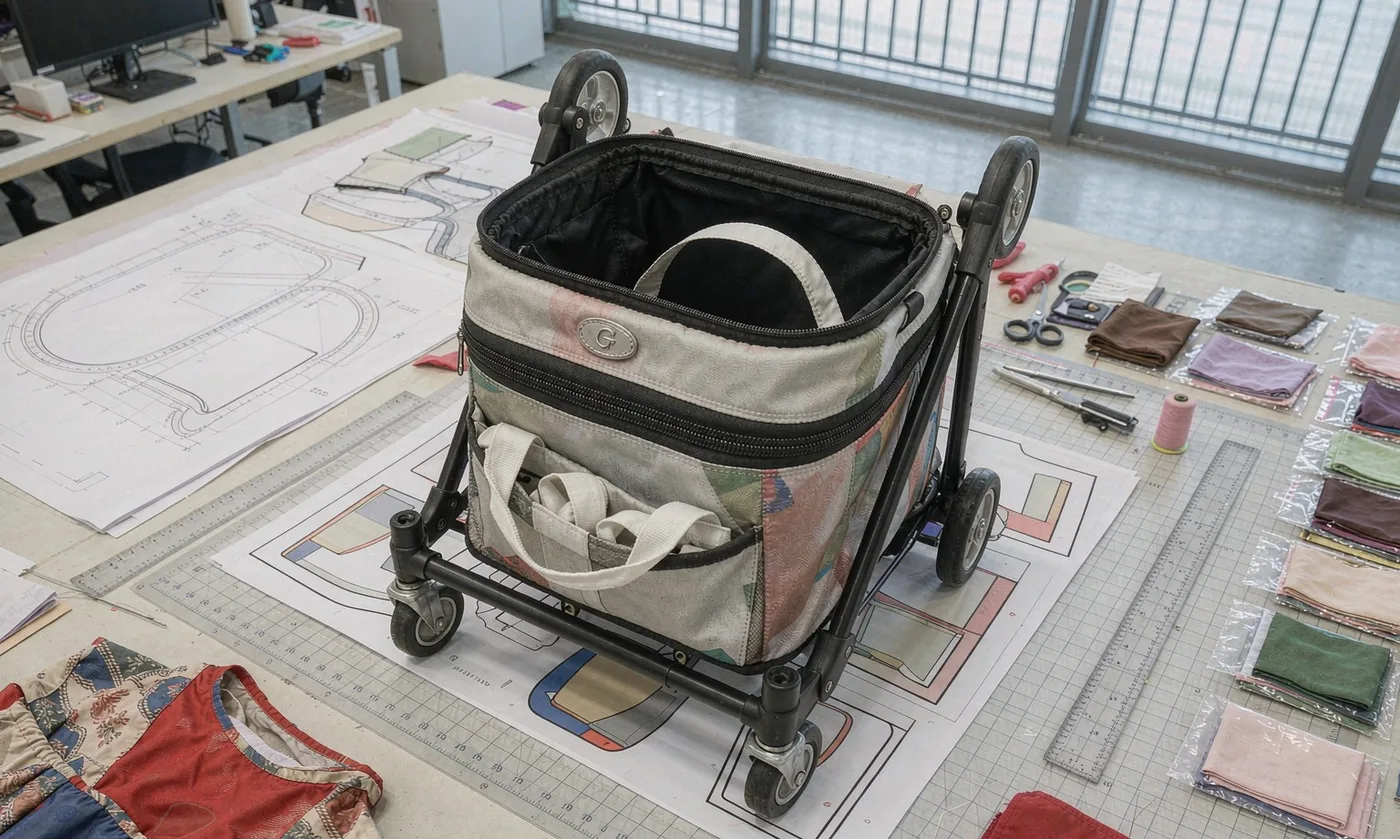
Collapse Ratio and Packed Cube: Measuring What You Ship
Collapse ratio is the folded height divided by the assembled height, measured under a defined compression load rather than by hand. It is the single most useful number in this category because it converts directly into carton cube and therefore into freight. Hand-folded samples always look better than reality; a stack in a carton under strap tension does not negotiate.
Measure it properly. Assemble the bag, stand it on its base, record the height, then apply a distributed load of 5-10 kg to the top face and record the settled height after one minute and again after twenty-four hours. The twenty-four hour figure is the honest one, because foam laminations creep. A bag that reads as a 0.40 ratio in the showroom frequently settles to 0.55 after a day under load, and that difference is freight money.
| Model / size | Assembled height (cm) | Folded height after 24 h (cm) | Collapse ratio | Units per master carton | Carton cube per unit (m3) | Units per 40 ft high-cube |
|---|---|---|---|---|---|---|
| Small, light interlining | 28 | 10.5 | 0.38 | 30 | 0.026 | 2,500-2,650 |
| Small, foam-laminated walls | 28 | 14.0 | 0.50 | 22 | 0.035 | 1,850-1,950 |
| Medium, light interlining | 34 | 13.0 | 0.38 | 20 | 0.039 | 1,650-1,750 |
| Medium, foam-laminated walls | 34 | 17.5 | 0.51 | 14 | 0.055 | 1,150-1,250 |
| Medium with removable base board | 34 | 11.0 | 0.32 | 24 | 0.032 | 2,000-2,150 |
| Large, foam-laminated walls | 40 | 23.0 | 0.58 | 9 | 0.086 | 720-780 |
The removable-base-board row is worth studying. Pulling the board out and packing it flat alongside the folded body removes the stiffest element from the collapse path and typically improves the ratio by 15-20 percent. It costs one extra assembly step at the distribution centre and one extra component to track, and it is often the cheapest available improvement to container utilisation.
Convert cube into money before signing. A 40-foot high-cube gives roughly 65-68 cubic metres of usable space and costs a broadly fixed amount per sailing, so freight per unit is simply that cost divided by the unit count in the table. Moving a medium model from 1,150 to 2,000 units per container changes landed cost per unit far more than a USD 0.30 negotiation on the ex-works price ever will.
Do not optimise cube into a corner. A bag engineered purely to fold flat tends to arrive looking flat, and the same stiffness that costs freight is what sells the product on a shelf. The workable compromise is a removable stiff element that ships flat and installs in seconds, which keeps both the photograph and the container honest.
Planning note: Require a measured collapse ratio after twenty-four hours under load, and convert carton cube into freight per unit before comparing any two quotations.
Repair, Refurbishment and the Cost of a Second Life
Soft bodies are repairable and rigid shells are not, and that difference belongs in the commercial model rather than in the sustainability paragraph. A torn seam, a failed zipper slider or a crushed base board can all be replaced on a sewn product at a fraction of replacement cost. For a retailer running a returns desk or a warranty programme, that is real money recovered per unit rather than written off.
Design for the repair before the range launches. Three decisions do most of the work. Make the base board removable through a sleeve rather than buried under lining, so a crushed board is a five-minute swap. Use a zipper with a replaceable slider and a standard gauge, so a failed slider does not condemn the whole bag. And keep the strap attachment accessible, because the strap is the highest-stress component in the entire product and the most likely thing to need replacing.
Spare-part economics then need planning. A retailer carrying one spare board and one spare strap per hundred bags can resolve the majority of field failures without shipping a replacement unit. The parts cost pennies, pack flat, and can be shipped with the original order at almost no incremental freight. What needs deciding up front is who stocks them and how a customer asks for one, because an unmanaged spare-part promise becomes a customer-service liability.
Refurbishment is the wholesale version of the same idea. Season-end returns, display units and lightly damaged stock can be cleaned, re-boarded and resealed rather than scrapped, and the recovered value frequently exceeds the cost of the work by a wide margin. Ask whether the supplier can quote a refurbishment route at the same time as the first order; arranging it after the stock has already been written down is too late.
Washability is the repair question customers actually ask. A removable, machine-washable liner turns the most common complaint - odour and soiling - into a laundry cycle instead of a disposal decision. Specify the liner as a separate component with its own care label and its own spare-part availability, and the product will survive considerably longer in service.
Planning note: Specify a removable base board, a replaceable slider and an accessible strap attachment, then decide who stocks spares before the first order ships.
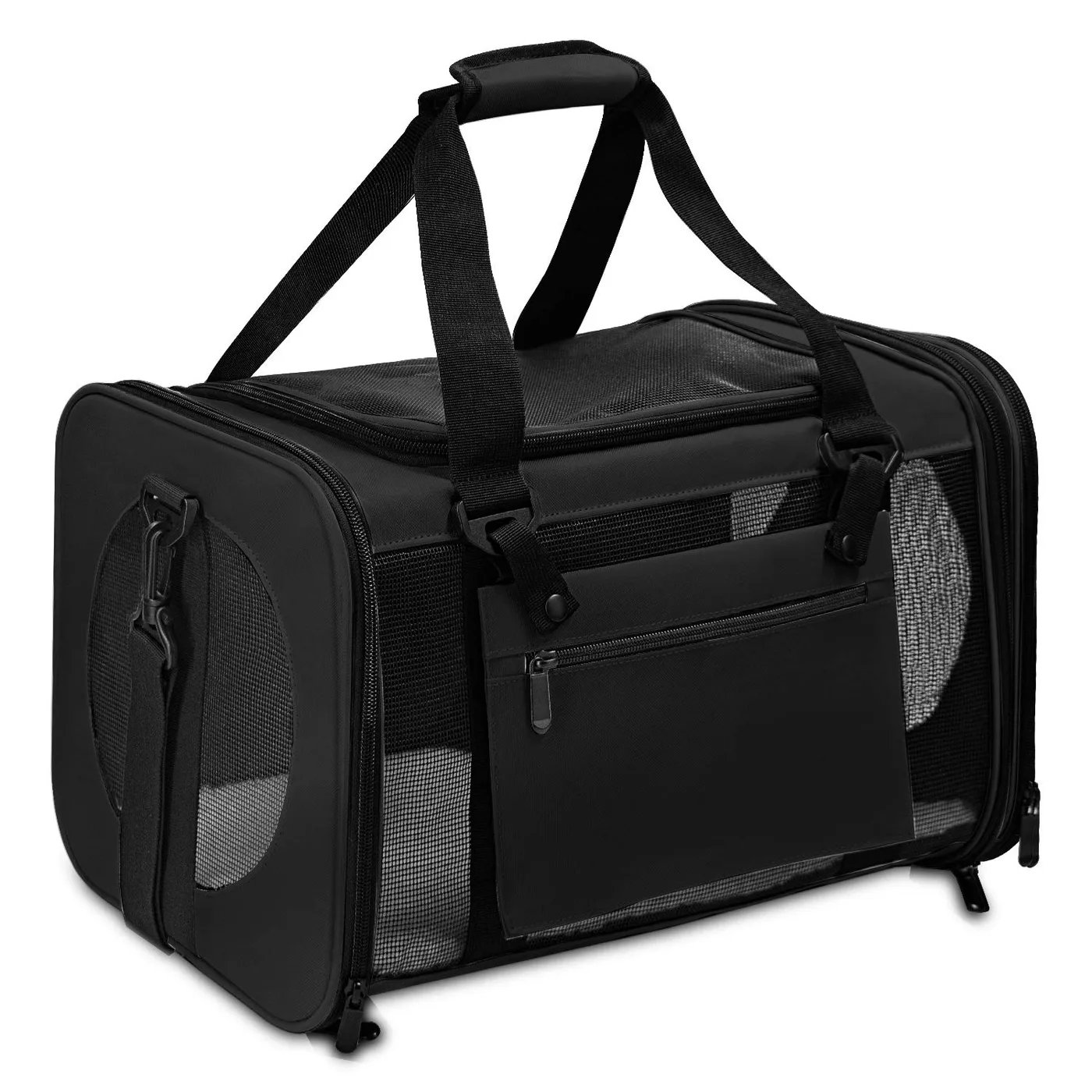
Cutting Marker, Sewing Sequence and Carton-Packing Efficiency
Soft-sided cost is dominated by fabric yield and sewing minutes, and both are set by the pattern rather than by the wage rate. A marker that nests the base panel against the wall panels efficiently can save several percent of fabric on a medium body, which is more than most buyers negotiate off the price in a season. Ask the supplier for the marker utilisation figure; a competent one knows it and an evasive answer is informative.
Seam count is the second lever. Every seam is sewing minutes, thread, and a potential failure point. A body that can be built from a single wrapped panel with one closure seam costs less and fails less than the same bag assembled from eight pieces, and it usually looks cleaner on a shelf as well. When two designs are otherwise comparable, prefer the one with fewer pattern pieces and ask why the other one needs more.
Symmetry helps both cutting and sewing. A body that is left-right symmetric can be cut in pairs and assembled without orientation checks, which reduces operator error and speeds the line. Asymmetric designs with a shaped front door or an offset pocket are fine at low volume and become a quality problem at high volume, because every orientation mistake becomes a defect.
Packing efficiency should be specified, not delegated. State the folding method, the folding sequence, whether the base board ships installed or flat, the polybag gauge and the carton fill. Then require a photograph of a finished carton before the bulk run starts. A carton packed by an unsupervised line will always be looser than the one packed for the photograph, and the gap shows up as freight.
There is a quality dividend too. A defined folding method prevents crease damage in transit, keeps the corners from being crushed by strap tension, and means the bag arrives looking like the sample. Bags that arrive creased generate complaints that have nothing to do with how well they were sewn.
Planning note: Request marker utilisation, pattern-piece count and a carton-loading photograph, because yield, sewing minutes and packing density drive the price more than labour rates do.
Where Soft Bodies Win on Freight and Lose on Shelf
The freight case is straightforward and large. A collapsible body ships several times more units per container than a moulded equivalent, stores in a fraction of the warehouse space, and can be held as flat inventory rather than as assembled volume. For a business paying for cubic metres at every stage, that advantage compounds from the factory to the distribution centre to the stockroom.
The shelf case is the reverse and it is worth being honest about. An assembled rigid shell looks purposeful under retail lighting; a soft body needs help. Without sufficient stiffness at the base and walls it photographs as a drooping sack, and the shopper reads drooping as cheap. This is why the stiffness gradient described earlier is a merchandising specification as much as an engineering one.
The remedy is a display insert, and it should be costed as part of the product rather than discovered at the planogram stage. A recycled pulp former, a fold-flat card ring or a defined tissue fill each hold the retail shape, and each has a different labour implication at the distribution centre. Decide which one the channel will actually use, because an insert that store staff will not install is money spent on nothing.
Photography carries more weight for soft bodies than for any other format in the category. Shoot the bag stuffed and unstuffed, shoot the fold, and shoot the interior floor with a measuring tape visible. The unstuffed shot answers the online shopper's real question, which is whether the bag will hold its shape on the first morning and every morning after that.
Placement in the range matters as well. A soft body sits naturally beside other carry formats such as the pet shoulder bag family and the duffel-style pet bag range, and cross-linking those listings keeps the comparison inside the assortment rather than sending the shopper to a competitor.
Planning note: Bank the freight saving, then spend a small part of it on an insert and on photography, because those two items are what stop a collapsible bag reading as cheap.
Inspection Points Unique to Flexible Construction
A soft body fails differently from a sewn handbag, so a borrowed checklist misses the failures that matter. The distinctive risks are stiffness loss, seam creep at the base-to-wall transition, zipper tracking around a curved aperture, and distortion after compressed packing. Each is measurable and each should appear on the worksheet given to the inspector.
Stiffness is checked by comparison against the sealed golden sample rather than by a number, because field measurement is impractical. The inspector assembles the unit, stands it, and looks for base sag and wall bow against the reference. Where a number is wanted, a simple deflection gauge under a 5 kg load is enough and takes seconds per unit.
Seam creep shows up as a base panel that has started to pull away from the wall, usually first at the corners where the load concentrates. Look for stitch elongation, lining tension and any visible gap at the binding. This failure is progressive, so catching it at incoming inspection matters more than catching it at pre-shipment, by which point every unit has already been assembled.
Zipper tracking around a curved opening deserves a specific check. Run the slider through its full travel three times on a sample from each carton and note any point where the teeth separate behind the slider or where the tape binds. A zipper that tracks badly when new will fail quickly in service, and it is one of the most common causes of early returns on soft-sided products.
Compression recovery should be verified after transit simulation. Pack a carton, strap it, leave it for twenty-four hours, unpack and measure whether the bag returns to its stated assembled height within an agreed tolerance. That single test catches foam that is too soft, packing that is too tight, and interlining that was substituted after the sample was approved.
Reference the methods so the criteria are not subjective. Fabric behaviour and care performance are commonly discussed against AATCC test methods, and process and documentation control against ISO 9001 quality-management requirements. Naming the method removes the argument about whose opinion applies.
Planning note: Give the inspector four soft-specific checks - stiffness against the golden sample, seam creep at the corners, zipper tracking and post-compression recovery - alongside the standard AQL 2.5 worksheet.
Assortment Planning Across a Soft-Sided Range
Flexibility invites proliferation, and proliferation is how soft-sided ranges lose money. Because a new colour or a new size costs no tooling, the temptation is to approve every variant the buying team likes. Every variant nevertheless consumes a 500-piece minimum, a forecast line and a warehouse slot, and the variants that fail do so at full landed cost. Cap the first season deliberately.
A workable opening ladder is two sizes and three colours, with the medium size and the neutral colour taking the largest share. Size curves on soft carry products are usually heavily skewed: the medium takes half or more of the units, the small takes the impulse share, and the large is a slow mover that exists mainly to make the range look complete. Plan the buy against that curve rather than splitting evenly.
Colour should be managed by depth, not by count. A neutral that sells every quarter at full depth beats four fashion shades at quarter depth, because the fashion shades generate the markdowns and the neutral generates the reorder. Where a seasonal shade is wanted, put it in the smallest size, where the absolute exposure is lowest and the impulse purchase rate is highest.
Reorder timing follows from the calendar. Samples take 6-10 working days and bulk 35-50 days after approval, so a seasonal reorder has to be decided while there are still several weeks of cover and while the fabric is still available. Confirm fabric continuity at the time of the first order; a shade that has to be re-dyed will not fit the 35-50 day window on a second run.
Finally, review the range on stiffness complaints rather than on units alone. If returns mention sagging, the answer is a stiffer interlining, not a discount. If returns mention bulk or weight, the answer is a lighter wall, not a new colour. Reading the return language correctly is what makes the second season cheaper than the first.
Planning note: Cap the first season at two sizes and three colours, buy to a skewed size curve, and revise the range using return language rather than sales volume alone.
Why brands source here
- Pet bag programmes run since 2014; founding team in sewn goods since 2004
- SGS-verified production floor of 4,950 m² with 137 workers across 7 lines
- Monthly capacity of 200,000 units, audited to BSCI and ISO 9001
People Also Ask
What is a soft-sided pet bag?
It is a frameless carry bag whose shape comes entirely from the fabric system - interlining, foam lamination and a base board - rather than from a moulded shell or a metal frame.
Why buy soft-sided instead of a hard shell?
It collapses, so it ships and stores in a fraction of the volume, costs no tooling to revise, and can be repaired in the field. The trade-off is shelf presence, which has to be bought back with stiffness and a display insert.
How do I measure how flat a pet bag folds?
Divide the folded height by the assembled height after twenty-four hours under a defined distributed load. The delayed reading is the honest one, because foam laminations creep.
What makes a soft pet bag sag?
Insufficient stiffness at the base, or a foam lamination that has broken down after repeated compression. Both are specification failures rather than fabric failures and both are visible in a sample.
Are soft-sided pet bags machine washable?
The liner usually is and the body usually is not. Specify a removable liner with its own care label and its own spare-part availability, and most soiling complaints become a laundry cycle instead of a return.
How much freight can better folding save?
Often more than price negotiation. Moving a medium model from roughly 1,150 to 2,000 units per 40-foot high-cube changes landed cost per unit by far more than a USD 0.30 saving on the ex-works price.
Do soft-sided bags hold their shape after shipping?
They should, if the interlining is specified correctly and the carton is packed to a defined method. Verify with a transit simulation: pack, strap, wait twenty-four hours, unpack and measure the recovered height.
Frequently Asked Questions
How small does a soft-sided pet bag actually fold for freight purposes?
Measure it rather than trust the photograph. A well-designed medium body reaches a collapse ratio around 0.32-0.40 after twenty-four hours under load; a foam-laminated wall construction typically settles nearer 0.50-0.55. That difference is freight money on every container.
What is the MOQ for a soft-sided pet bag programme?
The opening minimum is 500 pieces per colorway. Because no tooling is required, that minimum is genuinely low, but each additional size or shade still consumes a forecast line and a warehouse slot, so cap the first season deliberately.
How is stiffness specified so a supplier cannot substitute a cheaper interlining?
Specify behaviour instead of a fabric name: base deflection under a load, wall recovery after a squeeze, and mouth closure force. Seal a golden sample and a swatch set, then require the production run to match both.
Should the base board be removable?
Usually yes. A removable board in a sleeve improves the collapse ratio by roughly 15-20 percent because the stiffest element ships flat, and it can be replaced in the field rather than condemning the whole bag.
Can soft-sided pet bags be repaired rather than replaced?
Yes, and that is a commercial advantage over moulded formats. Design for it with a removable board, a replaceable zipper slider and an accessible strap attachment, then decide who stocks the spare parts before launch.
How long do samples and bulk production take?
Samples take 6-10 working days from a frozen specification. Bulk runs 35-50 days after final sample approval, provided the fabric is available; a shade that has to be re-dyed sits outside that window.
Which inspection standard applies?
Pre-shipment acceptance runs at AQL 2.5 with a soft-specific worksheet: stiffness against the golden sample, seam creep at the base corners, zipper tracking around the aperture, and height recovery after simulated transit compression.
How many units fit a container?
Depends entirely on the collapse ratio and the packing method. A medium body at 0.032 cubic metres per unit reaches roughly 2,000-2,150 units per 40-foot high-cube; the same body at 0.055 reaches about 1,150-1,250. Confirm the carton cube before comparing quotations.
Why do soft-sided bags look droopy in stores?
Because nothing is holding them up. Budget for a display insert - a pulp former, a fold-flat card ring or a defined tissue fill - and specify it as a line item rather than discovering the problem at the planogram stage.
Are fabric test reports needed for the destination market?
Usually. Expect substance declarations matched to the market, commonly REACH or CPSIA statements, and frequently OEKO-TEX documentation for the face fabric. Confirm the scope at quotation stage because laboratory time affects both cost and calendar.
How should the range be split between sizes and colours?
Two sizes and three colours for a first season, bought to a skewed curve with the medium size and the neutral shade taking the largest share. Fashion shades belong in the smallest size, where exposure is lowest.
What payment and Incoterm baseline is used?
T/T 30/70 against FOB Xiamen. Hold the Incoterm constant across competing quotations, otherwise origin charges and freight will distort what looks like a unit-price difference.
Can a soft-sided line be revised between seasons?
Yes, and cheaply, which is the main argument for making it the volume driver of a range. Colour, trim and interlining can all change without capital spend, provided the pattern does not need re-engineering.
What is the working pet weight range?
Roughly 2-10 kg. Below that a sling format suits better; above it the fabric system has to be stiff enough that the logistics advantage over a moulded base largely disappears.
Talk to QUANZHOU JUNYUAN BAGS about a wholesale pet bag order: MOQ 500 pieces per colourway, samples in 6-10 working days, bulk production in 35-50 days under AQL 2.5 inspection.
Get a free quote Request a sample