Source Pet Bags From China: A Buyer's Sequence
The sequence that works runs to seven stages and 95-120 calendar days from specification freeze to vessel departure, and the same work done out of order runs to 150-plus. Every stage skipped forwards reappears later as a re-sample costing 15-20 days. Start with a written spec, not with a supplier list.
Most failed pet bag programmes did not fail on price or on quality; they failed on ordering. A buyer who requests quotes before freezing a specification gets three quotes for three different products, then spends a month discovering it. A buyer who commissions samples before agreeing commercial terms discovers the price they budgeted does not exist. The sequence below is the order in which decisions can still be reversed cheaply, and it is the order our production team sees succeed repeatedly: specification freeze, supply-base mapping, RFQ pack, sample rounds, commercial closure, bulk under inspection gates, then post-shipment review. Volume commitments are set at MOQ 500 pieces per colourway, with samples in 6-10 working days, bulk production 35-50 days after sample approval and release at AQL 2.5. Those four numbers are only meaningful in sequence, because the 35-50 day bulk clock does not start until the sample is signed off, and the sample clock does not start until the specification stops moving. Buyers who compress the early stages to save two weeks routinely lose six at the back end. The sequence also decides who holds the leverage. A buyer who arrives with a frozen specification and a signed sample negotiates a known product; one who arrives with a vague brief negotiates hope, and hope is priced accordingly.
Pet bag sample cost is normally credited against the first production order, which makes Market & Business Strategy review the expensive step rather than the sampling itself. Pet carrier sample cost rises with hardware changes, so lock the hardware before the second sample round.
Why Order of Operations Decides the Outcome Before Any Supplier Does
Sourcing is usually described as a search problem, which is why buyers spend their early weeks searching. It is closer to a scheduling problem. Two buyers can approach the same group of pet bag manufacturers in China with the same budget and the same product idea, and the one who sequences decisions correctly will land a sellable range four to six weeks sooner. Buyers who source pet bags from China on sequence rather than on speed consistently spend less time firefighting, because the early stages are where correction is still a document edit rather than a production change.
The mechanism is simple once stated. Each stage produces the input the next stage needs, which is why buyers who source pet bags from China successfully tend to describe the work as dull. A specification produces a comparable quote. A comparable quote produces a meaningful sample request. A signed sample produces a bulk order that can be scheduled. When a stage is started without its input, it does not simply proceed badly; it produces output that has to be discarded, and discarding costs calendar time that cannot be bought back with money. Freight can be upgraded for a fee. A re-sample round cannot.
This is also why the visible price of a programme is a poor guide to its true cost. Two quotes for the same bag can differ by 6%, and that difference is recoverable in negotiation over a quarter. Three weeks lost to an unnecessary sample round at the start of a season is not recoverable at any price, because the retail window has moved. Sequence risk and price risk are not the same size, and they are rarely managed with the same attention.
| Stage | Calendar days | Output produced | Gate that must pass |
|---|---|---|---|
| 1. Specification freeze | 7-10 | Written tech pack and Bill of Materials | Internal sign-off on every measurable |
| 2. Supply-base mapping | 5-8 | Longlist of 10-15 candidates | Category fit, not search visibility |
| 3. RFQ pack | 10-14 | Comparable quotes on one spec | Three quotes on identical inputs |
| 4. Sample rounds | 18-30 | Approved golden sample | Signed sample retained by both sides |
| 5. Commercial closure | 3-5 | Signed order, deposit paid | Terms, Incoterm, payment schedule agreed |
| 6. Bulk production | 35-50 | Finished goods, inspected | AQL 2.5 release, packing verified |
| 7. Post-shipment review | 5-7 | Scorecard and re-order trigger | Variance against plan recorded |
The table is a planning instrument, not a promise. Days overlap where they can: supply-base mapping can run while the specification is finalised, and commercial terms can be discussed while samples are in transit. The value of writing it down is that slippage becomes visible as a number rather than as a feeling. A programme that is ten days late at stage three is a different problem from one that is ten days late at stage six, and only a written sequence tells you which.
Order of operations is the cheapest quality control available to an importer, and it costs nothing but discipline.
Stage One: Freeze the Specification Before You Contact Anyone
The specification freeze is the least glamorous stage and the one that determines everything downstream. It means committing, in writing, to fabric denier and construction, hardware finish, dimensions with tolerance, colour standard, closure type, ventilation method, load rating, labelling and packing. Every one of those items will change during a programme; the point of freezing is that they change through a revision record rather than through a misunderstanding.
Buyers resist this because it feels slow and because it forces decisions they would rather defer to a supplier. That deferral is expensive. When a supplier is asked to price a bag without a fabric specification, the honest ones ask and the rest assume, and the assumption is always towards the cheaper construction. The resulting quotes are not comparable, they are three answers to three different questions, and the apparent spread between them disappears the moment the spec is fixed.
A workable tech pack for a pet bag does not need to be an engineering drawing. It needs a dimensioned sketch, a materials list with grades, a construction note for the stress points, a colour reference with a standard (a Pantone reference or a physical swatch, not a photograph, because screens lie about colour), and a packing specification. The material choice deserves its own pass before the pack is frozen, and the trade-offs across shell fabrics, linings and mesh are set out in the pet bag materials reference. Our production team can quote from that in days; no supplier can quote meaningfully from a mood board.
The one item most often left out is tolerance. Stating a length as 45 cm is incomplete without stating what range is acceptable, and the absence of a tolerance is the single most common cause of a rejected shipment that both sides believe was made correctly. Write the tolerance at specification stage and the argument never happens.
Also worth deciding at this point is what is allowed to change later. Decide now whether a hardware substitution is acceptable without re-approval, because deciding during bulk production means either stopping the line or accepting an unapproved change.
A specification that has been frozen once and revised twice is worth more than a specification that was never frozen and was clarified forty times by email.
Stage Two: Map the Supply Base by Product Category Rather Than by Search Rank
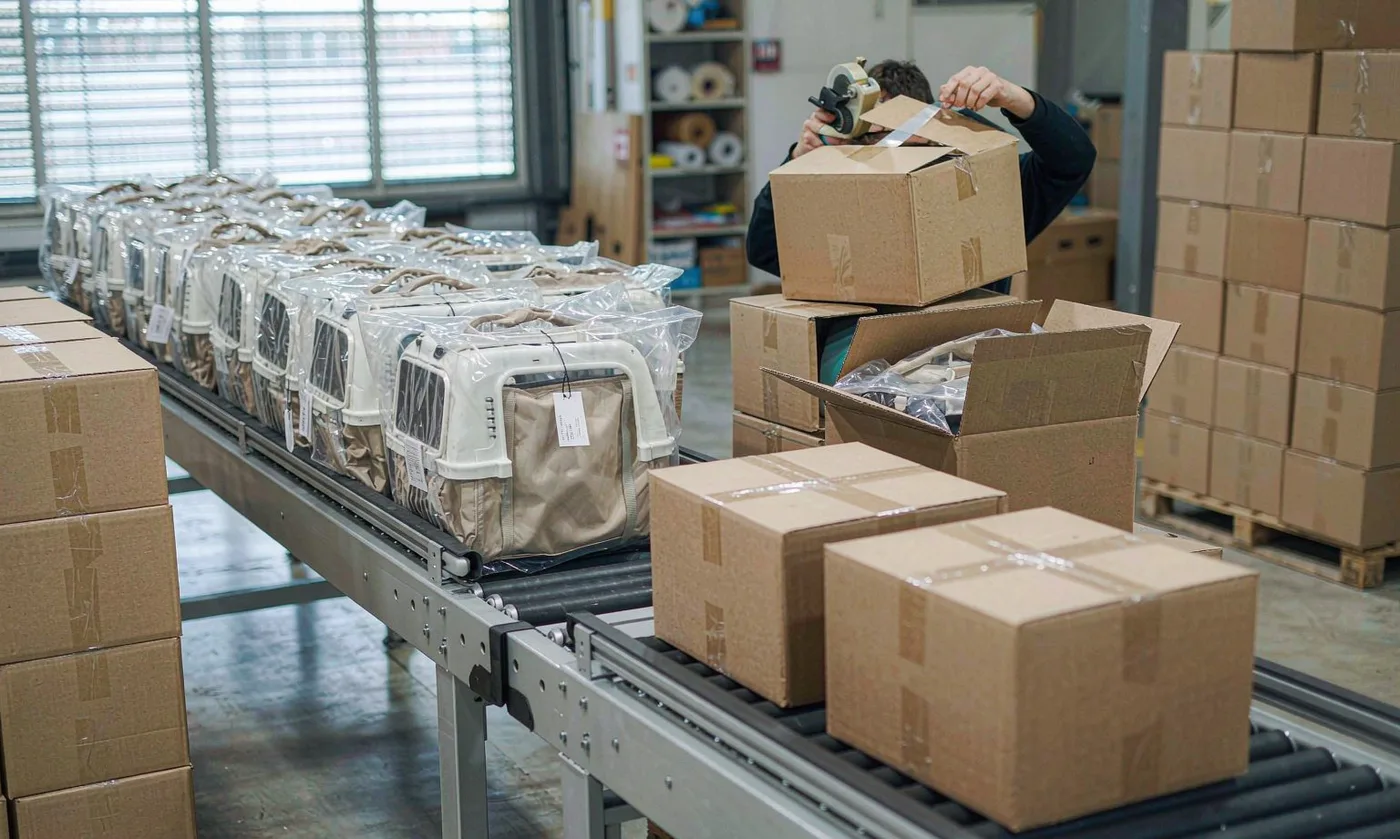
After the specification comes the map, and the map is built by product category rather than by platform visibility. Pet bag wholesale suppliers cluster by what they actually run on their lines: soft-sided carriers, structured travel bags, backpacks with ventilation panels, rolling formats with a frame, slings and leg-out designs. A supplier whose catalogue shows depth in one of those families is a better candidate than one whose catalogue shows a shallow row of everything, because catalogue breadth is easy to photograph and line capability is not.
The practical method is a longlist of ten to fifteen candidates assembled from four sources: category-specific trade fairs, trade flow data that shows who is actually shipping, referrals from a freight forwarder or an inspection company, and platform searches filtered by product rather than by keyword. Platform rank is a paid position and correlates with marketing spend, not with capability, and it should be treated as a discovery tool rather than a filter. The pet bag wholesale suppliers worth shortlisting are usually found through category fairs, freight and inspection referrals, and trade flow, not through the top of a search page.
Geography helps because production clusters by material. Quanzhou and the wider Fujian corridor has deep capability in soft bags and travel goods, which is why pet bag manufacturers in China concentrate there alongside Zhejiang and Guangdong facilities that serve different material mixes. Knowing the cluster tells you what a candidate is likely to be genuinely good at before you ask.
At mapping stage the only question worth asking a candidate is whether they run the category at volume. Most pet bag wholesale vendors will say yes; the useful answer is a number. Ask for the product families produced in the last twelve months and the share each represents. A supplier for whom pet bags are 8% of output will treat a bulk pet bag order as an interruption; one for whom they are 40% will treat it as a programme. That share number predicts behaviour better than any certificate.
The longlist should be recorded with a reason for inclusion next to each name. Reasons decay, and a list without reasons cannot be defended to a colleague six weeks later when someone asks why a candidate was dropped.
Map by what a production line does every day, and the shortlist nearly writes itself.
Stage Three: Issue an RFQ Pack That Does the Filtering for You
An RFQ pack is a filter disguised as a request. It should contain the full specification, target quantity by colourway, requested Incoterm and port, target delivery window, compliance requirements by destination market, packing and labelling requirements, and a fixed deadline for response with a named contact. If any of those are missing, the responses will diverge in that dimension and the comparison will be invalid.
Quantity should be stated as a range with a committed first-order figure attached, not as an aspiration. Suppliers price against a run length, and a request for a quote on "5,000 to 50,000 units" receives the price for the lower number with a note about the higher one. State the first order, state the annual intent separately, and ask for both prices. The difference between them is the volume leverage in the programme, and it is worth knowing at quote stage rather than discovering it at re-order.
Compliance requirements belong in the RFQ, not in a later email. If the destination market requires chemical documentation for the fabric, a test report for the coating, or specific labelling, say so now and ask the supplier to confirm in writing that the quoted construction already meets it. A supplier who confirms and later cannot produce the file has given you a written position; one who was never asked has given you nothing. The EU chemical regime administered by ECHA and US consumer product rules enforced by the Consumer Product Safety Commission both apply to textile pet articles, and the cost of compliance sits inside the unit price where it belongs.
Response behaviour is data. Track how long each candidate takes, whether they answer the questions asked or answer the ones they would prefer, and whether they quote the specification as written or quietly substitute. Pet bag wholesale vendors who substitute without flagging it have told you how they will behave in bulk at no cost to you.
Ask for the quote in a standard structure: unit price by quantity band, surcharges itemised separately, tooling or setup costs stated explicitly, sample cost and whether it is credited against bulk, and validity period. The pet bag wholesale price is only comparable once all five are present, and it is easier to standardise later than to reconcile five formats now.
The RFQ pack is the last free filter in the programme; everything after it costs money to run.
Stage Four: Treat Sample Rounds as a Capability Test
Sampling is where most programmes lose their schedule, and almost always for the same reason: the buyer treats the sample as a product to approve rather than as evidence about the supplier. Those are different questions. A sample that looks acceptable tells you the design is plausible; a sample that arrives on the date promised, made to the specification as written, with the correction notes from the previous round applied, tells you the supplier can run your bulk pet bag orders.
Score the round on four observables. Did it arrive within the stated window? Did it match the written specification on the measurable items? Were the previous round's corrections applied completely? Did it come with the documentation you asked for? A beautiful sample delivered nine days late with two of four corrections missed is a worse signal than a mediocre one delivered on time with all notes applied, because the first indicates a capacity or process problem and the second indicates a specification problem you can fix with a sentence.
Keep a written golden sample, signed and dated, retained by both sides. Every subsequent dispute about shade, stitch density or hardware finish resolves against that object in about ninety seconds, and without it the same dispute consumes a week of email. Photographs are not a substitute; they flatten colour and hide hand-feel.
Revision cost should be understood before the second round starts, because each round consumes 6-10 working days of sample-making plus transit, and the pattern-cutting change behind a dimension correction is not free. Ask what a change to each element costs in time and money before requesting it, and bundle corrections into one round rather than issuing them in a stream. A buyer who sends four separate revision notes over three weeks has chosen to spend an extra month.
Approve in writing, with the approval tied to the sample's identifying details. A verbal approval on a call is not a record, and the difference shows up when the bulk arrives slightly different and nobody can say what was agreed.
Sampling is the cheapest place to discover that a supplier cannot do the work, and it is the last place where discovering it costs only time.
Stage Five: Lock Commercial Terms at the Deposit Gate
Commercial closure is short and should be treated as a gate rather than a negotiation. Six items have to be settled before a deposit moves: unit price by quantity band, Incoterm and named port, payment schedule, lead time measured from a defined trigger, inspection standard and who pays for it, and the consequence of a failed inspection. Settling five of the six and assuming the sixth is settling nothing.
The standard structure in this category is T/T with 30% deposit and 70% against a copy of the bill of lading, quoted FOB Xiamen for sea consolidation. Neither figure is a moral position; both are risk allocations, and the reasoning behind each is set out in the guide to pet bag payment terms. The deposit covers material commitment, which is real and front-loaded, and the balance at document stage protects the buyer while goods are still controllable. Payment terms that differ sharply from this pattern deserve a question about why, in either direction.
Lead time must be defined by its trigger. "35-50 days" is only meaningful if both sides agree it starts at written sample approval and deposit receipt rather than at order placement, and the difference between those two definitions can be three weeks. Write the trigger next to the number. This is also the point to agree what happens to the schedule if the buyer's approval slips, because one party holding the calendar while the other holds the decision is how schedules quietly fail.
Inspection belongs in the terms, not in an afterthought email. Agree the standard, the sampling level and the remedy: rework at supplier cost, re-inspection at supplier cost, or a price adjustment. Agreeing the remedy before there is a dispute costs nothing; agreeing it during one costs the relationship. The internationally used acceptance quality limit framework published through ISO gives both sides a common vocabulary, which is the whole point of using it.
Currency and validity close the list. Fix the currency, fix the quote validity period, and state what happens to the pet bag wholesale price if raw material costs move beyond a stated band before the order is placed.
A signed order with six clear clauses prevents more disputes than a twelve-page contract with six ambiguous ones.
Stage Six: Run Bulk Against Inspection Gates Rather Than Promise Dates
Once the deposit clears, the useful management instrument is not a date but a set of gates. Bulk production for pet bags runs 35-50 days from approval, and inside that window there are four points where intervention is still cheap: material arrival and confirmation, first-off production, mid-run at roughly 30% completion, and final pre-shipment inspection. A buyer who only looks at the end date has given up three of those four chances.
Material confirmation is the most neglected and the most valuable. Ask for confirmation that the fabric, hardware and trim that arrived match what was approved, before cutting starts. A substitution caught at material stage costs a delay; the same substitution caught at final inspection costs the whole run. Ask for a photograph of the roll labels and the hardware against the approved sample.
The first-off check catches construction drift early. Two or three pieces off the line, photographed against the golden sample with measurements stated, will reveal whether the specification survived the transfer from sample room to floor. This is where a pet bag moq conversation is also settled in practice: the run length committed determines whether the line is set up once and left alone, and short runs invite more changeovers and more variance. The pet bag moq is not a number the supplier invented to be difficult, it is the volume at which that variance stops being paid for twice.
Mid-run at 30% completion is the point where a schedule problem is still fixable. If 30% is due on day 15 and only 12% is done, the arithmetic of the remaining days tells you the true completion date, and you learn it with 35 days of options rather than with five. Ask for a count, not an assurance.
Final inspection at AQL 2.5 should cover appearance, construction, function and packing, and packing deserves more attention than it usually gets. Carton strength, quantity per carton, marking accuracy and moisture protection are the failure modes that produce claims weeks after delivery and long after the inspection report was filed.
Manage bulk by gates and the date takes care of itself; manage by date and every gate arrives as a surprise.
Stage Seven: Close the Loop With a Post-Shipment Review
The stage almost everyone skips is the one that makes the second order cheaper than the first. Within a week of delivery, write down what actually happened: final unit cost against quote, actual days against planned days at each stage, defect rate observed at inspection and any claims received, documentation completeness, and the three things that would be done differently. Five numbers and three sentences.
The point is not administration, it is accumulation. A buyer who runs the same programme twice without a record negotiates the second one from memory, and memory favours the buyer's own reasoning and forgets the supplier's constraints. A buyer with a one-page record negotiates from evidence, and evidence is what moves a price band or a lead time commitment.
The review should also produce a re-order trigger, decided while the information is fresh rather than when stock runs low. Set the trigger as a stock cover threshold or a date, tie it to the seasonal calendar, and the next cycle starts at stage three instead of stage one, because the specification already exists and only needs revision. Programmes that re-order from a frozen specification with a revision record take roughly half the elapsed time of the first cycle.
Set the trigger against seasonality, not against stock alone. Pet bag demand has a visible seasonal shape, and an order triggered purely by a stock threshold will arrive after the window if the lead time is not counted backwards from the selling period. Read the seasonal pattern on wholesale pet bag demand seasonality and count backwards from the selling week rather than forwards from today.
Finally, feed the review back to the supplier in one paragraph. Telling a supplier what went well and what did not, in specific terms, is the cheapest investment available in how the next order is treated.
The first order buys product; the review buys the second order's terms.
Where Buyers Compress the Sequence and What It Costs Them
Three compressions account for most schedule damage, and all three feel like efficiency at the time. The first is quoting before the specification is frozen. It produces a spread of prices that looks like negotiating room and is actually noise, and the real negotiation starts only after the spec is fixed, which means the elapsed time was spent twice.
The second is sampling before commercial terms are discussed. A sample built to a price point that was never agreed is a sample that will be re-quoted, and re-quoting after approval puts the buyer in the weakest possible position: the design is liked, the sample exists, and the number has moved. Discuss the band before the sample, not after it.
The third is treating the production window as a countdown rather than as a set of gates. A buyer who hears "35-50 days" and diarises day 42 has no view of whether the run is on track until it is too late to act. The same buyer asking for a mid-run count has a fortnight of options.
None of these are mistakes of intelligence; they are mistakes of ordering, which is precisely why they are preventable. Any buying entity that works through the sequence in order, at MOQ 500 pieces per colourway on a frozen specification, is the one whose bulk pet bag orders land inside the retail window rather than just inside the year. The brand owner who skips the sequence is not saving time; they are borrowing it at a very high rate.
The sequence costs discipline and nothing else; ignoring it costs the season.
Why brands source here
- Pet bag programmes run since 2014; founding team in sewn goods since 2004
- SGS-verified production floor of 4,950 m² with 137 workers across 7 lines
- Monthly capacity of 200,000 units, audited to BSCI and ISO 9001
People Also Ask
How long does it take to source pet bags from China?
A well-run first programme takes 95-120 calendar days from specification freeze to vessel departure, of which bulk production accounts for 35-50 days. Programmes that start sampling before the specification is frozen typically run 30-50 days longer because of an extra revision round.
What is the first step when sourcing pet bags from China?
Freeze a written specification before contacting any supplier. A dimensioned sketch, materials list with grades, colour standard, tolerances and packing spec make quotes comparable; without one, each supplier prices a different product.
How many suppliers should I contact for a pet bag programme?
Build a longlist of 10-15 candidates mapped by product category, then send a full RFQ pack to all of them and shortlist on response quality. Three comparable quotes on an identical specification is the practical minimum.
When should I pay a deposit for a bulk pet bag order?
After written sample approval and after the six commercial items are settled: price band, Incoterm and port, payment schedule, lead time trigger, inspection standard and remedy for failure. T/T 30/70 is the common structure.
Can I skip the sample stage to save time?
No. Sampling is the cheapest point at which to discover a supplier cannot execute, and skipping it moves that discovery into bulk where it costs the run. Two disciplined rounds are faster than one undisciplined round plus a re-run.
What causes most delays in pet bag sourcing programmes?
Out-of-order staging. Quoting before a spec freeze, sampling before commercial terms, and managing bulk by promise date instead of by material, first-off, mid-run and final inspection gates account for most slippage.
Frequently Asked Questions
What does a pet bag specification need to include?
A dimensioned sketch, fabric denier and construction, hardware finish, colour reference with standard, closure and ventilation method, load rating, tolerances on every measurable, labelling and packing. Tolerances are the item most often omitted and the one that causes most rejected shipments.
Which Incoterm should I use for pet bags from China?
FOB with a named Chinese port, commonly Xiamen, is the practical default for sea consolidation because it keeps the buyer in control of the main carriage while the supplier handles export formalities and loading. CIF and DDP shift control and should be compared on total landed cost, not on headline freight.
How is the bulk production lead time measured?
From written sample approval and receipt of deposit, not from order placement. Agreeing the trigger in writing prevents a three-week gap between what the buyer expects and what the supplier planned, since material booking starts only after both.
What is AQL 2.5 and why is it used for pet bags?
AQL 2.5 is an acceptance quality limit: the defect threshold at which a shipment is accepted or rejected under a defined sampling plan. It is used because it gives buyer and supplier one shared numeric standard instead of a subjective judgement on the day.
Should compliance documents be requested at quote stage?
Yes. Ask in the RFQ whether the quoted construction already meets the destination market's chemical and labelling rules and get written confirmation. A supplier who confirms and cannot later produce the file has given you a documented position to work from.
How do I compare quotes from different pet bag wholesale vendors?
Request a standard structure: unit price by quantity band, itemised surcharges, explicit tooling and setup costs, sample cost and credit terms, and a validity period. Reconcile onto one format before comparing, because differences in packing and compliance inclusion distort headline prices.
What should a post-shipment review record?
Final unit cost against quote, actual days against planned days per stage, defect rate at inspection and any claims, documentation completeness, and three changes for next time. Feed one paragraph back to the supplier and set a re-order trigger while the data is fresh.
How does seasonality change the sourcing calendar?
Count backwards from the selling week rather than forwards from today. With 35-50 days of bulk plus 18-30 days of sampling plus transit, an order triggered by a stock threshold alone will routinely arrive after the retail window has opened.
Is a smaller first order safer for a new programme?
A smaller first order reduces cash exposure but not risk, because the same specification and sample work is required either way. A run at MOQ 500 pieces per colourway usually buys a more stable line setup and a more reliable schedule than a token quantity.
How often should a specification be revised?
Through a written revision record, not through email clarification. Revisions are normal; unrecorded revisions are the problem. Each revision should state what changed, when, and whether it affects cost, lead time or compliance.
What role does a sourcing agent play in this sequence?
A sourcing agent can compress stages two and three by mapping candidates and standardising quotes, but the buyer still owns the specification freeze and the approval gate. Outsourcing search does not outsource the decisions that determine the outcome.
How do I protect an own-brand design during sourcing?
Use an NDA before sharing a full tech pack, keep the golden sample and revision record under your control, and register design rights in the destination market before the first bulk shipment. Discuss tooling ownership explicitly, since tooling paid for but not owned can be reused.
Talk to QUANZHOU JUNYUAN BAGS about a wholesale pet bag order: MOQ 500 pieces per colourway, samples in 6-10 working days, bulk production in 35-50 days under AQL 2.5 inspection.
Get a free quote Request a sample