Pet Front Pack: Chest Carrier
A pet front pack holds the animal against the wearer's chest rather than the back, and a wholesale programme should cap that job at 6.5 kg, order at MOQ 500 per colour and budget FOB Xiamen at USD 7.10-12.40 a piece. Price inside that band is set by how much structure sits under the sternum panel, how wide the chest webbing runs, and how quickly one hand can close the top.
Front-worn units look simple on a sample table and then fail in the street, because the whole load hangs forward of the spine and the wearer has no way to shift it. The build described here puts a semi-rigid sternum panel under the animal, runs a 38-45 mm crossed webbing system across the upper back, and finishes with a drawcord-plus-buckle top that closes with one hand in roughly four seconds. That is the combination that keeps a short urban trip comfortable instead of tiring.
Order arithmetic is fixed before artwork starts. MOQ 500 per colour is the entry point, prototypes leave the bench 6-10 working days after the tech pack is frozen, and bulk runs 35-50 days from the moment the last sample, fabric and print file are signed. Acceptance sits at AQL 2.5 on a front-specific defect list, payment is T/T 30/70, and pricing is FOB Xiamen. Our production team schedules through an SGS-verified production base and partner facilities, and every slot is held by deposit plus approved materials rather than by a verbal promise.
First buy should stay narrow: two sizes in charcoal and oat, then one accent colour once sell-through is visible. Ask for quote, fit data, document scope and carton dimensions in a single package so finance can model landed cost and merchandising can brief stores without a second round of emails.
Pet bag tiered pricing usually breaks at three quantity points, and Pet Bag Types & Styles determines which point is realistic for a first order. Cheap pet carriers wholesale quotes that ignore carton cubage tend to lose their advantage once freight is added, so pet bag unit cost wholesale is the only number worth comparing.
Why Chest Position Rewrites the Load Equation
Moving a load from the back to the front of the body changes the physics before it changes the pattern. On a back-mounted design the spine absorbs part of the mass and the hip complex takes the rest; on a chest-mounted design the mass sits forward of the vertical axis of the body, so the lower back works continuously to keep the torso upright. For a buyer this matters because the failure is not dramatic. Nobody tears a strap. What happens is that a wearer who managed twenty minutes in a fit test reports shoulder burn at forty, and the product collects four-star reviews with the word uncomfortable in the first line.
The measurable counter is the stand-off distance between the animal and the wearer's sternum. Every additional centimetre of horizontal offset multiplies the turning moment the back muscles must resist. A design that measures 22 cm deep will feel subjectively heavier than one at 16 cm even when both carry the same 5 kg pet, and no amount of extra padding fixes that. When you review drawings, ask the supplier for the loaded horizontal offset at the centre of mass, not just the flat dimensions of the shell.
Second counter is contact area over the sternum panel. A narrow bag that presses on a 10 cm strip of ribcage produces a pressure complaint; the same mass spread over a 22 cm panel reads as support. This is why chest units benefit from a wide, slightly curved back-of-bag board rather than from thicker foam alone. Foam compresses and the contact patch shrinks; a shaped board holds the patch open.
Third counter is a sternum strap on the wearer's side. A crossed harness without a horizontal stabiliser lets the shoulder straps migrate outward, and outward migration is the single most common source of front-carry complaints. A 25 mm horizontal web with a side-squeeze buckle between the two vertical straps costs little and removes most of that variance.
For assortment planning this produces a hard message: chest carry is a short-duration category. Position it at 20-45 minute trips, not at half-day hikes. Retail copy that promises all-day comfort sets an expectation the geometry cannot meet, and the returns land on the merchant rather than on the mill.
Buying rule: cap the marketing story at short urban trips and buy the geometry that makes those trips genuinely easy, rather than padding a shape that fights the wearer's posture from the first step.
One-Handed Loading Is the Specification That Decides Everything
Front carry exists for one behavioural reason: the handler wants one free hand. That dictates the closing system, the entry angle and the internal tether location, and it is the first thing a buyer should test rather than the last. A unit that needs two hands to settle the animal and a third to fasten is simply a small bag worn on the wrong side of the body.
Practical test: hold a 5 kg weight in the left hand, lower it into the shell, and close the top with the right hand only, timed. Under five seconds passes. Five to eight seconds is sellable only if the closure is a single motion. Above eight seconds, the design will lose to a shoulder tote in every side-by-side shopper trial, because the tote has no fastening step at all.
Three closure families reach that target. A drawcord with a cord lock is fastest and cheapest, but it does not stop a determined animal from pushing the neck opening open unless a second element backs it up. A folded collar with two side-squeeze buckles is slower but gives audible confirmation, which retail staff like. A magnetic flap over a drawcord gives the best perceived quality at the highest unit cost and the weakest containment. Most wholesale programmes land on drawcord plus a single central buckle, which is the middle of that triangle.
Entry angle matters just as much as hardware. If the opening faces straight up, the handler must lift the animal over a rim, which is awkward with a squirming pet. If the opening cants 15-20 degrees toward the wearer, the animal slides in from the side under its own weight and the handler only guides. That cant costs one pattern change and nothing in materials.
The internal tether anchor is the last piece. Put it low and toward the wearer so the animal settles against the sternum panel instead of leaning outward and reopening the distance problem discussed above. A tether anchored at the top rim pulls the pet forward and up, which is exactly the wrong vector.
Buying rule: time the one-handed close on the prototype and reject anything slower than five seconds, because no amount of fabric upgrade recovers a shopper who struggled in the store aisle.
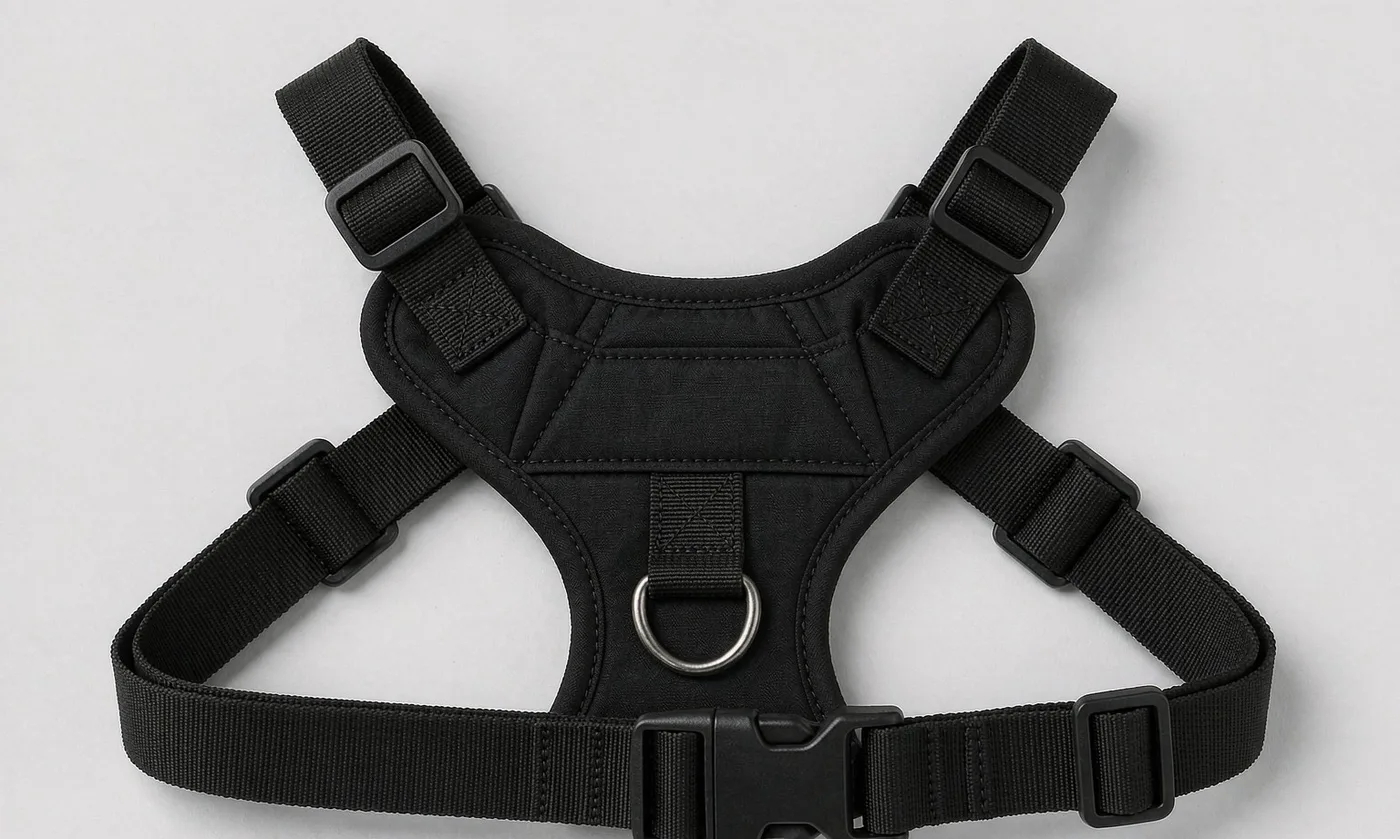
Chest Strap Layout: Cross Point, Buckle Position and Hardware Choice
The harness on a front pack is not decorative webbing; it is the entire load path. Layout decisions here drive both the comfort outcome and the hardware bill, and they are the easiest place for a low quote to hide a downgrade.
Vertical strap width should be 38-45 mm for any unit rated above 4 kg. Below that, the webbing rolls under load and the roll creates a hot line on the trapezius. Widths above 45 mm start to interfere with the wearer's arm swing on a chest-mounted load, so there is a real ceiling. Pair the width with a 4-6 mm closed-cell foam sleeve that is bonded rather than loose, because a loose sleeve migrates and bunches within a season.
Cross point location is the next decision. A high cross, sitting between the shoulder blades, stabilises the load upward but crowds the neck and tends to ride into the wearer's throat when the animal moves. A low cross, at mid-back, leaves the neck free but allows the panel to tilt forward under a wriggling pet. The workable compromise sits one hand-width below the nape, with the crossing webbing stitched to a floating yoke rather than directly to the shell, so the yoke can rotate a few degrees as the animal shifts.
Buckle position follows from the cross point. Front-mounted buckles are fast to reach and easy for retail staff to demonstrate, but they sit under the animal's chin and can pinch. Side-mounted buckles at rib height are kinder to the animal and still reachable, and they are the safer default for a wholesale range. Rear buckles look tidy in a photograph and are useless in practice.
Hardware spec should name metal or acetal, the cycle rating, and the pull value at temperature extremes. Acetal side-squeeze buckles are standard; specify a 60-degree cold-cycle test if the range ships to northern European or North American winter markets, because acetal stiffens and the release tab becomes hard to depress with gloves on.
Finally, ask for the ladderlock to be metal or to be replaced with a sewn bar-tack adjustment. Ladderlocks on a chest harness slip under cyclic loading, and slippage is a fit complaint that arrives three months after launch rather than during inspection.
Buying rule: specify 38-45 mm bonded webbing, a floating yoke at the cross point, side rib-height buckles and a cold-cycle rating, then verify all four on the golden sample.
Setting a Hard Weight Ceiling and Printing It Where Shoppers See It
Every chest-mounted programme needs a number, and the number has to be conservative enough to survive the largest animal a shopper believes is small. The working ceiling for this category is 6.5 kg. Above that, the forward moment exceeds what an average wearer tolerates for more than about fifteen minutes, and no structural change fixes it without turning the product into a backpack.
Setting the ceiling is a commercial act, not an engineering one. A higher printed number widens the addressable market on the product page and simultaneously widens the return population. Data from pet specialty returns consistently shows that fit disputes, not breakage, dominate soft carrier returns, and a printed ceiling is the cheapest single intervention available to a merchant. Put it on the front panel, put it in the first bullet of the listing, and repeat it on the hangtag.
The ceiling should be backed by a test that a buyer can cite. Ask the production team for a loaded deflection number: suspend the rated mass in the shell, mount it on a stand, and measure forward drop of the front rim after ten minutes and after sixty minutes. A well-built unit drops under 8 mm at ten minutes and under 15 mm at sixty. Those two figures are more persuasive in a retailer meeting than any comfort adjective.
Print also needs an exclusion line. Chest carry is unsuitable for brachycephalic animals in warm weather, for animals with spinal conditions, and for any trip that involves a long stair climb. A short exclusion list protects the merchant from a welfare complaint and costs two lines of carton space.
Behavioural guidance belongs on the same panel. Tell the handler to seat the animal rear-first, to close the top before standing upright, and to keep one hand under the base for the first few steps. This reads as care rather than as legal cover, and it measurably reduces the drop incidents that generate the worst kind of review.
Buying rule: print 6.5 kg as a ceiling rather than a suggestion, publish the ten and sixty minute deflection figures internally, and treat any request to raise the ceiling as a request to change category.
Body-Contact Fit: Matching Human Torso to Pet Chest Girth
Chest-carry sizing is a two-body problem, which is why a single S/M/L ladder borrowed from back-mounted ranges produces poor sell-through. The animal occupies the shell; the shell occupies the wearer's front. Both sets of measurements have to be published or the size chart fails.
Start with the animal. Chest girth behind the front legs is the controlling dimension, not weight. Two dogs of 5 kg can differ by 6 cm of girth, and the one with the deeper barrel is the one that jams the shoulder opening and pushes the centre of mass outward. Ask for a girth range per size and treat weight as a secondary filter only.
Then measure the wearer. Sternum-to-navel length decides how much panel the human body can actually present; a short-torso wearer cannot accommodate a deep shell without the rim digging into the diaphragm. Publishing an intended torso range keeps the listing honest and stops the most common negative review, which is that the bag rode too high.
The fit table below is the format a buyer should receive with the quote. It maps shell dimensions to both bodies and gives a carry-time envelope per size.
| Size | Pet chest girth | Pet mass | Shell W x H x D | Wearer sternum-to-navel | Usable carry window | Fit caution |
|---|---|---|---|---|---|---|
| S | 34-42 cm | 2.5-4.0 kg | 30 x 26 x 15 cm | 28-33 cm | up to 60 min | Deep-barrel breeds size up |
| M | 42-52 cm | 4.0-6.5 kg | 35 x 30 x 17 cm | 31-37 cm | up to 45 min | Check rim clearance at diaphragm |
| L | 52-62 cm | 6.5-9.0 kg | 40 x 34 x 19 cm | 35-42 cm | up to 25 min | Short-torso wearers should not size up |
Read that table as a gates document, not as marketing. The L row exists mainly to stop a buyer from pushing a 9 kg animal into a chest unit; at that mass the carry window has collapsed to the point where a shoulder or back design is simply the better product. If a channel partner insists on an L, ship it with a hangtag that says so.
Grading between sizes should be roughly 5 cm of shell width and 4 cm of shell height. Smaller steps make the chart unreadable in a store; larger steps leave animals stranded between sizes and push them to a competitor. Two sizes cover most first orders; three only when the retailer has a full soft-goods wall.
Fit panels should use at least three animals per size, including one with a deep chest and one with a narrow one, and at least two human wearers at the extremes of the torso range. Photographs from fixed angles help the approval file, but the recorded girth and torso figures are what the inspector measures against.
Buying rule: publish girth plus torso plus carry window in one chart, and refuse any quote that offers weight bands alone.
Urban Short-Trip Retail: Display Footprint and Shelf Economics
Chest units earn their space in a store because they are small. That is the entire merchandising argument, and a buyer should quantify it before committing volume. A front pack at 35 x 30 x 17 cm occupies roughly 45 percent of the shelf-facing area of a comparable back-mounted unit and about a third of its shipping cube, which means more facings per metre and more units per container.
Compute cube honestly. Folding the shell flat for transit saves real money but risks a permanent crease across the sternum panel, which is the one place a crease ruins function. The better answer is a rolled ship configuration with a paper form inside the panel cavity, or a flat fold with the board shipped separately in the same carton and a three-step reinsertion card. Both keep the carton under 9 cm tall.
Channel fit follows from the trip length established earlier. Pet specialty chains do well because staff can demonstrate the one-handed close at the shelf. Urban convenience formats and transit-adjacent shops do well for the same reason. Marketplace listings need a hero image that shows the wearer's hand free, because that single visual answers the shopper question faster than any bullet.
What does not work is outdoor and trail retail. Those shoppers self-select for longer trips, and a chest unit cannot serve them. Pushing a front pack into a hiking assortment produces slow turns and then a markdown, and the markdown is frequently blamed on the product rather than on the placement.
Packaging carries the story in self-service environments. A clear window that lets the shopper touch the sternum panel sells better than a printed graphic, and a hangtag with a single-line weight ceiling and a one-handed close icon outperforms a paragraph of copy. Keep the printed area small; the product is the demonstration.
For e-commerce, the decisive content is a front and side ruler shot plus a 10-second loading clip. Returns in this category cluster on perceived size, and both assets attack that directly.
Buying rule: sell the footprint and the demonstration, place the range in urban and specialty doors, and keep it out of trail assortments where the trip profile does not match.
What Actually Moves Cost on a Chest-Carry Unit
The indicative FOB Xiamen band for a properly specified chest unit is USD 7.10-12.40 at realistic volumes. Buyers frequently assume the shell fabric drives that spread. It does not; fabric is typically 18-24 percent of the converted cost. The spread comes from four items that are easy to trim and expensive to regret.
First is the sternum board. A 2.5 mm PP board with a die-cut radius costs a fraction of a moulded EVA form, but the EVA form holds its curve after a season of compression and the flat board takes a set. On a 500-unit buy the delta is small; on a repeat programme measured over returns it is not. Ask for both quotes and compare deflection, not price.
Second is harness assembly. Bonding and bar-tacking a foam-sleeved 40 mm strap takes significantly longer than stitching a plain 25 mm web, and labour minutes dominate the mid-range of this category. If a quote comes in well below the band, check strap width and whether the sleeve is bonded or slipped on before celebrating.
Third is hardware. Named acetal with a documented cycle rating costs more per set than unbranded parts, and the difference covers the cold-cycle behaviour described earlier. Metal ladderlocks or sewn bar-tacks add further. Hardware is the cheapest insurance in the whole bill of materials.
Fourth is the closure stack. Drawcord alone is cheapest; drawcord plus buckle adds a buckle, a web tab and a bar-tack; a magnetic flap adds a magnet, a pull-tab and a cover panel. Choose based on the containment requirement of the channel, not on the photo.
Benchmark quotes with all four items listed separately. If a supplier will not break out board, harness, hardware and closure, the comparison is not a comparison. Reprice at two quantity breaks with Incoterms held constant, because switching FOB and EXW mid-table destroys the audit trail.
Testing scope belongs in the same conversation. Physical checks on harness pull, board deflection and buckle cycling can be referenced against ASTM published test methods, and laboratory scope, sample count and report turnaround all land on both unit price and calendar.
Buying rule: break the quote into board, harness, hardware and closure, then cut only in the places where the shopper cannot feel the difference.
Sampling Gates and AQL Rules for Front-Worn Bags
Prototypes reach the bench 6-10 working days after the tech pack is frozen, assuming stock hardware and stock colours. Custom-dyed webbing, a moulded board or a branded buckle pushes the first article onto a longer pre-production track, and that track should be visible on the calendar from day one rather than discovered in week three.
Approve in a fixed order. Measure the shell and the girth opening against the fit table, then run the loaded deflection test at the rated mass, then time the one-handed close with a live handler, and only then look at colour, logo and print. Reversing that order is how programmes lose two weeks, because artwork has to be re-laid whenever a board radius or a buckle position moves.
Wearer trials should involve at least three people, spanning the torso range in the fit table, each walking a fixed 800 metre urban circuit with the rated mass in the shell. Record perceived effort at ten, twenty and forty minutes and photograph strap position at the end. Those notes are more predictive of returns than any laboratory number.
Bulk runs 35-50 days from final approval of sample, materials and artwork. That window covers material booking, cutting, assembly, inline checks, packing and the final inspection. Capacity figures at the SGS-verified production base support planning but a slot is held by deposit and approved inputs, not by a throughput claim.
Inspection at AQL 2.5 must use a front-specific defect list. Critical: any failure that could release the animal, including tether anchor pull-out and buckle fracture. Major: board creasing that changes the panel curve, strap width below spec, deflection beyond the agreed limit, and any buckle that will not release at cold temperature. Minor: stitch irregularity on non-structural panels and print registration tolerance.
Animal welfare references matter for the copy that ships with the unit; the American Veterinary Medical Association publishes guidance on companion animal transport that helps a merchant write a defensible hangtag without inventing claims.
Retain the golden sample, the signed test summary and the approved carton print under the purchase order number. When a complaint arrives in month five, those three artifacts settle it in an afternoon.
Buying rule: freeze measurement, load test and handling time before artwork, hold AQL 2.5 against a written front-specific defect list, and file everything under one PO number.
Order and quality terms
- MOQ 500 pieces per colourway; samples in 6-10 working days
- Bulk production 35-50 days after approval; AQL 2.5 inspection standard
- T/T 30/70 terms, FOB Xiamen, full document set per shipment
People Also Ask
What is a pet front pack?
A soft bag worn on the front of the body that holds a small animal against the sternum, leaving at least one hand free for urban errands and short transit.
Is a chest carrier comfortable for long walks?
No. The load sits forward of the spine, so the practical envelope is roughly 20-45 minutes depending on size. Longer trips belong to a back-mounted design.
How do I size a chest carrier?
Measure chest girth behind the front legs and the wearer's sternum-to-navel length. Weight alone mis-sorts deep-barrel animals.
Do chest carriers work for cats?
Yes for calm cats within the girth range, provided the top closure backs the drawcord with a buckle and the internal tether anchors low and toward the wearer.
What makes a chest carrier feel heavy?
Mostly horizontal stand-off from the body, then narrow webbing, then a collapsing sternum board. Padding is the least of the three.
How much does a wholesale chest-carrier cost?
Indicative FOB Xiamen is USD 7.10-12.40, with the board, harness assembly, hardware and closure stack setting where a given build lands.
What is the biggest defect risk in this category?
Forward panel collapse and shoulder-strap migration. Both are structural rather than cosmetic and both should be written into the inspection list.
Frequently Asked Questions
What weight ceiling should a chest-carry pet bag carry?
6.5 kg is the defensible ceiling for a front-worn unit. Above that the forward moment is too large for a normal wearer over any useful duration, and a shoulder or back-mounted design becomes the better product.
How wide should the shoulder webbing be on a front pack?
38-45 mm for anything rated above 4 kg. Narrower webbing rolls under load and creates a pressure line; wider webbing interferes with arm swing on a front-mounted load.
What is the MOQ for a wholesale pet front pack order?
MOQ 500 per colour. Most first programmes take two sizes in charcoal and oat and hold the accent colour until sell-through data exists.
How long does front pack sampling take?
Prototypes are completed 6-10 working days after the tech pack is frozen, provided hardware and colour are stock items. A moulded board or custom-dyed webbing adds a separate pre-production step.
When does the 35-50 day bulk window actually start?
It starts the day the final sample, the full bill of materials and the carton artwork are all approved. Any artwork arriving after that date pushes the packing step, not the sewing step.
Can the top close with one hand?
It should, in under five seconds. Test it with a rated mass in the free hand on the prototype rather than on a specification drawing.
Should buckles sit at the front or the side?
Side, at rib height. Front buckles sit under the animal's chin and can pinch; rear buckles cannot be reached by the wearer at all.
What does a sternum panel actually do?
It spreads the load across the ribcage and holds the animal close to the body. Keep the horizontal offset small, because every centimetre of stand-off increases the turning moment the back must resist.
Which inspection standard applies to this category?
Acceptance runs at AQL 2.5 against a front-specific defect list: tether anchor, buckle fracture and board creasing are the items that decide a shipment.
What payment and delivery terms are standard?
T/T 30/70 with FOB Xiamen pricing. Keep the Incoterm constant across competing quotes so freight does not distort the unit comparison.
Is this unit sold with airline approval?
No. Chest-carry units are an urban ground category. Any air travel claim should be left to categories designed for it, and handlers should check the operator rule directly.
Can chest packs ship mixed with other pet bag styles?
Yes, when delivery timing and materials align. Compare carton cube rather than weight, because soft structured units tend to fill a container before they reach a mass limit.
What should the hangtag say?
The weight ceiling, the girth range, a one-line exclusion list, and a three-step loading instruction. That combination cuts fit disputes more effectively than any comfort wording.
Talk to QUANZHOU JUNYUAN BAGS about a wholesale pet bag order: MOQ 500 pieces per colourway, samples in 6-10 working days, bulk production in 35-50 days under AQL 2.5 inspection.
Get a free quote Request a sample