Pet Back Pack: Backpack Style
A pet back pack spreads the animal's mass over both shoulders and the wearer's hips, which is why it tolerates 4-13 kg where a front-mounted design stops at roughly half that. Budget FOB Xiamen at USD 9.30-17.20 per unit, order from MOQ 500 per colour, and judge competing offers on foam density, strap width and open vent area rather than on denier.
Back-mounted soft pet bags are the only carry family where the human skeleton shares the work, so the engineering question is distribution rather than containment. The specification that holds up in the field pairs a 10 mm open-cell back slab with a moulded air channel, 55-70 mm shoulder straps with a documented rebound figure, a load-lifter running at 40-50 degrees, and a removable 4 mm base board that keeps the floor flat when the animal shifts. Get those four right and a 10 kg animal feels manageable on a two-hour walk.
Volume planning is unchanged across the range: MOQ 500 per colour, prototypes in 6-10 working days once the tech pack is signed, bulk 35-50 days counted from approval of sample, fabric and print, and release at AQL 2.5 against a written defect list. Terms are T/T 30/70, FOB Xiamen. Our production team books capacity through an SGS-verified production base and partner facilities, and a slot is secured by deposit and confirmed inputs rather than by an informal hold.
Launch with one 6-9 kg hero and one 9-13 kg large, both in a neutral outdoor tone, then add a second colour on the reorder. Request quote, load data, document scope and master carton dimensions together so the landed cost model and the planogram can be built from one set of numbers.
Pet bag market trends point to two things a buyer can act on: lighter shells and stricter chemical files, both of which land on Pet Bag Types & Styles. Pet carrier market size forecasts are useful for range planning but not for pricing, and pet bag market analysis should be read as a channel question rather than a volume promise.
Splitting the Load: Where a Two-Shoulder Build Puts the Weight
A back-mounted pet bag succeeds or fails on where the kilos end up. Human load carriage research puts the comfortable split at roughly 80 percent on the shoulders and 20 percent on the hips for a light pack, shifting toward 60/40 as mass rises. Pet bags rarely reach that second figure because most wholesale builds have no functional hip belt at all, which means the shoulders take nearly everything and the wearer reports neck fatigue long before the animal complains.
The fix is not a bigger pad. It is a load-lifter strap running from the top of the shoulder strap forward to the shell at roughly 40-50 degrees, which pulls the mass toward the spine and converts part of the drag into downward force. Adding two 20 mm lifter straps costs cents and changes the subjective rating of a 9 kg load more than doubling foam thickness does.
Second lever is the vertical position of the mass. An animal that settles low in the shell is comfortable for the wearer and uncomfortable for itself; one that rides high is stable but puts the centre of mass behind the shoulder blades and encourages backward pull. Aim for the animal's centre of mass between the wearer's shoulder blade and the top of the pelvis, and state that as a measured distance from the base board on the tech pack so the factory can hold it.
Third lever is a sternum strap on the wearer's chest. Without it the shoulder straps drift outward, the load moves away from the spine, and the perceived weight climbs steeply. With it, the same build reads as noticeably lighter. This is the single cheapest comfort component in the whole bill.
Buyers should request a load-path statement from the supplier: shoulder share, hip share if any, and centre of mass height. Most factories have never been asked, and the act of asking separates a partner who engineers from one who copies.
Procurement note: load split, lifter angle and centre-of-mass height are the three numbers that decide whether a back-mounted range earns repeat orders; foam thickness is a distant fourth.
Back Panel Stack: Foam Density, Thickness and Air Channel Area
The back panel is the most specified and least understood part of a pet backpack. Buyers ask for thickness; what matters is density, rebound and the geometry of the air path, because a thick slab of low-density foam collapses to nothing within a season and takes the ventilation with it.
Specify density in kg per cubic metre and rebound as a percentage after a defined compression cycle. A 10 mm slab at 25-30 kg/m3 with rebound above 90 percent will outlast a 15 mm slab at 18 kg/m3 that takes a permanent set. Ask the supplier for the foam code and hold a sealed swatch against bulk, because foam substitution is the most common silent downgrade in soft goods.
Air channel geometry is the second half. A flat slab pressed against the wearer's back traps heat; a channel formed by two raised ridges with a recessed valley between them creates a chimney that moves air as the wearer walks. The valley needs 8-12 mm of depth and 30-40 mm of width to function, and it must run vertically with an open top and bottom. A channel that is decorative, closed at one end, or covered by a solid lining does nothing.
Mesh over the panel should be a stiff spacer knit rather than a soft warp knit. Soft mesh collapses into the valley and blocks the chimney it is supposed to expose. Spacer knit holds the void open and is worth the modest premium.
The parameter table below is the format a buyer should attach to the RFQ so that two suppliers are quoting the same back system.
| Parameter | Entry build | Core build | Performance build | Why it matters |
|---|---|---|---|---|
| Rated pet mass | 4-8 kg | 6-10 kg | 9-13 kg | Sets strap and board spec |
| Back foam thickness | 8 mm | 10 mm | 12 mm spacer-laminated | Comfort decays after compression set |
| Foam density | 20 kg/m3 | 25-30 kg/m3 | 30-35 kg/m3 | Low density collapses within a season |
| Air channel depth | 6 mm | 10 mm | 12 mm plus top vent | Below 8 mm the chimney stalls |
| Strap width | 45 mm | 55-60 mm | 65-70 mm with lifter | Width beats padding under real load |
| Base board | 2 mm PE | 4 mm removable PP | 4 mm PP plus perimeter wire | Flat floor stops the animal shifting |
| Per-unit FOB Xiamen | USD 9.30-11.20 | USD 11.80-14.00 | USD 14.60-17.20 | Quote all three with same inputs |
Use that table as the bid sheet. Any supplier quoting a single number without the six input rows is quoting a different product, and the comparison will collapse later when the sample arrives.
Finally, cover the panel with a removable sleeve so it can be washed. A back panel that cannot be cleaned is a hygiene complaint waiting for a warm season, and a removable panel sleeve costs one zip and one pattern piece.
Procurement note: buy density, rebound and channel depth rather than thickness, and hold a sealed swatch of the approved foam against production.
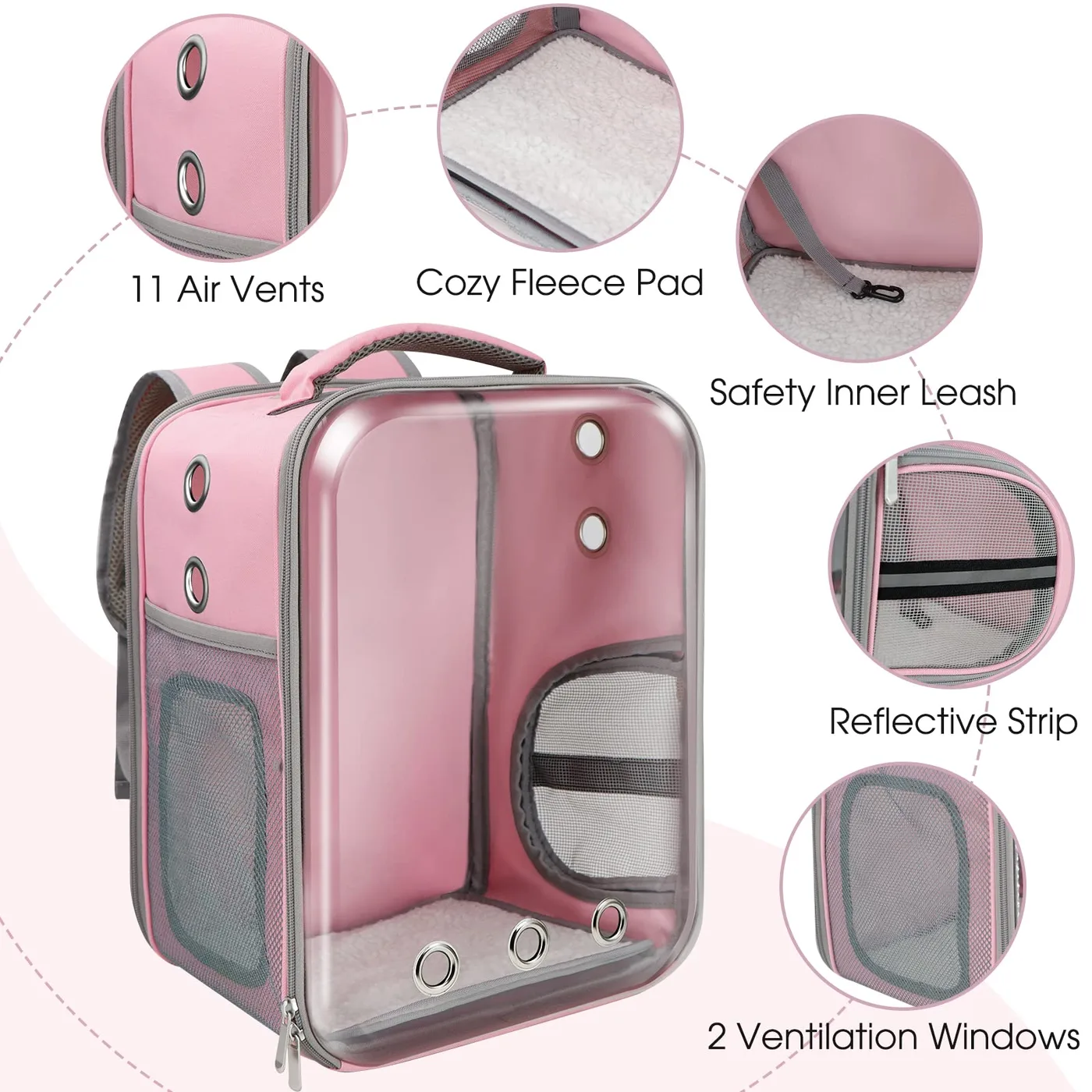
Strap Width, Padding Recovery and Load-Lifter Angle
Strap specification is where most wholesale backpacks quietly underperform. The common pattern is a 40 mm web wrapped in soft foam, which looks substantial in a photograph and rolls into a cord under a 9 kg animal within twenty minutes.
Width is the primary variable. Pressure on the trapezius equals load divided by contact width, so moving from 40 mm to 60 mm reduces contact pressure by a third without adding a gram of foam. For a 6-10 kg rated shell, 55-60 mm is the working range; for 9-13 kg, 65-70 mm plus a load lifter. Beyond 70 mm the strap starts to crowd the neck and restrict arm rotation.
Padding recovery is the second variable and the one suppliers omit. Ask for rebound after 500 compression cycles at a stated load. A pad that loses more than 15 percent of its thickness is a one-season product, and one-season products generate the review language that kills a listing in year two.
Load-lifter angle was covered above but belongs in the strap spec because it is built into the same assembly. The lifter anchors to the shell 10-14 cm forward of the shoulder strap top and pulls at 40-50 degrees. If it anchors too low the strap rides up; too high and the lifter does nothing.
Drop the sternum strap onto a sliding track so it can be positioned anywhere between collar bone and mid-chest. Fixed sternum straps fit one body shape and annoy everyone else, and sliders cost nothing at 500 units.
Specify the webbing itself as high-tenacity polyester with a stated breaking strength, and bar-tack every anchor rather than relying on a single pass of lockstitch. Anchor pull-out is the most common structural failure in this category and is entirely preventable at the pattern stage.
Procurement note: buy width first, recovery second, lifter geometry third, and treat soft foam as packaging rather than as structure.
Torso Adjustability: Fitting the Human Rather Than Only the Animal
A pet backpack has two occupants and only one of them fills the marketing copy. Buyers who grade the range purely by animal mass ship a product that fits a narrow band of human bodies and returns at a predictable rate.
The controlling human measurement is torso length, taken from the seventh cervical vertebra to the top of the iliac crest. Adult ranges span roughly 38-52 cm, and a fixed-strap backpack covers about 8 cm of that span comfortably. A wholesale programme therefore needs either two strap lengths or an adjustable yoke. Adjustable yokes with a hook-and-loop ladder and a marked scale cost more per unit but remove an entire class of fit return.
Shoulder strap curvature is the second human factor. An S-curve strap clears the neck and sits flat on the shoulder; a straight strap bridges and creates a gap at the top of the shoulder where the load concentrates. Specify S-curve in the tech pack and check it on the sample, because a flat pattern piece can be cut straight and still be called S-curve in a quote.
Hip belt geometry matters once the rating exceeds 9 kg. A web-only belt does nothing; a padded belt with a downward angle of 10-15 degrees transfers real load onto the pelvis and lets the shoulders off. If the range tops out at 8 kg, skip the belt and say so rather than shipping a decorative one.
Grading should then be published for both occupants. Give animal mass and back length for the pet, torso range and strap length for the human, plus a note on what happens at the overlap. Overlap handling is where size charts fail; state whether the larger or smaller size is recommended at the boundary and why.
Fit panels should include at least two human wearers at the extremes of the torso range and at least three animals per size, with one long-backed animal to check whether the shell supports the spine or lets it sag.
Procurement note: publish a two-occupant size chart with explicit boundary guidance, because the most expensive fit complaint is the one where the animal fits and the human does not.
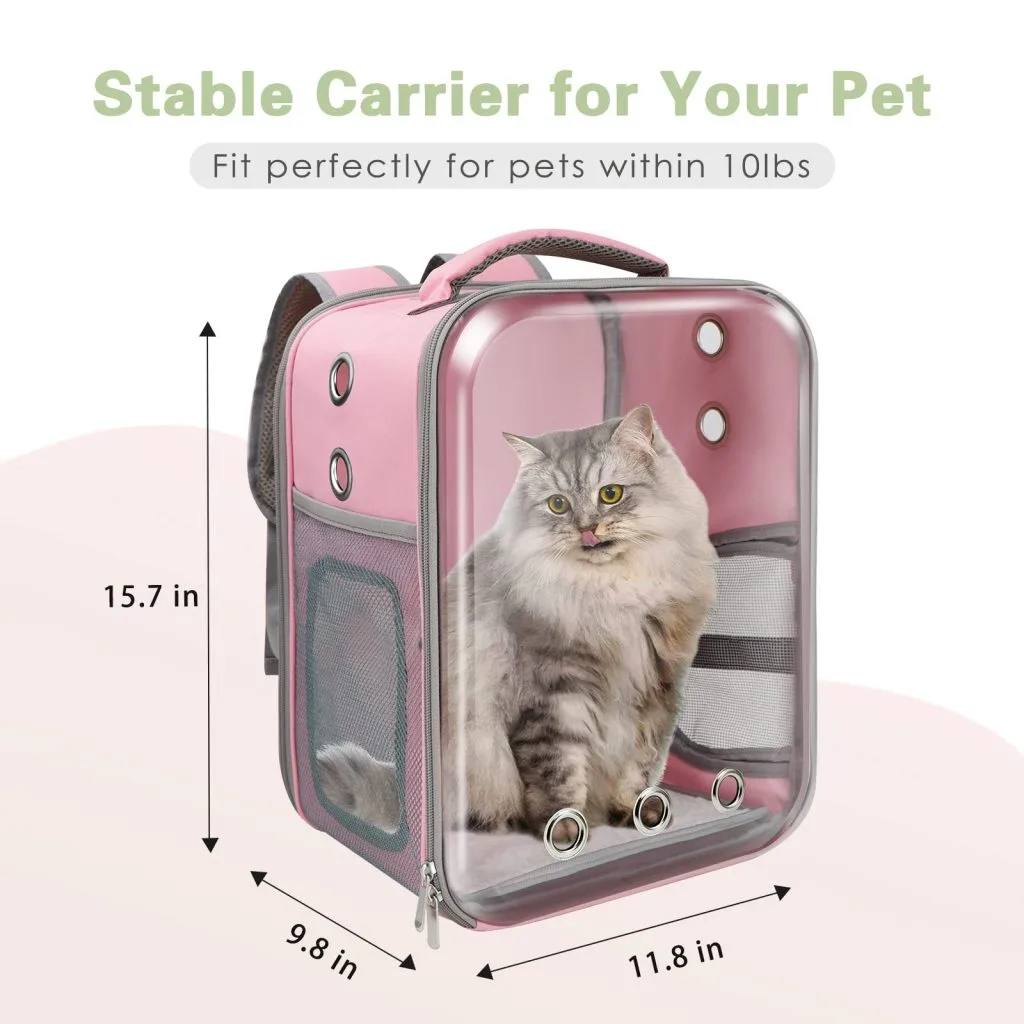
Ventilation Arithmetic: Open Area Against Insulation
Ventilation on a pet backpack is a geometry problem and should be quoted as a number. Ask the supplier for total open area in square centimetres, split between the side walls, the door or front panel, and the top. Then compare it against the metabolic load of the rated animal rather than against a photograph.
A practical floor for a 6-10 kg animal is 180-240 cm2 of genuine open mesh, distributed on at least two faces so air can cross rather than merely enter. Single-face ventilation produces a still pocket; cross ventilation produces flow. On a still day, cross flow is almost entirely driven by the wearer's movement, which is why side panels on both flanks outperform one large front window.
Open area must be measured as actual void, not as panel size. A 20 x 20 cm panel in fine no-see-um mesh has maybe 45 percent void; the same panel in a coarse hexagonal mesh has 70 percent. If the supplier quotes panel area, convert before comparing, or you will buy the visually larger and functionally smaller option.
Insulation is the counterweight. Mesh on the back-facing side of the shell conducts the wearer's body heat into the animal's space, so the panel nearest the human back should be a solid or semi-solid fabric with the air channel doing the work outside it. Putting mesh against mesh at the back is a common and expensive mistake.
Shade matters as much as flow in warm markets. A shell with generous side mesh but no top shade turns into a greenhouse at midday. Pair open flanks with a solid or reflective top panel, or offer a removable shade flap as an accessory rather than deleting the mesh.
Condensation and damp are the winter version of the same problem. A fully sealed shell in cold weather accumulates moisture from breath and coat; a small closable top vent lets a handler manage that without sacrificing warmth.
Procurement note: specify open area in square centimetres across at least two faces, convert mesh void honestly, and keep the back-facing surface solid.
Frame Sheet and Base Board: Holding Shape Under Load
Shape retention is what separates a pet backpack from a soft duffel with straps. Without a frame element the shell collapses inward as soon as the animal settles, the walls press on the animal, ventilation area drops to near zero, and the whole load sags toward the wearer's lower back.
Two elements do the work. A base board under the floor keeps the animal on a flat plane and stops the shell forming a hammock; a perimeter or sheet element in the back wall keeps the rear face from folding. The base board should be 4 mm PP for any rating above 6 kg, removable for washing, and cut with a 10-15 mm radius at the corners so it cannot wear through the lining.
The back wall element has three common options. A 1.5-2 mm HDPE sheet in a sleeve is cheap, rigid and heavy, and it creases permanently if folded in transit. A perimeter wire or rod holds the outline without adding a full sheet, keeps the centre soft for comfort, and survives folding. A moulded composite panel offers the best shape and the highest tooling cost, which only makes sense above a few thousand units.
For most wholesale programmes the perimeter rod is the right answer. It protects the ventilation void, folds for shipping, and does not fight the back foam for space.
Transit configuration follows from that choice. If a rigid sheet is specified, the carton must ship the unit flat with the sheet separate and a printed reinsertion card, or the sheet must be slotted so it can be folded once along a scored line. Either approach keeps the master carton under 12 cm, which matters because structured pet bags fill containers by volume long before they reach weight limits.
Ask the supplier for a loaded wall-deflection figure: apply the rated mass, wait thirty minutes, and measure inward movement at the widest point. Under 10 mm is a good result; over 20 mm means the ventilation spec is theoretical.
Procurement note: a flat removable base board plus a perimeter rod gives most of the performance of a moulded shell at a fraction of the tooling, and ships far better.
Cost Drivers Inside the Back System
Indicative FOB Xiamen for a properly specified pet backpack runs USD 9.30-17.20. The spread is much wider than for front-mounted designs because the back system itself is a sub-assembly with its own labour content, and buyers who only compare shell fabric miss most of the money.
Back system assembly is typically the largest single labour block. Cutting, laminating and closing a channelled foam panel with spacer mesh, then attaching S-curve straps with lifters and a sliding sternum, takes several times the minutes of a plain flat panel with straight webbing. If a quote is far below the band, count the strap anchors and look for a flat panel.
Foam grade is the second driver and the easiest to downgrade invisibly. The delta between an 18 kg/m3 and a 30 kg/m3 slab is meaningful at 500 units and trivial per unit at 5,000, which is why low quotes cluster there. Hold the foam code and check incoming density on the first production lot.
Hardware is third. Branded acetal buckles with documented cycle ratings, metal sliders on the sternum track and a quality zip with a locking slider add real cost and real reliability. Test-method references for hardware and textile claims can be checked through ASTM standards information, and naming the method in the tech pack removes the argument later.
Mesh grade is fourth and frequently overlooked. Stiff spacer knit costs more per metre than warp knit and is the difference between a functioning chimney and a decorative one.
Quality system context for the production base can be verified against ISO 9001 quality management guidance, and third-party verification is available through SGS testing and audit services. Name the document, material or lot each certificate covers; a generic certificate does not cover a specific foam.
Procurement note: break the quote into back system labour, foam grade, hardware and mesh grade, and reprice at two quantity breaks with the Incoterm unchanged.
Wear Trials, Documents and Inspection Wording
Prototypes are produced 6-10 working days after the tech pack is signed, assuming stock mesh, stock foam and stock hardware. A custom foam lamination, a branded buckle or a dyed-to-match webbing pushes the first article onto a longer pre-production path, and that path should appear on the calendar before the deposit is paid.
Approve in this order. Measure the shell and the back panel against the parameter table, run a loaded wear trial, then check deflection and rebound, and only then review colour, logo and print. Reversing the order risks relaying artwork after a strap anchor or panel radius moves.
The wear trial deserves structure. Use two wearers at the ends of the torso range, load to the rated mass with a weighted form, walk a fixed 3 km circuit with a 300 metre climb, and record shoulder pressure, back dampness and strap migration at 30, 60 and 120 minutes. Photograph strap position at each checkpoint. This is the cheapest way to predict returns.
Bulk production runs 35-50 days from approval of sample, materials and artwork, covering material booking, cutting, lamination, assembly, inline checks, packing and final inspection. Capacity at the SGS-verified production base supports planning, but a dated slot is held by deposit and confirmed inputs rather than by a headline figure.
Inspection at AQL 2.5 needs category-specific wording. Critical: strap anchor pull-out, buckle fracture, base board protruding through lining. Major: foam density below the approved code, air channel collapsed or blocked by lining, strap width under spec, deflection beyond the agreed limit. Minor: stitch irregularity on non-load panels and print registration tolerance.
Document set should travel with the shipment: approved sample reference, bill of materials with foam and mesh codes, dimension sheet, inspection summary and packing list, plus destination-specific material declarations agreed at quote stage.
Welfare copy for listings should stay factual. Independent transport and restraint testing discussion is published by the Center for Pet Safety, which is a useful reference when a retailer asks what a claim rests on.
Procurement note: freeze measurement and wear-trial results before artwork, inspect against a written defect list at AQL 2.5, and file every document under one purchase order number.
Why brands source here
- Pet bag programmes run since 2014; founding team in sewn goods since 2004
- SGS-verified production floor of 4,950 m² with 137 workers across 7 lines
- Monthly capacity of 200,000 units, audited to BSCI and ISO 9001
People Also Ask
What is a pet back pack?
A soft shell worn on the back with two shoulder straps, letting the wearer's skeleton share the animal's mass over longer walks and transit than a front or shoulder design allows.
Is a backpack better than a front pack for a heavy pet?
Yes above roughly 6 kg. Back mounting keeps the mass near the spine and allows hip transfer; front mounting puts every kilo forward of the body's vertical axis.
How do I size a pet backpack?
Grade by animal mass and back length, then check the human torso range and strap length. Both occupants have to fit or the size chart will fail.
How much ventilation does a pet backpack need?
Around 180-240 cm2 of true open area across two or more faces, with a solid panel on the side nearest the human back.
Why does my pet backpack feel heavy?
Usually strap migration outward, a collapsed air channel or a sagging base board. Added foam rarely fixes any of the three.
What does a wholesale pet backpack cost?
Indicative FOB Xiamen is USD 9.30-17.20, with back system labour, foam grade, hardware and mesh grade setting the final position.
Frequently Asked Questions
What pet weight can a backpack-style bag carry?
A properly specified two-shoulder build handles 4-13 kg. Above roughly 10 kg the hip belt stops being optional, because the shoulders cannot take that load alone for a useful duration.
How wide should shoulder straps be on a pet backpack?
55-60 mm for a 6-10 kg rating and 65-70 mm for 9-13 kg. Width reduces contact pressure far more effectively than extra padding.
What foam density should I specify?
25-30 kg/m3 for a core build with rebound above 90 percent after compression cycling. Below 20 kg/m3 the slab takes a permanent set within one season.
How much open mesh area is enough?
Aim for 180-240 cm2 of true void for a 6-10 kg animal, split across at least two faces so air can cross the shell rather than simply enter it.
What is the MOQ for a wholesale pet back pack order?
MOQ 500 per colour. A first programme usually takes one 6-9 kg hero and one 9-13 kg large in a neutral outdoor tone.
How fast is sampling?
Prototypes are finished 6-10 working days after the tech pack is confirmed, provided foam, mesh and hardware are stock items.
When does bulk production start?
The 35-50 day window begins once the final sample, the full material list and the carton print are all approved. Late artwork delays packing rather than sewing.
Do I need a hip belt?
Only above about 9 kg of animal. Below that a padded belt adds cost without transferring meaningful load; above it, the belt is what makes a ten kilo animal tolerable.
Should the back panel be mesh?
No. Keep the surface facing the wearer solid and let the external air channel do the work. Mesh against mesh transfers body heat straight into the animal's space.
What frame element is best value?
A removable 4 mm base board plus a perimeter rod. It holds the ventilation void open, folds for shipping and avoids the tooling cost of a moulded composite panel.
Which payment and delivery terms apply?
T/T 30/70 with FOB Xiamen pricing. Hold the Incoterm constant across competing quotes so freight differences do not distort the unit comparison.
Can backpack units share a container with other styles?
Yes when timing and materials align. Compare cube rather than weight, because structured shells generally fill the container before reaching any mass limit.
What documents should be requested?
Approved sample reference, bill of materials with foam and mesh codes, dimension sheet, inspection summary, packing list and any destination-specific material declarations agreed at quote stage.
Talk to QUANZHOU JUNYUAN BAGS about a wholesale pet bag order: MOQ 500 pieces per colourway, samples in 6-10 working days, bulk production in 35-50 days under AQL 2.5 inspection.
Get a free quote Request a sample