Pet Laptop Bag: Work + Pet Build Guide for Wholesale Buyers
A wholesale pet laptop bag needs two independent cavities - a padded 14-inch device sleeve rated for a 1.5 m drop and a pet zone rated for 6-8 kg - separated by a 6-8 mm closed-cell foam wall. Budget USD 9.60-16.40 FOB Xiamen for that build. Programmes run at MOQ 500 pcs per colourway, sample in 6-10 working days and ship 35-50 days after approval under AQL 2.5 inspection.
Executive Summary
This guide covers the dual-purpose build: a bag that carries a laptop and a small pet at the same time without compromising either. It is a harder product than it looks, because the two payloads have opposing requirements - electronics need impact isolation and low internal temperature, animals need airflow and a firm, stable floor.
Our production team quotes these programmes at MOQ 500 pcs per colourway, with mixed colourways permitted in one order. Samples take 6-10 working days from tech pack confirmation and bulk runs 35-50 days after sample approval. Every order is offered to AQL 2.5 pre-shipment inspection with third-party inspectors accepted, on T/T 30/70 against FOB Xiamen; DDP can be quoted alongside.
The decisions that determine whether the SKU succeeds are the divider specification, the foam density in the device sleeve, and the thermal path between the two cavities. Styling is downstream of all three. Two further variables deserve attention at quoting stage: packed carton volume, because foam is expensive to ship, and the target device size, because it sets the entire dimensional envelope. Both are cheaper to decide early than to change later.
Wholesale pet bags usa and wholesale pet bags europe run on different compliance files, so Pet Bag Types & Styles documentation should be prepared per destination rather than once. Export pet bags with the country-of-origin marking fixed at packing stage, because relabelling at the port costs more than the whole print run.
Why Laptop Plus Pet Is an Engineering Problem, Not a Styling One
Put a 1.4 kg laptop and a 7 kg animal in the same product and you have created a load-path conflict. The laptop wants to be suspended in foam away from the shell; the pet wants a rigid, non-tilting floor; the human carrying the whole assembly wants the mass close to their spine. Those three requirements pull the design in different directions, and the cheap solution - one big cavity with a padded sleeve dropped inside - satisfies none of them.
The failure modes are predictable and they show up in reviews within weeks. Devices crack when the bag is set down hard because the sleeve rests on the same base board that flexes under the pet. Animals refuse to settle because the floor tilts toward the heavier side. Zips burst at the divider because the two cavities are stitched into a shared seam instead of being built as separate boxes joined by a spine panel. Every one of these is a design-stage problem that becomes an unfixable production problem.
From a procurement standpoint the practical message is simple: price this SKU as a structured bag with two boxes, not as a sleeve inside a tote. The bill of materials is meaningfully higher, but the alternative is a return rate that erases the saving in one quarter.
- Two independent load paths: pet mass onto the base board, device mass onto suspended foam.
- A spine panel between the cavities that does not transfer pet movement into the device sleeve.
- A centre of gravity that sits within 40 mm of the bag's vertical centreline when both cavities are loaded.
- A base that stays flat on a desk - buyers set these bags down, they do not hang them.
- Access logic: the device sleeve must open without exposing the pet cavity to the street.
That final point is a genuine safety requirement rather than a nicety. If opening the laptop compartment unzips the pet cavity at the same time, the product has an escape risk every time it is used in public. Independent zips on independent panels, with the pet panel on the body-facing side, is the only arrangement we recommend for wholesale programmes.
Compartment Architecture and Load Paths
The build that works in volume production is two boxes sharing a spine. The pet box has a wrapped base board, four side panels, a mesh front and a top closure. The device box is a suspended sleeve: foam on all six faces, floating 8-12 mm off the shell so that an external impact never reaches the corners. The two are joined along a vertical spine panel that carries handle and strap loads, so neither cavity is load-bearing for the other.
| Zone | Construction | Key dimension | Cost driver |
|---|---|---|---|
| Pet cavity | 4 mm EVA + PP laminate board, wrapped | 10-13 L, 6-8 kg rated | Board thickness and wrap |
| Device cavity | Suspended sleeve, 8 mm closed-cell foam | Fits 14-inch, 355 x 245 mm | Foam density and cut complexity |
| Spine panel | Double-layer 900D with 2 mm foam insert | Full height of the bag | Labour - it is a second assembly stage |
| Accessories zone | Two slip pockets, one zip pocket | Charger, phone, documents | Lining area, minimal |
| Strap system | 38 mm webbing, removable pad | Load rated to 12 kg combined | Pad thickness and bar-tack count |
Two details on this map drive most of the cost variance between quotes. The first is the suspended sleeve. A sleeve that is merely lined with foam and stitched to the shell costs USD 0.40-0.70; a genuinely floating sleeve with foam returns on all six faces and a 10 mm air gap costs USD 1.60-2.90 and requires two extra assembly operations. The second is the spine panel, which adds a full-height assembly seam and roughly 6-9 minutes of labour per unit.
Buyers frequently ask whether the sleeve can simply be removable, saving the second cavity. It can, and for price-point programmes it is a legitimate choice - but be honest in the listing about what that means. A removable sleeve sitting next to a pet is not impact-protected; it is only scratch-protected. Marketplaces treat that distinction as a product-claim issue, and so should you.
Dimensional planning should start from the device, not the animal. Work backwards from the largest device you intend to claim - usually a 16-inch laptop at 360 x 250 x 18 mm - add 12 mm of clearance and 8 mm of foam on each face, and only then size the pet cavity to whatever volume remains. Starting from the pet and hoping the laptop fits is how programmes end up with a sleeve that fits a 13-inch device and a listing that claims 15-inch.
Handle and strap load rating
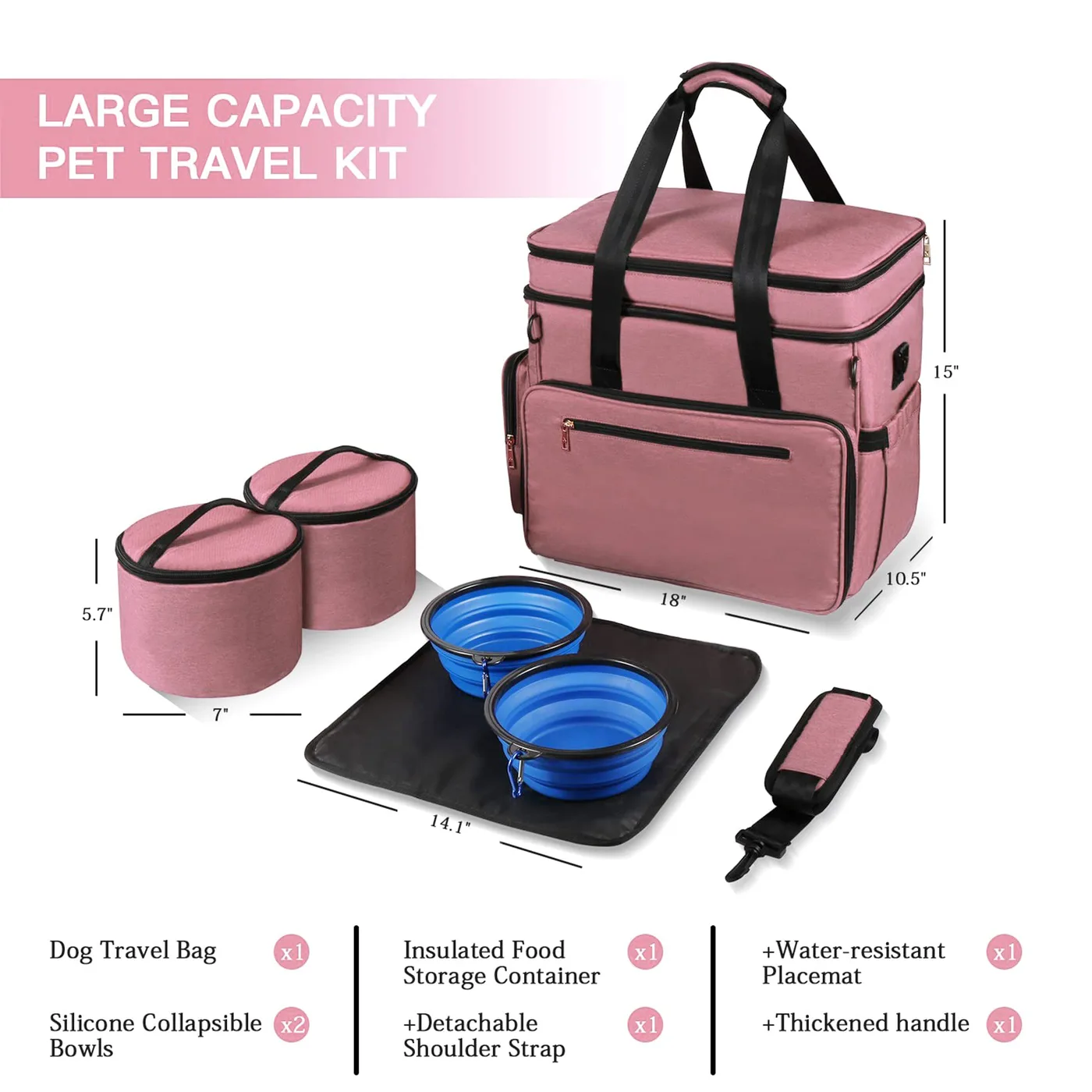
Handle strength is where dual-purpose bags are most often under-specified. A 7 kg pet plus a 1.4 kg laptop plus the shell is roughly 10 kg of static load, and dynamic load when the bag is lifted quickly or set down unevenly is 1.5-2 times that. Specifying handles and strap attachment points to a 20 kg static pull test with bar-tacked reinforcement costs very little and removes the single most damaging category of field failure.
The test specification should name the load, the duration and the acceptance criterion: a 20 kg static pull held for a stated period on each handle and strap root, with no stitch elongation beyond a stated limit and no damage to the panel. Dynamic behaviour matters as much as static strength, so add a repeated-lift cycle to the same specification - a bag that survives a single pull can still fail after three months of daily lifting.
Attachment geometry is the part buyers can influence cheaply. A handle root that terminates in the side seam will eventually tear out; one that extends 80-100 mm down the panel as a hidden webbing tail distributes the load across a much larger area for a few cents of material. Specify the extension length in the tech pack and check it on the sample by feel rather than by eye. For the same reason, avoid mounting handle roots directly over the divider seam, where two panels of differing stiffness meet and stress concentrates. Where a bag is likely to be lifted by one handle rather than two, specify that configuration in the pull test as well, because single-handle lifting is the most common real-world misuse and the one that tears handles out.
Impact Protection: Foam, Board and Drop Criteria
Impact protection is the part of the spec buyers most often leave vague, usually by writing "padded laptop compartment" in a tech pack and assuming that is sufficient. It is not. Padding is a material; protection is a measured result. The difference matters because a customer who drops a bag containing a USD 1,200 laptop does not care how the foam was described in the purchase order.
Specify three numbers. Foam density in kg/m3, foam thickness in mm on each face, and a drop-test criterion. For a mid programme the working combination is 8 mm of closed-cell EVA at 45-60 kg/m3 on the faces and 12 mm on the corners, tested by dropping a loaded bag from 0.8-1.0 m onto a hard surface in three orientations. Corner coverage is the detail that separates passing results from cracked screens, because corners are where the energy concentrates and where cheap sleeves have the least material.
Standardised test methods exist for exactly this purpose and naming them in the tech pack costs nothing. Physical and mechanical test methods are published by ASTM International, and abrasion and colour-fastness behaviour for the shell fabric is normally run to AATCC textile test methods. When a factory report cites a method number rather than an adjective, the result is enforceable.
- Foam: closed-cell EVA or PE, 45-60 kg/m3, no rebound memory loss after 72 hours compression.
- Corner reinforcement: doubled foam or moulded corner inserts, 12 mm minimum.
- Suspension: sleeve floating 8-12 mm from the shell on all faces.
- Test criteria: 1.0 m drop, three orientations, device undamaged and sleeve closure intact.
- Retest cadence: once per production year and after any foam supplier change.
Consistency across repeat orders is the harder problem, and it is a systems problem rather than a materials one. An ISO 9001 quality management system is what makes the third order match the first when the foam lot has changed and the line has been retooled. Buyers who source on sample quality alone tend to discover the gap on reorder rather than on first delivery, which is the worst possible time.
The test itself should be specified as a procedure, not as an outcome. State the load, the drop height, the surface, the number of orientations and the acceptance criterion, and require a written result with photographs of the sample afterwards. A supplier who can produce that report has the equipment and the habit; one who offers a verbal assurance does not.
Buyers should also decide what happens to a failed result. In practice a first drop test on a new sleeve design fails roughly one time in three, usually at a corner, and the fix is more corner material or a revised suspension. Building one revision round into the sampling calendar is cheaper than discovering the failure after bulk has started.
Weight rating and how to publish it
The weight rating on a dual-purpose bag is the specification most likely to be overstated, and it is the one a customer is most likely to test. The correct figure comes from the base board and handle load test, not from the volume of the pet cavity, and it should be the lower of the two numbers the structure and the harness can support.
Publish one figure in kilograms and pounds, on the sewn label and on the product page, and state the device weight separately. A bag rated for 8 kg of pet and a 1.6 kg laptop is carrying close to 12 kg in total, and the buyer needs to see both numbers to judge whether the product suits them.
An honest rating protects the listing in a way that an optimistic one cannot. Marketplace review sections are full of photographs of broken base boards, and every one of them started as a rating decision made at the tech pack stage.
There is a second reason to publish conservatively: the rating interacts with the device cavity. A bag rated for a heavier animal needs a stiffer base board and stronger handle roots, and both add weight that reduces the payload available for the device and the owner's other items. Rating the pet cavity honestly at what the structure can carry for an hour keeps the whole product lighter and more comfortable.
Where a range spans sizes, resist the temptation to use one rating across all of them. A small bag and a large bag in the same family have different base boards and different handle geometries, and publishing one figure for both guarantees that one of them is wrong.
Thermal and Ventilation Balance in a Dual Cavity Build
Heat is the constraint nobody budgets for. A laptop generates 25-45 W under load and must not be operated inside a closed sleeve; a small dog generates meaningful body heat and must not be sealed in a cavity with no cross-flow. Putting both in one shell, separated by a foam wall, creates a thermal puzzle: the divider that protects the device from impact also blocks the airflow the animal needs.
The resolution is to separate thermal and impact functions. Use a thin perforated or spacer-mesh section at the top third of the divider for convection, keep the lower two-thirds solid foam for impact and structure, and give the pet cavity intake low on one side and exhaust high on the opposite side. Cross-flow at different heights moves air without a fan, and it does not compromise the sleeve.
Buyers should also write the operating rule into the insert: the device compartment is for transport, not for charging or operation. This sounds obvious, and it is the single most common misuse pattern in the field. A clear instruction insert is both a safety measure and a defence if a claim is ever made.
Practical specification checklist for the ventilation side:
- Mesh area equal to at least 12% of the pet cavity's internal surface, split across two opposite sides.
- Aperture of 1.2-1.5 mm in PVC-coated polyester mesh - claw resistant and wipe-clean.
- A roll-back or zip-open top panel that gives the animal head-out visibility when stationary.
- No shared air path between the pet cavity and the device sleeve.
- Light-colour linings in warm-climate markets; dark linings raise internal temperature measurably.
Finally, consider the shoulder seasons. A bag that is thermally comfortable in October will be uncomfortable in July, and returns cluster in the first warm month after launch. If the programme targets warm markets, spend the USD 0.30-0.50 on a lighter lining colour and a larger mesh area at design stage rather than discounting through the summer.
Cost Structure and Price Banding for Dual-Purpose Builds
A dual-purpose build costs more than a single-cavity pet bag of the same external size, and buyers who benchmark it against a simple tote will conclude the quote is high. It is not high; it is a different bill of materials. The right comparison is against other structured multi-cavity bags.
| Build level | Sleeve construction | Base board | FOB band |
|---|---|---|---|
| Entry | Removable foam-lined sleeve, 5 mm | 3 mm PP board | USD 9.60-11.80 |
| Mid | Fixed suspended sleeve, 8 mm EVA | 4 mm EVA + PP laminate | USD 12.20-15.40 |
| Premium | Moulded corner sleeve, 12 mm, recycled nylon shell | 5 mm moulded EVA with feet | USD 16.80-22.50 |
Where the money actually goes, for a mid build at roughly USD 13.60: shell fabric and lining 30-35%, foam and board 14-18%, hardware 12-15%, labour 22-27%, packaging and documentation 4-6%, factory margin 8-12%. Labour is a larger share than in a single-cavity bag because the spine panel and the suspended sleeve each add assembly operations that cannot be automated away.
The saving levers, in order of value and in order of risk, are worth separating. Volume consolidation and colourway reduction save money with no product risk. Packaging simplification saves money with modest brand risk. Dropping from a suspended sleeve to a removable sleeve saves USD 1.20-2.20 and transfers impact risk to the customer - that is a decision for the brand owner, and it should be made deliberately with the listing copy adjusted to match.
Freight deserves a specific note here because foam is a volume problem. A sleeve with 12 mm corner foam occupies carton space that a flat bag does not, and the volumetric weight penalty on air freight can exceed the entire foam cost. If a programme is likely to air-freight a top-up mid-season, specify compression-packable cartons and ask for the packed carton dimensions at quoting stage, not at booking stage.
Branding, Packaging and the Unboxing Gate
Dual-purpose bags are bought by people who own two expensive things - a laptop and a pet - and that customer notices presentation. Branding and packaging on this SKU are therefore a larger share of perceived value than the category average, and they are also a larger share of the cost structure.
Branding options, in ascending order of cost and impact: a woven label on the lining or the exterior seam, a printed lining pattern, an embossed or engraved zip puller, a metal or TPU logo plate, and a debossed patch. A new woven label costs a one-off loom setup and adds 10-15 days on the first order only; custom metal hardware requires tooling and adds 15-25 days. Both are reusable on reorders, which is why the first order is always the expensive one.
- Woven label: USD 0.10-0.35, one-off loom setup, no lead-time impact on reorders.
- Printed lining: USD 0.30-0.85, requires a strike-off approval.
- Custom puller: USD 0.15-0.45, tooling for engraved or moulded designs.
- Logo plate: USD 0.35-1.20, tooling and an attachment operation.
- Printed sleeve or box: USD 0.45-1.60, plus carton volume and freight impact.
Packaging has a freight consequence that buyers routinely discover late. A printed box improves perceived value and worsens carton density, and on a structured dual-cavity bag the effect is measurable: boxed units can reduce container utilisation by 15-25% compared with a polybag. Model it before choosing, and if the programme is air-freighting any volume at all, reconsider the box.
Protection in transit is the other packaging decision. A structured bag with a foam sleeve should be shipped with internal support - a paper or board insert in the pet cavity - so it cannot be crushed diagonally in the carton. A bag that arrives deformed has already lost its most important moment, and no amount of good packaging design recovers a crushed silhouette.
Finally, plan the insert card as part of the package rather than an afterthought. For this SKU the card should state the device size the sleeve is dimensioned for, the pet weight rating, and the transport-only rule for the device compartment. Those three lines set expectations correctly and they answer the three questions that generate the majority of pre-purchase enquiries.
MOQ, Sampling and the Production Calendar
As with every structured style in this category, the working minimum is MOQ 500 pcs per colourway, set by fabric dye-lot minimums and cutting yield rather than by line capacity. Mixed colourways inside one order are accepted, and for a first programme we generally recommend 1,500 pcs across three colourways rather than 3,000 in one: the colourway spread gives you listing data without concentrating risk.
Sampling runs 6-10 working days per round once the tech pack is locked, and dual-purpose builds realistically need two rounds. The first validates structure - does the bag stand, does the sleeve fit the intended device, does the pet floor stay flat. The second validates fabric, colour, branding and the foam feel. Trying to combine them is possible if you supply a reference sample and a physical device; otherwise it is false economy.
| Stage | Duration | Buyer gate |
|---|---|---|
| Tech pack, artwork and target device confirmation | 5-10 days | Written sign-off |
| Structure sample | 6-10 working days | Fit and stand-up approval |
| Branding and colour sample | 6-10 working days | Golden sample sealed |
| Bulk production | 35-50 days | AQL 2.5 inspection booked |
| Sea freight, customs, inland | 30-45 days | Warehouse receipt |
Read end to end, that is 85-115 days from a signed tech pack to goods received. Backdate from the listing or shelf date. The most common planning error in this category is booking the sample after the marketing calendar is fixed, which forces either air freight at 4-6 times sea cost or a missed launch window.
Reorders are faster because the tooling and patterns exist: 35-50 days still applies to production, but the sampling phase collapses to a single confirmation round of 5-8 days. Buyers running a family of lifestyle SKUs - a work bag, a laptop bag and a commuter tote - should consolidate into a shared production slot where possible, because shared fabric buys and one inspection booking are worth more than the small scheduling flexibility lost.
Compliance, Testing and Channel Requirements
A bag that holds a laptop is sold through channels that ask different questions than pet channels do. Office-supply and electronics-adjacent retailers want dimensional compatibility claims substantiated, chemical compliance documentation on foam and coatings, and packaging that survives their fulfilment process. Pet channels want weight ratings, ventilation statements and escape-prevention language. A dual-purpose SKU has to satisfy both sets at once.
For the US, general consumer product safety applies, and California's Proposition 65 exposure warnings are administered by OEHHA; foam, coatings and hardware finishes are the components most commonly asked about. Federal consumer product requirements and recall obligations sit with the US Consumer Product Safety Commission, and buyers should register the responsible-party identity before the first shipment rather than after it.
For the EU, REACH substance restrictions apply to coated fabrics, foam and hardware, and any recycled-content or OEKO-TEX style claim needs a certificate number that can be printed on packaging and produced on request. Assume that a claim printed on a hangtag will eventually be audited.
- Dimensional compatibility claim: state the exact device size, not "fits most laptops".
- Weight rating: one figure in kg and lb, derived from the board and handle test, printed on the label.
- Traceability: batch code on the product and carton, retained for at least 24 months.
- Instruction insert: transport-only statement for the device cavity, tether use, ventilation guidance.
- Test reports: drop, abrasion, colour fastness, hardware corrosion, plus chemical screens requested by the retailer.
Independent verification is worth budgeting for on the first order. Third-party pre-shipment inspection and laboratory testing are accepted by most retail groups without argument, and SGS testing and inspection services cover both sides of that requirement. Note the distinction that trips buyers up: our production base is SGS-verified for floor space and capacity, which speaks to the facility, while the pre-shipment inspection speaks to your cartons. Both are useful; neither replaces the other.
One closing practical point about inspection on this specific SKU. AQL 2.5 is the right standard, but the defect classification has to be written for a dual-cavity product: add sleeve misalignment, foam voids, divider seam gaps and missing corner reinforcement to the critical list. A generic bag checklist will pass a bag whose laptop sleeve is 6 mm out of square, and that is exactly the defect your customer will find.
Order and quality terms
- MOQ 500 pieces per colourway; samples in 6-10 working days
- Bulk production 35-50 days after approval; AQL 2.5 inspection standard
- T/T 30/70 terms, FOB Xiamen, full document set per shipment
People Also Ask
Do pet laptop bags actually protect a laptop?
Only if the sleeve is suspended with foam on all six faces and corner reinforcement of 12 mm. A foam-lined sleeve stitched flat to the shell protects against scratches, not against a drop.
What weight pet can a pet laptop bag carry?
The practical band is 6-8 kg for a 10-13 L pet cavity with a 4 mm laminated base board. Above that the combined load makes the bag uncomfortable to carry and shifts the centre of gravity away from the spine.
Is it safe to carry a laptop and a pet in one bag?
Yes, provided the cavities are structurally independent, the pet panel opens separately from the device panel, and the device cavity is used for transport only.
How do you stop a pet laptop bag from tipping over?
A wide flat base with five feet, a low centre of gravity within 40 mm of the vertical centreline, and a pet cavity floor that does not cantilever past the base footprint.
Which channels sell pet laptop bags best?
Office-supply and commuter retail convert on device-compatibility claims and material quality; pet channels convert on weight rating and ventilation. The listing copy has to speak to whichever channel the SKU is placed in.
How much extra does the second cavity cost?
The spine panel and suspended sleeve together add roughly USD 2.00-3.60 over an equivalent single-cavity structured bag, mostly in foam material and two extra assembly operations.
Can the sleeve be made removable to save cost?
It can, saving USD 1.20-2.20, but the listing must then describe scratch protection rather than impact protection, because a removable sleeve sitting beside a pet is not isolated from impact.
Frequently Asked Questions
What makes a pet laptop bag different from a pet backpack with a sleeve?
The device cavity in a purpose-built pet laptop bag is a suspended, six-sided foam box floating 8-12 mm off the shell, not a sleeve dropped into a shared cavity. That isolation is what protects a device when the bag is set down under the weight of the animal.
Can the laptop compartment and the pet compartment share a zip?
No. Sharing a zip creates an escape risk every time the bag is opened in public. Pet panels must open independently, on the body-facing side, with their own closure.
What foam specification should I request for device protection?
Closed-cell EVA at 45-60 kg/m3, 8 mm on the faces and 12 mm on the corners, with a drop criterion of 1.0 m in three orientations and the device undamaged.
What MOQ applies to a pet laptop bag?
MOQ is 500 pcs per colourway, with mixed colourways allowed in a single order. A first programme of 1,500 pcs across three colourways is the common starting size.
How long do samples take for a dual-cavity pet bag?
6-10 working days per round after the tech pack is confirmed. These builds usually need two rounds: one for structure and device fit, one for fabric, colour and branding.
What is the bulk lead time?
Bulk production runs 35-50 days after sample approval. Custom hardware tooling or a new woven label adds 10-15 days on the first order only.
Will the pet's body heat damage the laptop?
Not if the design keeps a solid foam divider between the cavities with no shared air path. The operating rule that matters is that the device cavity is for transport only - never for charging or running the device.
How much does a wholesale pet laptop bag cost?
Expect USD 9.60-11.80 FOB Xiamen for an entry build with a removable sleeve, USD 12.20-15.40 for a mid build with a suspended sleeve, and USD 16.80-22.50 for a premium moulded-corner build.
Which device sizes should the sleeve be dimensioned for?
Start from the largest device you intend to claim - typically a 16-inch laptop at roughly 360 x 250 x 18 mm - then add 12 mm clearance and 8 mm of foam per face before sizing the pet cavity.
What inspection standard applies?
AQL 2.5 with a defect classification written for dual-cavity products: sleeve misalignment, foam voids, divider seam gaps and missing corner reinforcement belong on the critical list.
Which documents do US and EU retailers ask for?
Country of origin, fibre composition, batch traceability code, an instruction and warning insert, plus drop, abrasion, colour-fastness, hardware corrosion and chemical test reports. Prop 65 positioning and REACH statements are the two most frequently requested items.
Can own-brand branding be added to the sleeve and hardware?
Yes. Woven labels, printed lining, embossed zip pullers and engraved logo plates are routine on this build. New tooling adds 10-15 days on the first order and nothing on reorders.
Talk to QUANZHOU JUNYUAN BAGS about a wholesale pet bag order: MOQ 500 pieces per colourway, samples in 6-10 working days, bulk production in 35-50 days under AQL 2.5 inspection.
Get a free quote Request a sample