Pet Work Bag: Office Style Wholesale Buyer Guide
A wholesale pet work bag should be specced at 12-18 litres, a 600D-900D polyester or recycled nylon body, a rigid 3-5 mm base board and a 6-8 kg rated pet compartment, ordered at MOQ 500 pcs per colourway. Office styling means muted colourways, matte hardware and a silhouette that reads as a briefcase or structured tote rather than outdoor gear. Budget USD 7.40-13.80 FOB Xiamen for a dual-cavity build, 6-10 working days for samples and 35-50 days for bulk after approval, inspected to AQL 2.5.
Executive Summary
This guide is written for buyers building an office-style pet bag programme for commuter retail, corporate gifting or marketplace listings. The category trades on restraint: buyers are not paying for expedition features, they are paying for a bag that looks credible in a meeting and still contains a small animal safely for a 20-60 minute trip.
Our production team runs these programmes at MOQ 500 pcs per colourway, with mixed colourways permitted inside one order so a 1,500-pc buy can be split three ways. Samples are turned in 6-10 working days after tech pack sign-off; bulk production runs 35-50 days after sample approval, longer only when a custom woven label or a new hardware tool is involved. Every shipment is offered to AQL 2.5 pre-shipment inspection with third-party inspectors accepted, on T/T 30/70 terms against FOB Xiamen.
The three decisions that move margin most are cavity construction, base board specification and hardware finish. Everything else - lining colour, zip pull shape, dust bag - is a rounding error by comparison. Buyers specifying this category for the first time usually over-invest in appearance and under-invest in the base; the reverse allocation produces a better product at the same cost.
Wholesale waterproof pet bags and wholesale 600d pet carrier lines are quoted against coating weight rather than against fabric name, and Pet Bag Types & Styles specs have to say which test method applies. Wholesale durable pet carriers then hold their price because the failure cost - a returned unit - is far higher than the coating premium.
What Qualifies as a Pet Work Bag in a Wholesale Assortment
In a wholesale catalogue, a pet work bag sits between a fashion tote and a travel carrier. It has to read as office-appropriate on a shelf or a product page while still carrying a live animal safely. That dual requirement drives every downstream spec decision, from fabric hand to hardware finish. Buyers who treat the category as "a tote with a mesh panel" routinely see returns concentrate in the first 60 days of a listing, usually for the same three reasons: the bag slumps when empty, the pet zone has no firm floor, and the human items share a cavity with the animal.
The functional boundary is clearer than it looks. A pet work bag is built for short, predictable trips - home to office, office to a café, a train or rideshare leg of 20-60 minutes - with the pet settled and contained rather than exercising. That is different from a hiking pack, which is built for load transfer over hours, and different from an airline cabin carrier, which is built to a dimension envelope first and a comfort envelope second. Merging those requirements into one SKU is the most common cause of over-specification and margin loss.
Practically, the category is defined by five boundaries:
- Trip length of 20-60 minutes, not multi-hour carry.
- Pet weight band of 4-8 kg, which sets base board and handle load rating.
- A structured silhouette that holds shape empty - office buyers reject slumping bodies on sight.
- A contained pet zone with ventilation panels, a firm floor and an interior safety tether.
- A separate human zone for laptop, documents and personal items, physically divided from the pet zone.
That last boundary is what separates a pet work bag from a generic pet tote. The animal zone and the human zone cannot share one undivided cavity: a 6 kg dog and a 14-inch laptop in the same space produce either a damaged device or an uncomfortable animal. Most office-style programmes therefore run a dual-cavity construction with an independent base board under each cavity, which adds roughly USD 0.60-1.10 to FOB depending on board type and fabric weight.
Finally, decide early whether the SKU is merchandised as a pet product or as a work bag that happens to carry a pet. The answer changes photography, copy, packaging and the retail buyer you pitch. Pet-channel listings convert on safety language and weight ratings; office and gifting channels convert on material, silhouette and colour naming. Getting this wrong is expensive because it usually means a re-shoot after the first purchase order.
Core Specification Sheet for Office-Style Pet Bags
A written spec sheet is the single cheapest risk-reduction tool in this category. The table below reflects the band our production team quotes most often for commuter programmes in the US and EU. Treat it as a starting envelope, not a fixed formula: a gifting programme at USD 9.90 retail will land at the lower end, a premium department-store programme will land at the upper end.
| Parameter | Entry programme | Mid programme | Premium programme |
|---|---|---|---|
| Total volume | 12-14 L | 15-18 L | 18-22 L |
| Pet weight rating | 4-5 kg | 6-8 kg | 8-10 kg |
| Body fabric | 600D polyester, PU backing | 900D recycled polyester, DWR finish | 1680D ballistic weave or recycled nylon |
| Base board | 3 mm PP board, fabric wrapped | 4 mm EVA + PP laminate | 5 mm moulded EVA with feet |
| Hardware | Standard zinc alloy, matte nickel | Custom-logo matte gunmetal | Brushed antique brass, engraved |
| Ventilation | Two side mesh panels | Three panels + top roll-back flap | Four panels + structured air channel |
| Interior tether | Fixed webbing loop | Adjustable webbing + swivel clip | Adjustable + elastic shock absorber |
| Empty weight | 0.85-1.05 kg | 1.05-1.35 kg | 1.35-1.70 kg |
| FOB Xiamen band | USD 7.40-9.20 | USD 9.80-12.40 | USD 13.20-18.60 |
Two parameters on this sheet deserve more attention than they usually get. The first is empty weight. Office buyers carry the bag with a pet inside plus a laptop plus a water bottle; every 100 g removed from the shell is 100 g of usable payload. A heavy shell also pushes the parcel into a higher shipping bracket for e-commerce fulfilment, which quietly erodes contribution margin.
The second is the base board. It is the part a customer never sees and the part that generates the most complaints when it is wrong. A 3 mm PP board under a 7 kg dog will bow within weeks, the pet will feel unstable and the bag will lose its silhouette on the shelf. Specifying 4 mm EVA laminate costs roughly USD 0.35-0.55 more and removes an entire class of review damage.
Finally, put tolerances in the tech pack. A +/- 5 mm tolerance on overall dimensions, +/- 3% on empty weight and an explicit Pantone reference with a delta-E limit of 1.5 for dyed fabric will prevent most of the disputes that otherwise surface at pre-shipment inspection. Without tolerances, "close enough" becomes a negotiation at the worst possible moment in the calendar.
Dimensions and the carry-on question
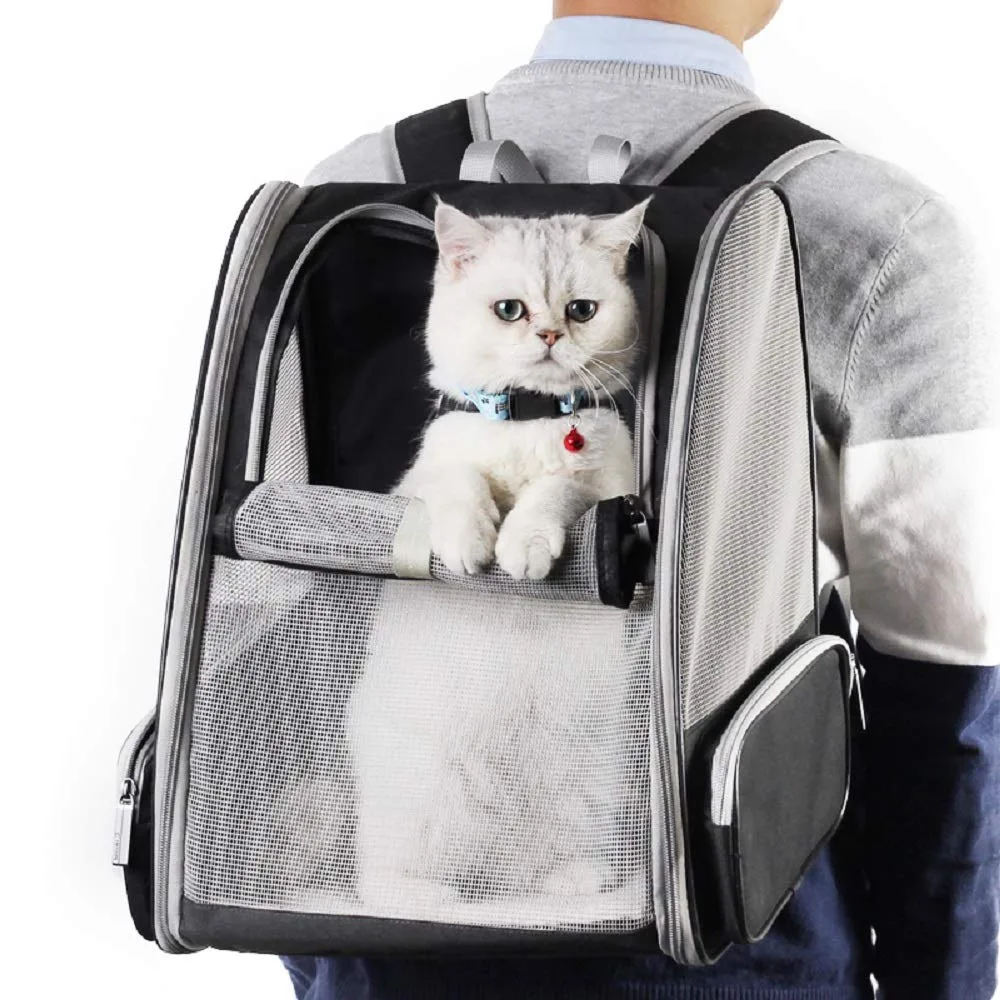
Office-style pet bags are frequently asked whether they fit under an aircraft seat. The honest answer for a 15-18 L structured body is usually no, and buyers should state that clearly rather than imply it. If a customer needs an airline-compliant product, that is a different SKU with a different dimension envelope, and the relevant rules are published by IATA under the Live Animals Regulations and by national authorities. Positioning a work bag as airline-approved without the envelope to back it is a compliance and review risk that no discount justifies.
Buyers who want a genuinely travel-capable SKU should commission it separately rather than stretching a work bag to fit. The cabin envelope is a hard constraint that governs the entire design: it limits the base footprint, it limits the height of the pet cavity, and it usually rules out a second full-size compartment. Trying to satisfy it inside an office silhouette produces a bag that is too small for a laptop and too tight for the animal, which fails in both channels at once.
Where a range needs both, the honest structure is two SKUs sharing materials and branding, sold as a commute product and a travel product. The shared fabric buy keeps unit cost sensible and the customer receives a product that does what its listing claims. Airline pet carriage rules and cabin acceptance criteria are published by carriers and by the international industry body, and they change; any listing implying air travel approval should cite the current rule and the measured dimensions of the product against it.
Material and Hardware Choices That Survive a Daily Commute
A daily commute is a harsher test than most buyers expect: five days a week of abrasion against desk edges, train seats and car door frames, plus coffee spills, rain and the occasional chew. Material selection should therefore be driven by abrasion and cleanability, and only then by hand feel and colour.
For the body, 600D polyester is the floor for a credible office SKU and 900D recycled polyester is the practical sweet spot for mid programmes. Recycled content is now a procurement requirement rather than a nice-to-have for several European retail groups, so confirm the GRS transaction certificate chain at quoting stage, not at inspection stage. Where the programme needs a more executive hand, a 1680D ballistic weave or a recycled nylon with a matte finish reads well and resists scuffing, at a cost premium of USD 1.80-3.20 per unit.
Hardware finish matters disproportionately in this category because office buyers read hardware as a quality signal. Matte nickel and gunmetal are safe; glossy chrome looks inexpensive under retail lighting; antique brass reads premium but narrows the colour palette. Whatever the finish, require a salt-spray or equivalent corrosion result in the test report, because handle rings and D-rings are the parts that fail first in humid markets.
Testing references should be named in the tech pack rather than left to the factory's discretion. Fabric colour fastness and abrasion are normally run to AATCC test methods, while management-system consistency across repeat orders is what an ISO 9001 certified quality system is meant to guarantee. Naming the method removes the argument about whether a result was measured or asserted.
- Lining: 210D ripstop polyester, dyed to match, with a wipe-clean PU coating - avoids the pale-lining-stains-fast complaint.
- Zips: #5 or #8 coil with branded pullers; metal teeth look good but add weight and cost.
- Mesh: PVC-coated polyester mesh at 1.2-1.5 mm aperture, not cotton netting - it resists claws and cleans.
- Webbing: 25 mm high-tenacity polyester for handles, bar-tacked at every load point.
- Feet: five metal or moulded feet minimum on a structured base to keep the panel off wet floors.
One more decision that belongs in this section: mono-material construction. A bag built entirely from polyester - fabric, webbing, thread, mesh - is materially easier to sell into EU markets with extended producer responsibility reporting, and it simplifies any future recycling claim on the packaging. Multi-material builds with PVC backings and mixed-fibre linings create a documentation burden that grows every year.
Cost Structure: Where the FOB Price Actually Goes
Understanding the cost stack is the difference between negotiating productively and negotiating blindly. For a mid-programme office pet bag at roughly USD 10.80 FOB Xiamen, the split is broadly: fabric and trim 34-40%, hardware 12-16%, base board and structure 8-11%, labour and overhead 20-25%, packaging and documentation 4-6%, and factory margin 8-12%. These bands shift with oil prices, dye lots and order size, but the ranking is stable.
The implication for buyers is that the usual request - "can you do 8% less?" - lands on the wrong line item. The realistic savings levers are volume consolidation, colourway reduction, packaging simplification and hardware standardisation. Cutting fabric weight or board thickness to hit a price saves cents and costs returns.
| Lever | Typical saving / unit | Risk introduced |
|---|---|---|
| Order 3,000 pcs instead of 1,000 | USD 0.55-1.10 | None - better cutting yield |
| Reduce from 4 colourways to 2 | USD 0.30-0.60 | Narrower shelf appeal |
| Standard hardware instead of custom tooling | USD 0.45-1.40 | Weaker brand signal |
| Polybag + carton instead of printed gift box | USD 0.35-0.85 | Lower unboxing perception |
| Drop 900D to 600D body | USD 0.40-0.70 | Abrasion complaints, slumping |
| Reduce base board from 4 mm to 3 mm | USD 0.35-0.55 | Bowing under load, shape loss |
Freight and duty sit outside FOB but inside the landed calculation, and this is where office-style SKUs are frequently mispriced. A structured bag does not compress. A 15 L structured body in a carton of 10 units can cost more to ship per unit than a larger soft bag that packs flat, because volumetric weight governs air freight and less-than-container-load sea freight. Ask your forwarder for a volumetric quote before you fix the retail price, not after.
Payment terms also carry a real cost. T/T 30/70 - 30% deposit, 70% against bill of lading - is the standard structure and it is priced into the quote. Requests for extended terms, or for DDP rather than FOB Xiamen, are not free: they are priced as working-capital risk. If a programme genuinely needs DDP, ask for both numbers side by side so the comparison is honest.
MOQ, Colourways and Order Planning for Mixed Programmes
MOQ in this category is driven by fabric minimums and cutting efficiency rather than by line time. Dye lots typically start at 800-1,200 metres per colour, which translates into roughly 500 finished units for a mid-sized pet bag. That is why MOQ 500 pcs per colourway is the working standard, and why dropping to 200 units per colour almost always costs more per unit than the volume saving is worth.
The practical workaround is a mixed order: 500 units per colourway with two or three colourways in one purchase order, or one fabric colour across the whole order with different lining and hardware combinations to create visual variety. The second approach is underrated. A single body colour with three lining stories gives a retailer three hangtag SKUs while the factory buys one dye lot.
- First programme: 1,500-2,000 pcs across 3 colourways is the safest test size for a new listing.
- Reorder: 1,000 pcs minimum keeps the cutting yield sensible and holds the price band.
- Seasonal drop: commit fabric 60 days ahead of the listing date, not 30.
- Gifting: allow 15 extra days if a co-branded woven label or printed sleeve is involved.
Timing deserves its own paragraph because it is where most first programmes go wrong. Samples take 6-10 working days after the tech pack is confirmed, and that clock does not start until artwork, Pantone references and hardware choices are all locked. Bulk takes 35-50 days after sample approval. Add 25-35 days for sea freight to a US or EU warehouse and 5-10 days for customs and drayage. A realistic plan from signed tech pack to Amazon FBA receipt is therefore 90-110 days. Backdating from a Black Friday or back-to-work date is the only safe way to set the calendar.
For buyers running multiple lifestyle SKUs - a work bag alongside a weekender or a gym-style piece - consolidating into one production slot is worth asking about. Shared fabric buys and shared colourways reduce unit cost and reduce the number of pre-shipment inspections you have to manage. Our production team plans these slots monthly across the partner facilities, and a consolidated order is materially easier to schedule than three small ones arriving separately.
Compliance, Labelling and Retail Documentation
Office-style pet bags sold into the US and EU carry a documentation load that has nothing to do with the animal and everything to do with the product being a consumer good. Plan the document set at quoting stage; retrofitting it after production is the most expensive way to do compliance.
For the US, the baseline is general product safety plus state-level chemical exposure rules. California's Proposition 65 warning obligations are administered by OEHHA, and retailers frequently require a written position on phthalates and lead content in coated fabrics and hardware before they will onboard a supplier. If children are not the target user, say so in the product brief - it changes which test series applies.
For the EU, the relevant questions are REACH substance restrictions and, where a claim is made, the evidence behind it. Recycled-content claims need a transaction certificate chain; OEKO-TEX style claims need a valid certificate number printed on the hangtag. Buyers should assume that any claim printed on packaging will at some point be asked for evidence, and that "the supplier said so" is not evidence.
- Country of origin marking, sewn or printed to the importing market's format.
- Fibre composition label for the body and lining.
- Tracking label with batch or production date for recall traceability.
- Warning and instruction insert - weight limit, ventilation guidance, tether use.
- Test reports: colour fastness, abrasion, hardware corrosion, and any chemical screen requested by the retailer.
- Carton marking and barcode format matching the retailer's receiving specification.
Independent verification is worth budgeting for. Third-party testing and inspection is the normal mechanism for proving the above, and SGS testing and inspection services are accepted by most large retail groups without argument. Our own production base is SGS-verified for floor space and capacity, but that verification covers the facility, not your shipment - the pre-shipment inspection is a separate exercise and should be specified separately.
One practical tip that saves real money: build the document set once per platform, not once per SKU. If the work bag, the laptop bag and the gym bag share fabric, hardware and lining, one test series can often cover the family, provided the report scope names the shared components explicitly.
Channel Requirements: Office Retail, Corporate Gifting and Marketplace
An office-style pet bag can be sold through three quite different channels, and each one imposes requirements that are easier to design in than to retrofit. Deciding the primary channel before the tech pack is locked is the cheapest decision in the programme.
Office and stationery retail wants a restrained product with a clear material story and packaging that survives shelf handling. It will ask for a barcode, a compliant fibre label and carton quantities that match its receiving specification, and it will want the bag to stand upright on a shelf without support. Structure and base board specification matter more here than anywhere else in the range.
Corporate gifting is a different proposition entirely. The bag is a branded object, the recipient may not own a pet-sized animal, and the presentation is the product. Gifting buyers want a neutral colourway, a printed sleeve or box, an insert card and often a co-branded woven label. They will accept a slightly higher unit cost for better packaging, and they will not accept a bag that arrives creased.
- Office retail: shelf-ready carton, upright standing, barcode and fibre label, restrained palette.
- Corporate gifting: neutral colourway, printed sleeve or box, insert card, co-branded label, 15 extra days.
- Marketplace: photography-first design, a single clear hero feature, a review-safe spec and a polybag that survives fulfilment.
Marketplace is the channel where specification errors are punished fastest, because the feedback loop is public and immediate. The two defects that generate the most marketplace damage in this category are a bag that slumps in the product photograph and a weight rating that is optimistic. Both are visible, both are avoidable, and both are cheaper to fix in the tech pack than in a listing.
Sampling, Lead Time and the Pre-Shipment Inspection Gate
The sampling phase is where a programme either gets de-risked or gets committed to a mistake. Two rounds are normal and should be budgeted: a first prototype to validate structure and silhouette, and a second to validate fabric, colour and branding after the first round's changes. Trying to compress this into one round is possible when the buyer has an existing reference sample, and risky otherwise.
What to check on a first sample has little to do with aesthetics. Stand the bag empty on a flat surface and look for slumping or leaning. Load the pet cavity with a sandbag at the rated weight and check base deflection over 24 hours. Open and close every zip 30 times. Pull the tether hard in three directions. Smell the interior - odour complaints are a top-three review driver in this category and they are almost always a lining adhesive or foam issue that a spec change can fix cheaply.
| Stage | Duration | Gate |
|---|---|---|
| Tech pack and artwork lock | 5-10 days | Buyer sign-off |
| First sample | 6-10 working days | Structure and silhouette approval |
| Revision and second sample | 6-10 working days | Fabric, colour, branding approval |
| Pre-production sample (optional) | 5-8 working days | Golden sample sealed |
| Bulk production | 35-50 days | AQL 2.5 inspection booking |
| Sea freight + customs | 30-45 days | Warehouse receipt |
Pre-shipment inspection should be specified by standard, not by vibe. AQL 2.5 with a defined sampling plan and a written defect classification is the industry norm for sewn goods; anything looser transfers the cost of defects to your customer. Insist on a critical-defect list that includes broken stitches at load points, hardware failure, missing tether and dimensional deviation beyond tolerance. Those four items account for the overwhelming majority of chargebacks in this category.
After approval, protect the gain: seal a golden sample, keep it at the buying office, and reference it in the purchase order. Reorders drift when there is no physical reference - fabric lots change, a zip supplier is swapped, a foam density is quietly reduced. A golden sample plus a written component list is the cheapest insurance against silent specification drift across repeat seasons.
Production capability
- SGS-verified production space of 4,950 m², 149 machines, 7 assembly lines
- Pet bag output since 2014 from a 137-person team
- 200,000 units shipped monthly under BSCI and ISO 9001 systems
People Also Ask
What size pet work bag do I need for a 6 kg dog?
A 15-18 L body with a 4 mm laminated base board and a rated load of 6-8 kg is the correct envelope for a 6 kg dog, with the interior tether clipped to a harness rather than a collar.
Are pet work bags allowed in the office?
Most offices allow contained pets at the discretion of building management, and a structured, quiet bag with covered ventilation panels draws far fewer complaints than an open-top soft carrier.
How do you clean a pet work bag lining?
Specify a 210D wipe-clean PU-coated lining and a removable, washable base pad. That combination handles the large majority of accidents without a full wash cycle, which a structured board cannot survive repeatedly.
What is the best hardware finish for an office pet bag?
Matte gunmetal or matte nickel reads as office-appropriate and hides scuffing under retail lighting. Antique brass reads premium but narrows the colour palette; glossy chrome reads cheap.
How much does shipping add to a structured pet bag?
Structured bags do not compress, so volumetric weight governs. Budget 12-20% of FOB for sea freight to a US or EU warehouse on a full container, and materially more for air or LCL on a low-density carton.
Can one pet work bag SKU serve both gifting and retail?
It can, but the packaging differs: gifting needs a printed sleeve or box and a neutral insert, while retail needs a barcode, a compliance label and a shelf-ready hangtag. Plan both at quoting stage.
Frequently Asked Questions
What is the difference between a pet work bag and a regular pet tote bag?
A pet work bag uses a dual-cavity build with a structured base board, matte hardware and a muted office palette, while a pet tote is usually a single soft cavity with fashion styling. The work bag is designed to carry a laptop and documents in a compartment physically separated from the pet zone, and it holds its silhouette when empty.
What MOQ applies to an office-style pet bag programme?
The working minimum is 500 pcs per colourway. Mixed colourways are permitted inside a single order, so a 1,500-pc programme can be split into three colourways at 500 each without changing the unit price band.
How long does sampling take for a pet work bag?
Samples take 6-10 working days after the tech pack is confirmed. Artwork, Pantone references and hardware selection all have to be locked before the clock starts, and most programmes use two sample rounds.
What is the bulk production lead time?
Bulk production runs 35-50 days after sample approval. Custom hardware tooling or a newly woven branded label typically adds 10-15 days to the upper end of that range.
Can a pet work bag be used as an airline carry-on?
Usually not. A 15-18 L structured body does not compress into the under-seat envelope, and buyers should not market it as airline-approved unless the SKU was dimensioned to that envelope and tested accordingly. Airline pet rules are published separately by carriers and by IATA.
Which fabric is best for a commuter pet bag?
900D recycled polyester with a durable water-repellent finish is the practical default for mid programmes: it resists abrasion, cleans easily and supports a recycled-content claim. 600D suits entry price points; 1680D ballistic or recycled nylon suits premium placements.
How much does a wholesale pet work bag cost?
Expect USD 7.40-9.20 FOB Xiamen for an entry build, USD 9.80-12.40 for a mid build with a 4 mm laminated base board and custom hardware, and USD 13.20-18.60 for a premium ballistic or recycled nylon build.
What inspection standard should be specified?
AQL 2.5 with a written defect classification is the norm for sewn goods. The critical-defect list should cover broken stitches at load points, hardware failure, a missing interior tether and dimensional deviation beyond the agreed tolerance.
Can I put my own brand label on the bag?
Yes. Woven labels, printed lining, embossed zip pullers and metal logo plates are all routine. A new woven label adds 10-15 days on the first order; subsequent reorders use the existing loom setup.
Which documentation is required for US and EU retail?
Country of origin marking, fibre composition, a traceability batch label, an instruction and warning insert, plus chemical and physical test reports requested by the retailer. California Proposition 65 positioning and REACH substance statements are the two most commonly requested items.
How should the pet weight limit be stated on the product?
State a single rated figure in kilograms and pounds on the hangtag and the sewn label, derived from the base board and handle load test rather than from the volume. Rating a 12 L bag at 10 kg is a defect waiting to happen.
What payment and shipping terms are standard?
T/T 30/70 against bill of lading on FOB Xiamen is standard. DDP can be quoted as an alternative, and it is priced separately because it carries working-capital and duty risk.
Talk to QUANZHOU JUNYUAN BAGS about a wholesale pet bag order: MOQ 500 pieces per colourway, samples in 6-10 working days, bulk production in 35-50 days under AQL 2.5 inspection.
Get a free quote Request a sample