Pet Tote Bag: Stylish and Functional
Short answer: a pet tote bag program works when style decisions are made on a platform that stays cheap to repeat — pick one silhouette, one base fabric and one trim family, then vary print and colour across three to five SKUs. Standard terms are MOQ 500 pieces per colour, 6-10 working days for sampling, 35-50 days for bulk and AQL 2.5 final inspection. Totes reward assortment discipline far more than design novelty.
This guide is for buyers building a pet tote bag assortment: the open-top and zip-top formats sold as much for how they look as for what they carry. Totes are the style-led half of the pet bag category, and they behave differently from travel formats in three ways — they are specified seasonally rather than by duty cycle, they sell through print and colour rather than through technical features, and they are judged at the shelf and in the photograph before they are judged in use. Our production team runs tote programs on MOQ 500 pieces per colour, 6-10 working days for development samples, 35-50 days for bulk after sample approval and deposit, AQL 2.5 final random inspection, T/T 30/70 and FOB Xiamen, from an SGS-verified production base of 4,950 square metres with 7 lines, 149 machines and 137 staff at roughly 200,000 pieces of monthly capacity under BSCI and ISO 9001. Read the platform logic first, then the fabric and print options, then the channel requirements: in this category the commercial outcome is decided by how well the assortment shares components, not by how distinctive any single bag looks.
Wholesale pet bags usa and wholesale pet bags europe run on different compliance files, so Pet Bag Types & Styles documentation should be prepared per destination rather than once. Export pet bags with the country-of-origin marking fixed at packing stage, because relabelling at the port costs more than the whole print run.
Why Totes Carry the Style Half of the Pet Bag Category
Pet totes occupy a different commercial position from travel bags. A travel bag is bought for a journey and judged on performance; a tote is bought for everyday errands and judged on appearance, then on convenience. That ordering matters, because it changes what a buyer should spend money on. In a tote program, fabric hand feel, print quality, trim finish and colour accuracy carry more of the purchase decision than technical specifications do.
The consequence for sourcing is that tote programs are assortment businesses. A single tote rarely sustains a program; three to five variants sharing a platform do. The variants are created through print, colourway, trim and minor dimensional changes rather than through new constructions, which is what keeps development cost low and repeat orders cheap.
Tote demand also behaves seasonally in a way travel bag demand does not. Colour and print stories rotate, and a program that treats its tote line as a fixed catalogue rather than a seasonal drop will look dated within two seasons. Buyers should plan tote assortments on a seasonal calendar with a stable base and a rotating surface, in the same way apparel buyers plan a range.
There is a structural advantage worth exploiting: totes are the most freight-efficient format in the pet bag category. An unstructured tote nests or folds, packs at high density, and cubes out a container well. Programs that include totes alongside bulkier travel SKUs use them to fill containers that would otherwise ship air, which improves landed cost across the whole assortment.
The risk in the category is the opposite one. Because totes are easy to make, they attract the lowest-quality entrants, and the failures are visible: a print that cracks after washing, a trim that bleeds colour, a handle that stretches under load. Buyers who specify the visible surfaces as carefully as the structural ones avoid the review problems that dominate this category; the testing references published by AATCC give the common language for colourfastness and abrasion.
Silhouette, Size Matrix and Weight Bands
Tote silhouettes should be defined by three dimensions plus one structural statement: width, height, gusset depth, and whether the bag is unstructured, lightly padded or framed. Those four choices determine both the look and the unit cost, and they should be fixed before print development begins, because print artwork is sized to the panel.
| Silhouette | Typical dimensions (cm) | Weight band | Channel fit |
|---|---|---|---|
| Compact errand tote | 32 x 28 x 14 | Up to 5 kg | Gift, impulse, marketplace |
| Standard everyday tote | 40 x 32 x 16 | Up to 8 kg | Core assortment across all channels |
| Large carry tote | 48 x 34 x 18 | Up to 12 kg | Specialty retail, online |
| Framed open-top tote | 45 x 30 x 25 | Up to 10 kg | Premium retail, structured presentation |
| Zip-top travel tote | 45 x 32 x 20 | Up to 10 kg | Travel-adjacent positioning |
Gusset depth is the dimension buyers most often get wrong. A shallow gusset looks flat and elegant on a shelf photograph and is unusable in practice, because an animal needs depth more than width. A 14 cm gusset is workable for a small pet; below about 12 cm the bag stops being functional regardless of how it photographs.
Weight bands should be stated explicitly for each silhouette, because they drive handle specification. A tote rated to 8 kg needs a webbing-reinforced handle joined with a bar-tacked root; a decorative tote rated to 3 kg does not. Mixing the two — a decorative handle on a bag sold for an 8 kg animal — is the most common structural error in the category and produces exactly the field failure customers write about.
Size ranges should be planned as a curve rather than as a set. Small and medium totes carry most of the volume; large formats sell in lower quantities but at higher unit value and better margin. A sensible first-season split concentrates roughly two-thirds of units in small and medium and lets large formats carry disproportionate margin.
Fabric, Print and Trim Options for a Tote Program
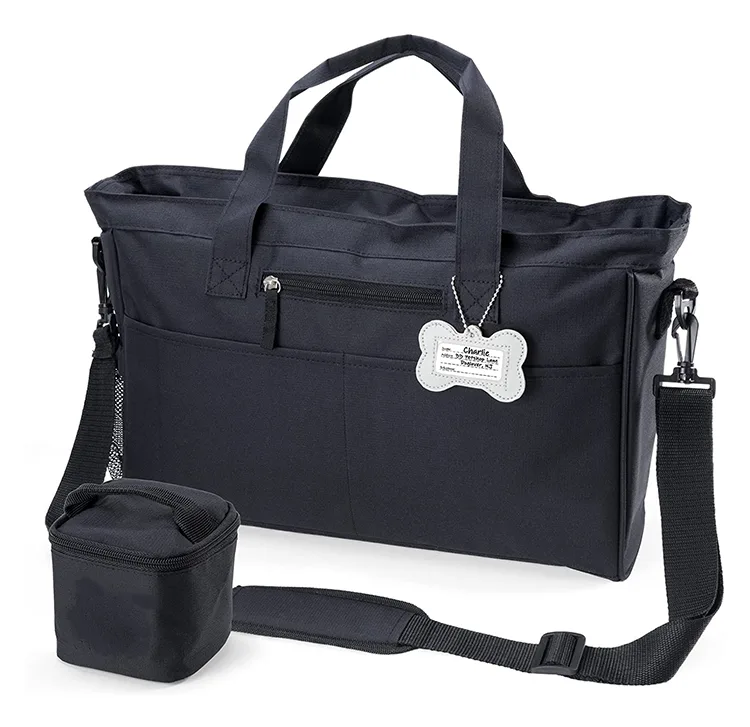
Fabric choice sets both the price band and the print capability, and the two are linked: some print methods work beautifully on canvas and poorly on coated polyester. Choose the base fabric for the duty and the hand feel, then choose the print method for that fabric rather than the other way round.
| Base fabric | Hand feel and look | Print compatibility | Cost index |
|---|---|---|---|
| Cotton canvas 12 oz | Natural, premium, softens with use | Excellent for screen and digital print | 115-130 |
| 600D polyester, PU backed | Clean, technical, wipeable | Good for sublimation and screen | 100 |
| Nylon 420D | Soft, slightly lustrous | Good for sublimation, fair for screen | 118-135 |
| Recycled polyester 600D | Similar to standard polyester, story value | Good for sublimation | 108-125 |
| Poly-cotton blend | Softer than canvas, more stable | Excellent for screen | 105-120 |
Print method selection has a cost structure worth understanding. Screen printing carries a per-colour setup charge and rewards longer runs; digital printing carries no screen charge and suits short runs and multi-colour artwork; sublimation requires a polyester base but produces a durable, wash-fast result with no hand-feel change; woven labels and patches add a perceived-quality signal at low unit cost. Buyers running a rotating seasonal program often use digital print for the first season to avoid screen charges, then switch to screen once a design proves out.
Trim is where perceived quality is won or lost on a tote. Binding tape quality, thread colour match, zipper tape colour, puller design, and the precision of label placement are all visible at arm's length. Specify trim by sample card rather than by description, and require that the approval sample include a trim card that travels with the production order.
Colour accuracy deserves a defined process because it is the most common source of tote disputes. Specify Pantone references or physical swatches, require a lab dip or a printed strike-off before bulk, and set an acceptance tolerance under defined lighting. Where a program shares a colour across several SKUs, approve one master standard and require that every component be matched to it, not to a previous production run.
For skin-contact and chemical requirements, specify certificates at material receipt: OEKO-TEX for textile contact claims, REACH declarations for the EU, and CPSIA and California Prop 65 screening for the US. Guidance on California requirements is published by OEHHA, and the textile label most widely accepted by retail channels is issued under OEKO-TEX.
Structure Decisions: Unlined, Lightly Padded or Framed
Structure is the decision that most directly determines both cost and perceived quality in a tote, and there are three honest options.
Unlined or lightly lined construction is the cheapest and packs best. It suits gift-led and impulse-priced totes, and it produces the relaxed silhouette that photographs well in lifestyle imagery. Its weakness is that it collapses when empty, which reads as cheapness in a retail environment where the bag is displayed standing.
Lightly padded construction adds a thin foam layer between shell and lining. It holds shape better, protects the animal slightly, and adds a meaningful cost step in both material and labour. For a core everyday tote in the mid price band, this is usually the right specification, because shape retention is the attribute customers mention most in positive reviews.
Framed or structured construction adds a base stiffener and side support. It stands on a shelf, protects the interior volume, and commands a higher price point. It costs more, cubes worse in a container and complicates washing. Framed totes suit premium retail channels where shelf presentation drives conversion, and they are worth the cost in precisely that context.
A hybrid approach is common and usually correct: a removable stiffened base panel inside a lightly padded bag. The panel gives shelf presence and prevents sag, and it can be removed for washing or for flat packing. Specify the panel material, thickness, sleeve fabric and retention method, because a loose panel is a defect that inspection rarely catches.
Whichever option is chosen, the handle specification must match the structure. A structured bag carrying a 10 kg animal needs a reinforced handle root with a bar-tack or box-stitch pattern and, ideally, an internal reinforcement patch. Specify the root construction numerically and photograph it on the approval sample, because this is the join that fails in the field.
Interior Layout, Liners and Cleanability
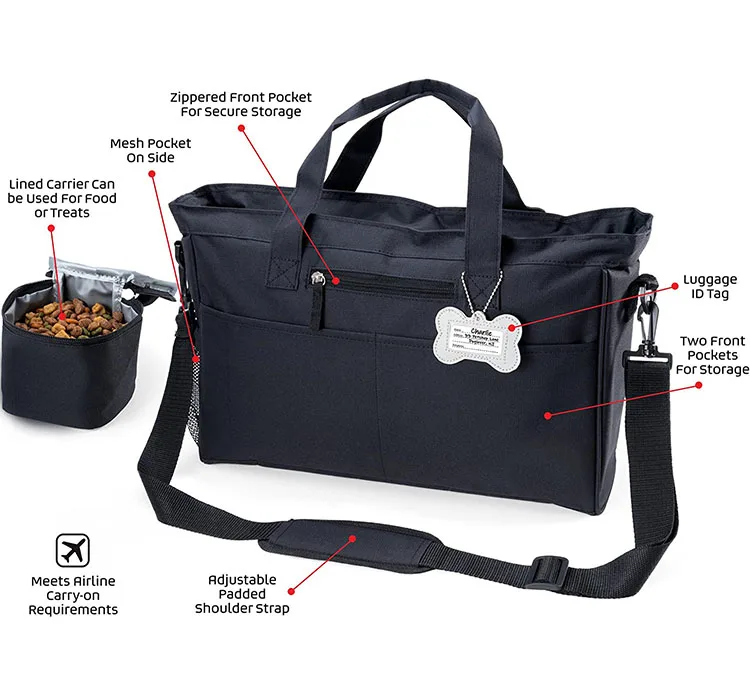
Tote interiors are simpler than travel bag interiors, and the temptation is to over-design them. Resist it: every interior pocket adds two panels, one binding operation and one opportunity for a defect. Most successful tote programs carry one slip pocket and one zip pocket, plus a harness attachment point, and nothing more.
The liner decision is more consequential than the pocket count. A coated or laminated lining wipes clean and resists odour, which is the attribute customers care about after the first month of use; an uncoated lining is cheaper and breathes slightly better. For pet applications, the coated lining is almost always the right choice, because cleaning complaints dominate negative reviews in this category and a laminated lining is the cheapest available defence.
Removable liners are an option worth considering for premium programs. A lift-out liner that can be washed separately adds cost and a component, and it adds a genuine convenience story. Where they are used, specify how the liner is retained — press studs, hook-and-loop or a simple sleeve — and test retention with the bag loaded.
Interior colour is an underrated decision. A dark lining hides soiling between washes and looks clean for longer; a light lining looks premium on the shelf photograph and shows every mark. Mid-tone linings in a colour close to the shell are usually the best compromise, and they also reduce the risk of colour transfer complaints.
Finally, specify the internal attachment point for a harness clip, with a stated pull strength, and any divider the design includes. These are small components with outsized consequences for safety perception, and they are the first items removed during value engineering. Mark them as fixed in the specification before cost discussions begin.
Price Bands, Cost Drivers and Margin Planning
Tote price bands are wide, and the spread is driven mainly by fabric, print method and structure rather than by size. Understanding the ranking lets a buyer place a product in the right band deliberately instead of discovering its price after sampling.
| Configuration | Cost index | Suitable retail position | Margin characteristic |
|---|---|---|---|
| Unstructured, unlined, screen print | 78-88 | Impulse and gift | Low ticket, high volume |
| Unstructured, lined, digital print | 90-100 | Core marketplace | Balanced volume and margin |
| Lightly padded, lined, screen print | 100-115 | Core retail | Strong repeat rate |
| Structured base panel, premium trim | 115-135 | Specialty retail | High ticket, lower volume |
| Canvas with woven label and patch | 125-150 | Premium and gifting | Highest margin per unit |
The two levers that reliably improve tote margin are platform sharing and print method selection. Platform sharing — one base fabric, one trim family and one construction across three to five SKUs — moves every component into a better purchase tier and lets a buyer reach bulk material pricing on a modest total order. Print method selection saves setup cost in the first season: digital print avoids screen charges on unproven designs, and switching to screen later converts a proven design into a cheaper unit cost.
The lever that reliably damages margin is colourway proliferation. Each additional colourway adds a dye lot, a trim match, a print strike-off and a separate cutting setup, and in a category where the whole proposition is surface design, buyers naturally want more colourways than the volume supports. Three colourways per print story is a workable rule for a first season; five is workable once volume is proven.
Freight is the pleasant part of tote economics. Unstructured totes pack densely, and a tote-heavy container achieves far better utilisation than a travel-bag-heavy one. Program-level landed cost should therefore be modelled across the assortment rather than per SKU, with totes subsidising the cube of bulkier formats. The mechanics of that calculation are set out in our wholesale pet bags bulk buying guide.
Channel and Presentation Requirements
Totes sell across more channels than any other pet bag format, and each channel imposes requirements that reach back into the specification. Planning them together is much cheaper than retrofitting.
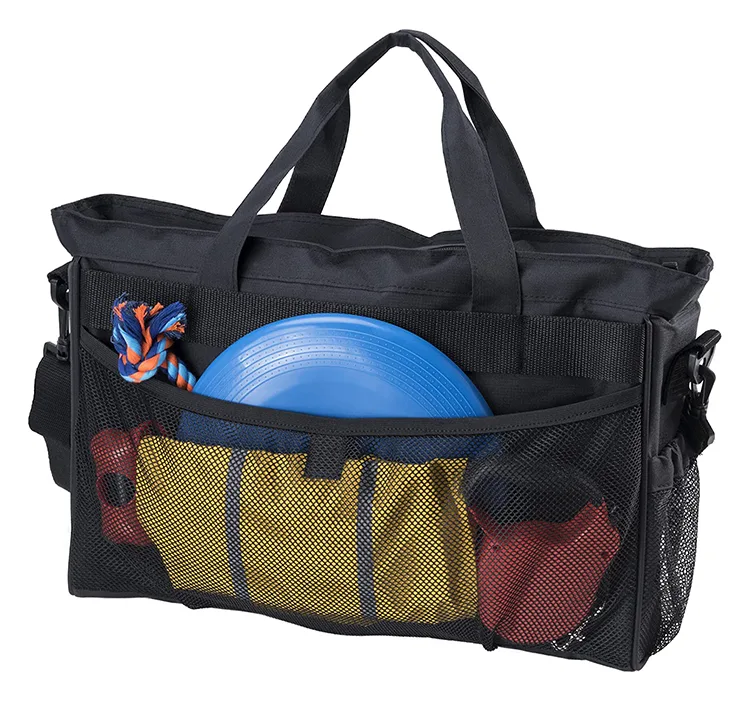
Marketplace channels require a scannable barcode on the retail pack, compliant fibre and care labelling, polybag suffocation warnings where bagging is used, carton weight limits, and increasingly a documented test file. Retail channels require shelf presence — which is an argument for a structured base panel — plus hangtag or display packaging, carton and pallet standards, and social-compliance documentation on the production base. Specialty and gift channels require presentation quality above all: print registration, trim precision and packaging finish are judged visually at the point of sale.
Packaging is the specification item most often left until last and most often expensive to fix. A tote sold on a shelf may need an individual printed box; the same tote sold through marketplace fulfilment needs a polybag and a barcode. Decide the channel mix before the packing specification is written, and consider a two-tier pack where volume justifies it: bulk cartons for fulfilment, retail-ready cartons for shelf accounts.
Label artwork should be approved as a separate gate. Fibre content, care symbols, country of origin and any weight guidance must be correct for the destination market, and label errors are among the most common causes of listing removal and retail chargeback. Approving artwork separately from the sample costs two days and prevents the most avoidable compliance failure in the category.
Compliance documentation should be maintained by material family rather than per SKU, which is especially valuable in a tote program where SKU count is high and construction is shared. One fabric test covering five prints is normally acceptable where the base cloth, finish and dye house are identical, and it turns a per-SKU compliance cost into a per-season one.
Sampling and Assortment Sequencing
Tote sampling should be planned as a platform exercise rather than as a series of individual bags. Sample the platform once — base fabric, construction, trim family, handle specification — then approve print and colour variants on strike-offs rather than on full samples. This halves sampling cost in a category where SKU count is naturally high and construction is shared.
Development sampling takes 6-10 working days for a first build. Print strike-offs are faster and cheaper and should carry the colour approval burden: approve the Pantone or swatch match on a strike-off, and reserve the full sample for construction, handle integrity and dimensional checks.
Bulk production takes 35-50 days from sample approval and deposit. Tote programs tend toward the shorter end when the base fabric is stocked and the print method requires no special setup, and toward the longer end when a custom-dyed colour, a woven label or a structured panel is involved. Locking the base fabric at sample approval is what keeps a tote program at the short end.
Sequence the assortment deliberately. Launch two to three SKUs, hold the remainder for a second drop, and use eight weeks of sell-through data to decide which prints earn a re-order. Programs that launch five totes simultaneously cannot tell which print is working and end up re-ordering the wrong one.
Finally, plan the seasonal calendar backwards from the drop date. Allow 6-10 working days for sampling, roughly two weeks for artwork and colour approval, 35-50 days for bulk, and three to five weeks for freight and clearance. Then re-baseline every downstream date the moment anything slips — the discipline that separates tote programs that hit their season from those that arrive two weeks after it.
Quality Risks Specific to Tote Programs
Tote programs fail in predictable ways, and knowing the pattern lets a buyer specify against it rather than discovering it through returns. The risks fall into three groups: surface, structural and dimensional.
Surface risks dominate because the category sells on appearance. Print registration drift across a run, colour mismatch between the shell and the trim, pilling on strap covers, and label placement variance are the four most common major defects counted at inspection. Each is preventable with a defined standard: an approved print proof, a trim card matched to a master colour standard, a specified cover fabric with an abrasion rating, and a placement template with a stated tolerance.
Structural risks are fewer but more expensive. Handle root failure is the principal one, and it is almost always a specification error rather than a workmanship error: a decorative handle root on a bag sold for a heavier animal. The second is base sag, where the absence of a stiffener lets the bag deform under load and pull the lining away from the shell. Both are prevented by specifying the root construction and the base panel numerically and protecting those two lines during any price discussion.
Dimensional risks are the quietest and the most persistent. A tote specified without a tolerance will drift across a run as cutting and sewing variation accumulate, and a two-centimetre drift in height or gusset changes how the product photographs, how it fits a retail fixture and whether a customer's pet fits inside it. State tolerances on all three dimensions and measure three production units at inspection rather than one.
Inspection should therefore carry a tote-specific defect list. Print registration, trim shade match against the master standard, bar-tack presence at handle roots, base panel presence and placement, and dimensional tolerance should all be classified as major or critical, because these are the items that generate returns rather than the general workmanship items that inspectors traditionally weight most heavily.
Finally, close the loop. Feed the first season's returns data back into the specification before the second season is quoted: which defect appeared most often, which size returned disproportionately, and which colourway drew the complaints. Programs that revise their specification from data improve every season; programs that revise it from opinion repeat the same year.
Why brands source here
- Pet bag programmes run since 2014; founding team in sewn goods since 2004
- SGS-verified production floor of 4,950 m² with 137 workers across 7 lines
- Monthly capacity of 200,000 units, audited to BSCI and ISO 9001
People Also Ask
How do I build a pet tote assortment on one platform?
Fix one silhouette, one base fabric, one trim family and one construction, then vary print, colourway and minor dimensions across three to five SKUs. Platform sharing moves every component into a better purchase tier and lets a modest total order reach bulk material pricing.
What gusset depth does a functional pet tote need?
About 14 cm is workable for a small pet; below roughly 12 cm the bag stops being functional regardless of how well it photographs. Animals need depth more than width, so gusset depth is the dimension buyers most often under-specify.
Should I use screen printing or digital printing for totes?
Digital printing has no screen charge and suits short runs and unproven designs; screen printing has a per-colour setup cost and rewards longer runs. A common pattern is digital print in the first season, then screen printing for designs that prove out.
Why does a tote collapse on the shelf?
Unstructured or unlined construction has no shape retention, so it slumps when empty and reads as cheap in retail presentation. A lightly padded construction or a removable stiffened base panel solves this at modest cost.
How do I keep colours consistent across a tote range?
Specify Pantone references or physical swatches, approve a master standard and match every component to it rather than to a previous run, and set an acceptance tolerance under defined lighting with a strike-off approval gate.
What is the cheapest way to sample a five-SKU tote range?
Sample the platform once for construction and approve print and colour variants on strike-offs rather than full samples. This typically halves sampling cost in a category where SKU count is high and construction is shared.
Frequently Asked Questions
What is the MOQ for a pet tote bag program?
The standard MOQ is 500 pieces per colour. Where several prints share one base fabric and construction, the program can reach bulk material pricing on a modest total order, which is the main reason to plan totes as a shared platform.
How long does tote sampling and production take?
Development sampling takes 6-10 working days and bulk production takes 35-50 days from sample approval and deposit. Totes trend toward the shorter end when the base fabric is stocked and the print method needs no special setup.
Which fabric is best for a printed pet tote?
Cotton canvas gives the best hand feel and the best screen print result at a higher cost; 600D polyester is the cost-efficient workhorse and suits sublimation and screen printing. Choose the base fabric for duty and hand feel, then match the print method to it.
Should a pet tote be structured or unstructured?
Unstructured totes pack well and photograph relaxed but collapse on a shelf; lightly padded construction holds shape and suits the mid price band; framed construction stands on a shelf and suits premium retail. A removable stiffened base panel is a common and effective hybrid.
How many colourways should a first tote season carry?
Three colourways per print story is a workable rule for a first season. Each additional colourway adds a dye lot, a trim match, a print strike-off and a separate cutting setup, so colourway count usually costs more than buyers expect.
What is AQL 2.5 used for on tote orders?
AQL 2.5 is the acceptable quality limit for the final random inspection, defining how many major defects are tolerable in a statistically drawn sample. On totes, print registration errors and trim mismatches are the most commonly counted major defects.
Do I need to test every print design?
Normally no. Testing by material family is accepted where the base cloth, finish and dye house are identical and the construction is shared, which is why a tote program with high SKU count benefits disproportionately from platform sharing.
What packaging do different channels require?
Marketplace channels require barcodes, compliant labelling, polybag warnings and carton weight limits; retail channels require shelf presence, display packaging and pallet standards; gift channels require presentation finish. Decide the channel mix before the packing specification is written.
What payment and Incoterm terms apply?
Standard terms are T/T 30/70 with the balance released against a passed AQL 2.5 inspection, and FOB Xiamen as the default Incoterm. Buyers should stay on FOB until they have real freight data to benchmark a landed quote.
How should I approve print and colour?
Approve Pantone references or physical swatches on a print strike-off rather than on a full sample, and set an acceptance tolerance under defined lighting. For shared colours, approve one master standard and match every component to it.
What is the most common quality failure in pet totes?
Handle root failure is the most common structural failure, usually from a decorative handle specified on a bag sold for a heavier animal. Print cracking and trim colour bleed are the most common surface complaints and are prevented by specifying colourfastness testing.
Can totes improve my freight economics?
Yes. Unstructured totes nest or fold and pack at high density, so a tote-heavy container achieves far better utilisation than a travel-bag-heavy one. Model landed cost across the assortment rather than per SKU to capture that benefit.
Talk to QUANZHOU JUNYUAN BAGS about a wholesale pet bag order: MOQ 500 pieces per colourway, samples in 6-10 working days, bulk production in 35-50 days under AQL 2.5 inspection.
Get a free quote Request a sample